

Key takeaways
- Rear-seat width: Measure between the door panels and compare it with the booster’s outside width, not its advertised sleeping area.
- Seat-belt geometry: Confirm that the lap-and-shoulder belt can pass through the seat’s intended belt path without twisting.
- Headrests: Some harnesses and seat covers use headrest straps; a vehicle without accessible headrests may not be compatible.
- Lower anchors: Do not assume a booster can use a child-seat anchor simply because it has a strap. Check whether the manufacturer explicitly approves that installation.
- Front seats: Avoid the front passenger seat when an active airbag is present. The back seat is generally the safer location for a pet restraint.
- Curved or deeply bucketed seats: A rigid or thickly padded booster may tilt. A harness can be easier to install securely in this type of vehicle.
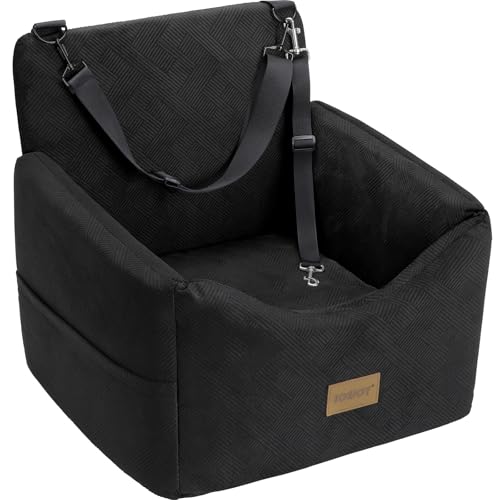
The best dog car seats for safe travel are crash-tested harness systems for large dogs, while small dogs usually get the best balance of restraint, visibility, and comfort from a properly anchored booster such as the K&H Pet Products Bucket Booster or Kurgo Skybox—provided the seat fits both the dog and the vehicle.
Our top picks


As an Amazon Associate we earn from qualifying purchases at no extra cost to you. Ratings are shown as listed on Amazon.
Quick picks by situation
| Situation | Best choice | Why it fits | Typical market range |
|---|---|---|---|
| Maximum crash protection | Sleepypod Clickit Terrain | Automotive-style restraint design, broad adjustment range, and independent crash-safety certification history | $100–$180 |
| Small dog that wants to look out | K&H Bucket Booster | Raised interior, tether attachment, and several sizes for front or rear seating | $45–$90 |
| Compact booster for occasional trips | Kurgo Skybox Booster Seat | Lightweight, collapsible design with a short internal tether | $50–$90 |
| Dog that dislikes elevated seats | Crash-tested vehicle harness | Keeps the dog lower on the vehicle seat and can provide better room for turning or lying down | $60–$180 |
What matters more than the product name
1. A restraint that connects to the vehicle
A booster that merely sits on the seat is not a safe restraint. Look for a seat with a vehicle seat-belt path, lower-anchor compatibility, or a clearly specified method of securing the whole seat. The dog should then be attached to the seat using a short internal tether or an approved harness connection.
Never attach a tether to a collar. A sudden stop can place dangerous force on the neck. Use a well-fitted body harness, and check whether the manufacturer permits its tether to connect to that harness. Do not connect two independent tethers to a harness unless the manufacturer specifically allows it; the attachments can interfere with one another in a collision.
2. Crash-safety evidence
“Safety seat” can mean nothing more than a padded bed with a leash clip. Crash testing is a separate issue. The strongest evidence is a published test standard, an independent organization such as the Center for Pet Safety, or detailed manufacturer test information identifying the restraint, test configuration, and dog size used.
The K&H Bucket Booster and Kurgo Skybox are best viewed as travel boosters that improve containment and visibility; their padded construction alone should not be interpreted as proof of crash protection. The Sleepypod Clickit Terrain is a different category: it is a vehicle restraint harness designed around seat-belt-style load distribution and has been associated with independent crash-safety certification. Even with a certified product, correct fit and installation remain essential.
3. Weight limits and usable interior space
Weight capacity is only half the fit calculation. Measure your dog from the floor to the top of the head while sitting, and from the chest to the base of the tail while standing. Add room for the dog to turn around without allowing so much empty space that the dog can be thrown around inside the seat.
| Product or type | Published or common capacity | Approximate interior or fit information | Best use |
|---|---|---|---|
| K&H Bucket Booster, small | Up to about 10 lb | Approximately 14 × 14 × 9 inches | Toy breeds and very small dogs |
| K&H Bucket Booster, large | Up to about 30 lb | Approximately 22 × 17 × 11 inches | Small dogs needing a wider elevated seat |
| Kurgo Skybox, small | Up to about 20 lb | Approximately 12 × 16 × 8 inches | Compact rear-seat use |
| Kurgo Skybox, large | Up to about 30 lb | Approximately 16 × 22 × 11 inches | Larger small dogs, subject to vehicle space |
| Crash-tested harness | Often approximately 6–110 lb, depending on size | Fit is determined by chest girth, neck, and body length rather than seat dimensions | Medium and large dogs or dogs that need more floor space |
Dimensions and limits can vary by model revision, so confirm the current manufacturer specification before buying. A 25-pound dog may fall within a “30-pound” limit but still be too long or tall for a compact booster.
Head-to-head: booster seat versus crash-tested harness
Booster seats
A booster is the better choice when your dog is small, settles well in a defined space, and benefits from a higher view. Raised sides can prevent wandering between seats, and the washable liner is convenient for muddy paws or motion sickness. The trade-off is that a soft booster does not automatically protect the dog in a collision. It must be secured to the vehicle, and the dog must be tethered inside it.
Visibility is also a fit issue. A dog should be able to see out without standing continuously or climbing over the side. If the seat is too deep, the dog may be unable to look out; if it is too shallow, the dog may lean or attempt to jump out.
Crash-tested harnesses
A harness is usually more practical for dogs over roughly 25–30 pounds, vehicles with limited rear-seat width, and dogs that prefer to lie down. It leaves the seat surface open and does not consume the legroom of a large booster. However, it requires more careful adjustment than a bed-style product. The chest strap should sit across the sternum, not the throat, and the harness should not rotate around the rib cage when pulled gently from the side.
Harnesses also expose a common mistake: attaching a standard walking leash to a car restraint point. A walking harness and a crash-tested vehicle harness are not necessarily interchangeable. Follow the manufacturer’s approved belt path and attachment instructions.
Vehicle compatibility checklist
- Rear-seat width: Measure between the door panels and compare it with the booster’s outside width, not its advertised sleeping area.
- Seat-belt geometry: Confirm that the lap-and-shoulder belt can pass through the seat’s intended belt path without twisting.
- Headrests: Some harnesses and seat covers use headrest straps; a vehicle without accessible headrests may not be compatible.
- Lower anchors: Do not assume a booster can use a child-seat anchor simply because it has a strap. Check whether the manufacturer explicitly approves that installation.
- Front seats: Avoid the front passenger seat when an active airbag is present. The back seat is generally the safer location for a pet restraint.
- Curved or deeply bucketed seats: A rigid or thickly padded booster may tilt. A harness can be easier to install securely in this type of vehicle.
Setup steps that prevent the most common failures
- Measure before ordering. Record the dog’s weight, chest girth, sitting height, and body length. Compare all four measurements with the manufacturer’s chart.
- Install the empty seat first. Pull the vehicle belt tight, remove slack from the belt path, and check that the seat does not slide substantially from side to side.
- Attach the dog’s harness. Use the designated tether point, keep the tether short enough to prevent climbing out, and leave enough length for the dog to sit, lie down, and turn around.
- Perform a stationary escape test. With the car parked, watch whether the dog can step over the side, reach the front seats, or put a paw around the tether. Correct the setup before driving.
- Introduce short journeys. Begin with a few minutes in the parked vehicle, then drive around the block. This helps reveal overheating, anxiety, or a poor fit before a long trip.
Ownership realities: what wears out first
The first failures are usually not the main fabric. Tether clips can bend or loosen, stitching at anchor points can fray, and foam can compress where the dog repeatedly steps in. Vehicle belts and metal buckles should be inspected for cuts, crushed webbing, or a buckle that no longer latches cleanly.
Choose a removable, machine-washable cover if the dog rides frequently. A waterproof liner is useful for drool and accidents, but it can trap heat in warm weather if the dog cannot move away from it. Wash according to the care label and let all padding dry completely before reinstalling it. Avoid bleach or solvents that can weaken webbing.
Replace a restraint after a collision, even if the damage is not visible. Also replace it when the dog outgrows the fit, when stitching separates, or when a tether clip no longer closes reliably. For occasional travel, a $70 booster used twice a week for two years costs about 67 cents per trip; that calculation is useful only if the seat remains correctly fitted and structurally sound.
Bottom line
Choose the Sleepypod Clickit Terrain or another independently documented crash-tested harness when collision protection is the primary concern. Choose a K&H Bucket Booster when a small dog needs elevation and a roomy, washable perch. Choose the Kurgo Skybox when vehicle space and portability matter more than premium restraint engineering. Whatever the product, prioritize a secure vehicle connection, a compatible body harness, correct dimensions, and a rear-seat installation over padding, appearance, or a high weight limit alone.



Write Your Review
No reviews yet. Be the first to share your experience!