

Key takeaways
- Rigid or semi-rigid base: prevents the floor from sagging and gives the cat a more stable platform.
- Interior tether: useful only when attached to a properly fitted harness, never directly to a collar.
- Lockable or double-direction zippers: reduce the chance that a determined cat can push a zipper open.
- Secure seams: inspect the points where mesh joins fabric, as these are common escape routes.
- Wide, stable base: reduces swaying when you walk or turn.
The best cat backpacks for 2026 are a structured, well-ventilated carrier for short trips, a larger expandable model for longer travel, or a lightweight soft-sided backpack when low weight and easy storage matter most.
Our top picks


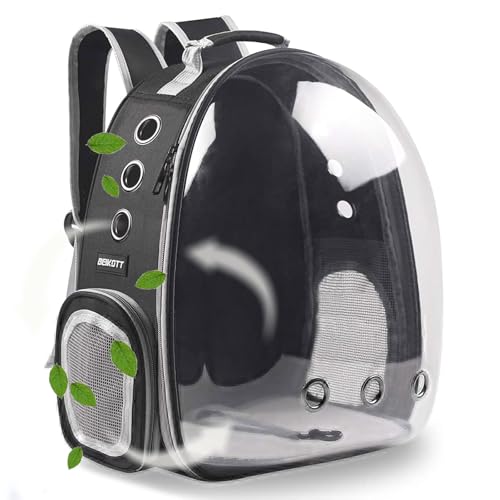
As an Amazon Associate we earn from qualifying purchases at no extra cost to you. Ratings are shown as listed on Amazon.
Quick picks by travel situation
| Situation | Best backpack type | Useful target specifications | Why it fits |
|---|---|---|---|
| Vet visits, short walks, and public transport | Compact structured backpack | 16–18 in high; 12–14 in wide; 10–12 in deep; cat limit 15–20 lb | Stable enough for brief trips without being unnecessarily bulky |
| Longer journeys or waiting between connections | Expandable backpack with side or rear enclosure | 18–22 in high; 13–16 in wide; 11–14 in deep; cat limit 18–25 lb | Provides more usable floor space and room to reposition |
| Warm weather | Mesh-heavy soft-sided backpack | At least three ventilated panels; 30–50% of side area in mesh | Maximizes airflow while keeping the carrier relatively light |
| Nervous or visually stimulated cat | Structured backpack with roll-down privacy panels | Two or more zippered openings; adjustable privacy cover | Lets you reduce visual input without blocking ventilation |
| Frequent commuting | Reinforced backpack with padded harness and washable base | 3–5 lb empty weight; chest-supported shoulder straps; removable liner | Better balance between carrying comfort and repeated cleaning |
What makes a cat backpack safe?
Start with the cat’s body measurements rather than the backpack’s advertised weight limit. Measure from the floor to the top of the head while standing, then from the chest to the base of the tail. The backpack should allow the cat to sit without pressing against the roof, turn around, and lie down without being forced into a curled position.
Weight capacity is only a safety threshold, not a comfort measurement. A carrier rated for 20 pounds may be too short or narrow for a long-bodied 15-pound cat. Conversely, a compact cat may fit comfortably even when the carrier has considerable unused weight capacity. For a cat weighing 12 pounds, a practical target is a carrier rated for at least 15–18 pounds, provided its internal dimensions are suitable.
- Rigid or semi-rigid base: prevents the floor from sagging and gives the cat a more stable platform.
- Interior tether: useful only when attached to a properly fitted harness, never directly to a collar.
- Lockable or double-direction zippers: reduce the chance that a determined cat can push a zipper open.
- Secure seams: inspect the points where mesh joins fabric, as these are common escape routes.
- Wide, stable base: reduces swaying when you walk or turn.
Head-to-head: compact versus expandable backpacks
Compact structured backpacks
A compact backpack is usually the better choice for a 10-minute walk to the car, a veterinary appointment, or a short train ride. Its smaller footprint is easier to place under a seat or carry through a crowded building. A firm shell or frame also protects the cat when the backpack is set down.
The trade-off is limited movement. Many compact designs are comfortable for roughly 30–90 minutes, but they are not ideal as a cat’s primary space for an all-day journey. Dome-shaped windows can add visibility but may reduce usable headroom near the sides.
Expandable backpacks
An expandable model is more versatile for longer travel because a zipped side or rear panel can open into a mesh enclosure. The backpack remains closed while moving, then provides additional room during a safe stop. This can make a meaningful difference when a cat must wait in a hotel room, station, or other controlled environment.
Expansion does not automatically make a carrier suitable for overnight use. Check whether the opened section has a supported floor, whether the mesh can be punctured, and whether the whole enclosure can be secured to prevent the cat from pushing it away from the main carrier. Expanded sections also require more cleaning and take longer to dry.
Ventilation, visibility, and escape prevention
Look for ventilation on at least three sides, not just a transparent front window. Mesh should remain open when privacy flaps are lowered, and the openings should be large enough to move air without creating a weak, easily torn panel. In hot or humid conditions, avoid carriers that depend on a small front vent or place the cat directly against a plastic window.
Visibility is a preference that varies between cats. A curious, relaxed cat may settle better with a broad viewing panel. A cat that reacts to dogs, traffic, or unfamiliar people may benefit from partially covered sides. The most practical design has roll-down panels that can be adjusted during the journey rather than permanently opaque or permanently exposed walls.
Before the first trip, test every opening indoors. Close the carrier, apply pressure to each zipper with your fingers, and check whether the cat can reach the mesh through the opening. A top opening is convenient for loading, but it should have a full zipper path and a safety tether or controlled handling area. Do not rely on a drawstring opening as the only barrier for an agile cat.
Comfort for the cat and the person carrying it
For the cat, the most important comfort features are a level base, a non-slip washable mat, adequate headroom, and freedom to turn around. A soft cushion that compresses heavily may feel comfortable at home but can make the carrier unstable during movement. A thin, firm mat with a spare absorbent layer is often more practical for travel.
For the owner, an empty backpack weighing 5 pounds can become a 17-pound load with a 12-pound cat. That is before adding water, paperwork, and a cleaning kit. Padded shoulder straps, a chest strap, and a ventilated back panel distribute this weight better than thin fashion-style straps. A sternum strap is especially helpful when walking more than a few minutes.
| Feature | Short-trip minimum | Longer-travel preference | Reason |
|---|---|---|---|
| Interior length | Cat body length plus 3–5 in | Cat body length plus 5–8 in | Allows turning and repositioning |
| Ventilation | Two large sides plus front or rear vents | Three or more ventilated sides with adjustable covers | Improves airflow and gives visibility choices |
| Base | Firm, non-slip, removable mat | Firm supported floor with spare washable liner | Reduces instability and simplifies accidents |
| Empty weight | Preferably under 4 lb | Preferably under 6 lb unless extra structure is needed | Leaves more of the carrying capacity for the cat |
| Closures | Lockable zippers and reinforced seams | Lockable zippers, tether point, and secondary opening control | Provides more protection during repeated handling |
Budget and ownership considerations
Basic soft-sided cat backpacks generally fall around $35–$70, structured everyday models around $60–$120, and larger expandable or heavily reinforced designs around $100–$180. Prices vary with frame construction, materials, and included accessories. A higher price is useful when it buys a stronger base, better stitching, washable components, or a genuinely more comfortable harness system—not merely a larger viewing window.
Calculate value by use rather than purchase price. A $90 backpack used twice a month for two years costs about $1.88 per use: $90 divided by 48 trips. A $45 model used only for two stressful journeys costs $22.50 per use. Frequent travelers should prioritize durable zippers, replaceable mats, and fabrics that tolerate repeated wiping.
The parts most likely to wear first are zipper tracks, mesh corners, shoulder-strap stitching, and the bottom panel. After each trip, inspect these areas and remove fur from the zipper teeth. Wash the removable mat according to its care instructions, wipe hard surfaces with mild soap, and dry the carrier completely before storing it. Avoid strong fragrances, which can make the carrier less appealing to some cats.
How to introduce a new backpack
- Leave the backpack open in a familiar room for several days.
- Place a familiar blanket or treat inside, without forcing the cat to enter.
- Once the cat enters willingly, close the door for a few seconds and reopen it calmly.
- Practice lifting the empty carrier, then carrying the cat for one or two minutes indoors.
- Increase duration gradually and stop if the cat is showing marked distress.
Never use the first trip as the first fitting test. Check that the cat cannot press against the zipper, that the tether allows natural movement without reaching an opening, and that the loaded backpack stays upright. For cats with breathing problems, severe travel anxiety, or other health concerns, ask a veterinarian about appropriate travel planning before relying on any carrier design.
Final buying decision
Choose the smallest backpack that allows your cat to sit, turn, and lie down comfortably—not the smallest one that technically holds the cat. Pick a compact structured model for brief, controlled trips; an expandable carrier for longer journeys and waiting periods; and a mesh-heavy design for warm conditions. Across all three choices, prioritize a stable base, three-sided ventilation, adjustable visibility, secure zippers, and straps that remain comfortable after the cat is inside.



Write Your Review
No reviews yet. Be the first to share your experience!