

Key takeaways
- 600D Oxford polyester: A common balance of abrasion resistance, weight, and price. Suitable for routine use when seams and backing are well made.
- 900D or thicker polyester: Better for large dogs, frequent loading, and rough outdoor conditions, but heavier and less flexible.
- Quilted fabric: Adds cushioning and can reduce hair penetration, but quilting creates more seams to clean.
- PVC or TPU waterproof backing: Helps stop water from reaching upholstery. TPU is often quieter and more flexible; PVC can feel stiffer.
- Rubberized or silicone dot backing: Improves grip, but it will not compensate for loose straps or a badly sized cover.
- Mesh windows: Improve airflow and visibility in a hammock, but may be a weak point if a dog scratches or chews.
The best dog seat covers are hammock-style covers for most back seats, bench-style covers for passengers who need access to one side, and cargo liners for SUVs whose dogs ride behind the second row.
The right choice depends less on the dog’s size than on your vehicle layout, how often people share the car, and whether muddy paws, spilled water, or loose hair are your main problem. A good cover should fit the seat or cargo floor tightly, resist water without becoming slippery, leave seat-belt hardware usable, and come off easily enough that cleaning does not become a chore.
Our top picks


As an Amazon Associate we earn from qualifying purchases at no extra cost to you. Ratings are shown as listed on Amazon.
Quick comparison: hammock, bench, or cargo cover?
| Design | Best vehicle fit | Typical coverage | Water resistance | Seat-belt access | Typical price range |
|---|---|---|---|---|---|
| Hammock | Sedans, wagons, and SUVs with a rear bench | Rear seat, seat backs, and footwell | Usually coated polyester or Oxford fabric; good for wet paws and spills | Good if it has zippered or Velcro openings; poorer when fully closed | $30–$100 |
| Bench | Rear seats where a passenger must sit beside the dog | Seat cushion, backrest, and often the door sides | Good with a waterproof backing and sealed or tightly woven seams | Usually the easiest design for buckles and a dog seat-belt tether | $25–$90 |
| Cargo liner | Hatchbacks, wagons, and SUVs with the second row upright or folded | Cargo floor, side walls, and sometimes the seat backs | Best protection when the floor is flat and the liner has raised edges | Not usually relevant; use a properly anchored harness or crate | $40–$150 |
These are broad market ranges, not fixed prices. A cover with thicker fabric, rigid side panels, non-slip backing, or vehicle-specific shaping generally costs more than a universal thin cover.
Choose by situation
| Your situation | Best starting choice | Why |
|---|---|---|
| One dog rides in the back and rarely shares the seat | Hammock cover | It blocks the footwell, protects the seat backs, and creates a larger enclosed area. |
| A child or adult regularly sits beside the dog | Bench cover | It leaves a seating position available and makes buckle access simpler. |
| Two or more dogs use the rear of an SUV | Cargo liner | It gives dogs a wider, flatter surface and protects the floor and side trim. |
| Frequent beach, hiking, or rainy-weather trips | Heavy-duty hammock or cargo liner | Prioritize waterproof backing, raised edges, washable surfaces, and strong anchors. |
| Limited budget and occasional use | Basic bench cover | It protects the main contact surfaces without paying for extra hammock panels. |
| A dog changes between several vehicles | Universal cover with adjustable straps | It is easier to transfer, though it may leave gaps in some vehicles. |
Hammock covers: the broadest protection
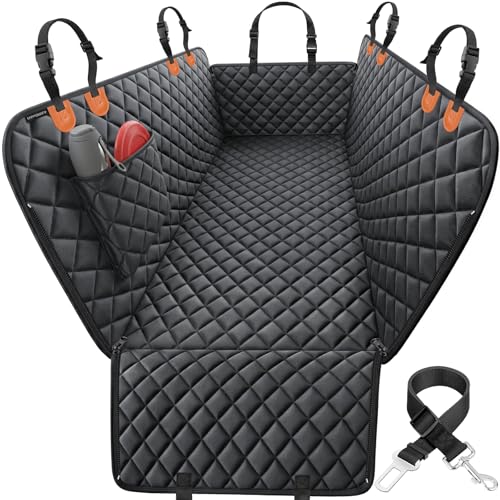
A hammock cover attaches to the front and rear headrests, suspending a fabric panel between the front seats and the rear bench. The panel covers the seat cushion, the rear seat back, and much of the footwell. This is usually the best dog seat cover design for a dog that moves around, sheds heavily, or arrives with wet paws.
Look for four adjustable headrest straps, two or more seat anchors that push into the seat crease, and side flaps that cover the door panels. A zippered center section is useful when one passenger needs access to the rear seat. Without a center opening, you may have to remove or fold the cover each time someone sits down.
The main weakness is fit. A hammock that is too short will expose the footwell; one that is too wide may bunch at the doors. In a vehicle with unusually tall front seats or a split rear bench, measure before ordering. A hammock also should not replace a safety restraint: use a crash-tested harness and compatible tether arrangement according to the restraint maker’s instructions.
Bench covers: the practical passenger-friendly option
Bench covers fit over the rear seat like a fitted blanket. They are preferable when the dog shares the back seat with a person, when rear footwell access must remain open, or when you want the simplest installation. Many have separate openings for the seat-belt buckles and a center split that allows one side of the seat to fold.
Bench covers vary widely in side protection. A model with short flaps may protect the cushion but leave the doors exposed to mud and claws. For better coverage, choose side wings at least 20–30 cm high and a waterproof panel that extends over the front edge of the cushion.
Because the dog can reach the floor more easily, bench covers are less effective than hammocks at containing dirt. They are also more likely to shift when a dog steps on and off the seat. Anchoring tubes, a grippy underside, and a strap around the seat back help reduce movement.
Cargo liners: best for SUV and hatchback space
A cargo liner is the strongest choice when the dog rides in the rear cargo area. The better designs cover the floor, seat backs, and side walls, with a bumper flap that folds out during loading. Raised edges are valuable because water and loose dirt tend to collect at the perimeter rather than run into the vehicle’s carpet.
Check whether the liner is designed for the second-row seats upright, folded, or both. A universal rectangle may work on a flat floor but leave gaps around wheel arches. Vehicle-specific liners usually fit better, while universal liners are more flexible if you change vehicles.
For large dogs, measure usable floor length and width rather than the vehicle’s advertised cargo volume. A dog needs room to stand, turn, and lie down without pressing against the hatch. If a crate is used, measure the crate footprint first and choose a liner that extends beyond it on all sides.
Materials that matter more than appearance
- 600D Oxford polyester: A common balance of abrasion resistance, weight, and price. Suitable for routine use when seams and backing are well made.
- 900D or thicker polyester: Better for large dogs, frequent loading, and rough outdoor conditions, but heavier and less flexible.
- Quilted fabric: Adds cushioning and can reduce hair penetration, but quilting creates more seams to clean.
- PVC or TPU waterproof backing: Helps stop water from reaching upholstery. TPU is often quieter and more flexible; PVC can feel stiffer.
- Rubberized or silicone dot backing: Improves grip, but it will not compensate for loose straps or a badly sized cover.
- Mesh windows: Improve airflow and visibility in a hammock, but may be a weak point if a dog scratches or chews.
“Waterproof” does not always mean leakproof. Water can pass through needle holes, zippers, or unsealed seams. If a dog frequently rides after swimming, prioritize a cover with a waterproof lower panel, overlapping closures, and a removable absorbent towel layer on top.
Seat-belt access and non-slip performance
Inspect the cover’s openings before installation. Seat-belt slots should be wide enough for the buckle to pass through without forcing the fabric, but not so large that dirt can fall directly into the seat crease. Zippers tend to give cleaner access than loose Velcro, while Velcro can be easier to operate with wet hands.
Non-slip performance comes from several parts working together: textured backing, seat anchors, headrest straps, and a close fit. A slick waterproof surface may be easy to wipe clean but can make a dog slide during braking or turns. If the cover feels slippery, add a washable rubberized mat designed for vehicle use rather than placing an unsecured blanket underneath it.
Do not cover or obstruct a vehicle’s seat-belt buckles, seat-mounted airbags, or other safety equipment. Side flaps should not interfere with door operation, and a dog should not be attached to a collar with a tether that could cause injury. Use a suitable harness or secured crate and follow its instructions.
Installation: a five-minute fit check
- Vacuum the seat and remove objects from the seat crease. Dirt underneath can reduce grip and wear the upholstery.
- Place the cover so its center seam aligns with the center of the seat. Misalignment causes bunching and exposes one side.
- Push the supplied anchors firmly into the seat crease, then tighten the headrest straps without over-tensioning them.
- Open every seat-belt slot and verify that all buckles can be reached. Fold any split seat section to confirm it still operates.
- Close the doors and hatch slowly. Check that no fabric is trapped in the latch, window seal, or door hinge area.
After installation, press down on each corner and pull the cover forward. If it moves more than about 5 cm, retighten the straps or choose a better-fitting size. A cover that shifts during every trip will wear faster and leave exposed areas.
Cleaning, durability, and ownership costs
Shake or vacuum loose hair before washing; otherwise, hair can clog a washing machine filter. Wipe muddy areas with mild soap and water, then air-dry the cover completely. High heat can warp waterproof coatings, weaken elastic, or shrink fabric. Avoid bleach and harsh solvents unless the manufacturer specifically permits them.
The first parts to wear are usually headrest-strap stitching, seat anchors, zipper teeth, and the waterproof coating along fold lines. Examine these areas monthly if the cover is used several times a week. A small tear in the upper fabric may be repairable, but a split seam or damaged buckle opening can allow water to reach the upholstery.
For example, a $60 cover used twice a week for one year costs about $0.58 per use before washing. A $120 heavy-duty cover used four times weekly for two years costs about $0.29 per use. Frequent use can justify stronger materials, while occasional passengers may be better served by a simpler cover that is easier to store.
Bottom line
Choose a hammock for maximum rear-seat and footwell protection, a bench cover when human passengers need regular access, and a cargo liner for dogs traveling behind the second row of an SUV or hatchback. Whichever design you choose, prioritize accurate dimensions, a waterproof backing, usable seat-belt openings, secure anchors, and a surface that stays stable under paws. Those details matter more than decorative quilting or a long feature list.


Write Your Review
No reviews yet. Be the first to share your experience!