

Key takeaways
- For eggs, pancakes, and sautéing, prioritize a thin turner and locking tongs.
- For soups and stews, choose a ladle holding approximately 90–120 milliliters.
- For pasta and vegetables, look for a slotted spoon with drainage openings and a pasta server.
- For baking, include a whisk with at least 8–10 wires and a comfortable grip.
- For roasting, choose tongs at least 25–30 centimeters long to keep hands away from heat.
The best stainless steel utensil set for most kitchens is a 10- to 12-piece set made from 18/10 stainless steel, with balanced handles, dishwasher-safe construction, and a compact crock or rail for storage.
Our top picks


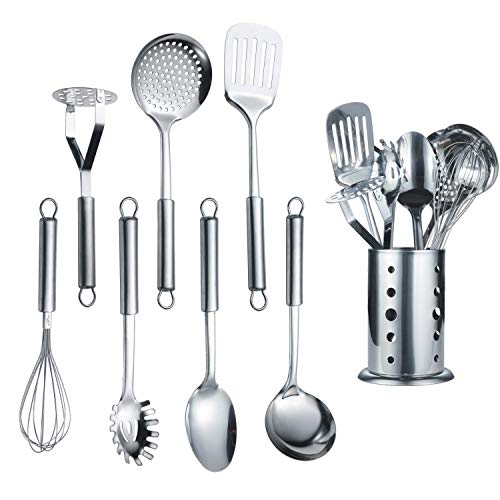

As an Amazon Associate we earn from qualifying purchases at no extra cost to you. Ratings are shown as listed on Amazon.
Quick picks by kitchen situation
| Kitchen situation | Best set type | Recommended count | Why it fits | Typical market range |
|---|---|---|---|---|
| Small apartment or occasional cooking | Compact core set | 6–8 pieces | Covers everyday tasks without filling a drawer | $25–$60 |
| Frequent home cooking | Balanced all-purpose set | 10–12 pieces | Includes both cooking tools and serving essentials | $45–$120 |
| Large household or batch cooking | Expanded set with larger tools | 14–20 pieces | Reduces washing and adds specialty tools | $80–$220 |
| Nonstick cookware | Silicone-tipped stainless set | 8–12 pieces | Protects coatings while retaining a rigid metal core | $40–$130 |
| Minimal counter space | Wall-rail or drawer-friendly set | 6–10 pieces | Avoids a bulky countertop holder | $35–$110 |
What should a complete utensil set include?
Piece counts can be misleading because some manufacturers count a storage crock, hooks, or measuring spoons as part of the total. Compare the actual tools rather than the headline number.
A useful 10-piece core set normally includes a solid turner, slotted turner, serving spoon, slotted spoon, ladle, pasta server, whisk, kitchen tongs, potato masher, and utensil holder or storage rail. For many cooks, this combination covers frying, stirring, draining, serving, whisking, and handling hot food.
A six-piece set can be enough if it contains a turner, spoon, tongs, ladle, whisk, and a slotted tool. A 14-piece set becomes worthwhile when it adds a second pair of tongs, a larger ladle, a flexible fish turner, a skimmer, and measuring spoons. Specialty tools such as a garlic press or ice cream scoop should only increase the value if you will use them regularly.
Count the tools you use, not the tools included
- For eggs, pancakes, and sautéing, prioritize a thin turner and locking tongs.
- For soups and stews, choose a ladle holding approximately 90–120 milliliters.
- For pasta and vegetables, look for a slotted spoon with drainage openings and a pasta server.
- For baking, include a whisk with at least 8–10 wires and a comfortable grip.
- For roasting, choose tongs at least 25–30 centimeters long to keep hands away from heat.
Stainless steel grades: 18/10 versus 18/0
“Stainless steel” describes a family of alloys, not one uniform material. The two labels most often found on utensil sets are 18/10 and 18/0. The first number refers approximately to chromium content; the second refers to nickel content.
| Steel grade | Approximate composition | Strengths | Trade-offs |
|---|---|---|---|
| 18/10 | 18% chromium, 10% nickel | Better corrosion resistance, brighter finish, less likely to develop staining | Usually costs more; often not induction-relevant for utensils |
| 18/8 | 18% chromium, 8% nickel | Good corrosion resistance and a useful middle ground | May be slightly less resistant to discoloration than 18/10 |
| 18/0 | 18% chromium, little or no nickel | Lower cost and often magnetic | More prone to water spots, surface dulling, and rust if neglected |
For the best stainless steel utensil set, 18/10 or 18/8 is usually the safer long-term choice, particularly if utensils will be washed frequently. Grade alone does not determine durability: a thick, well-formed 18/0 turner can outlast a flimsy 18/10 tool. Look for clear material disclosure, substantial construction, and a smooth transition between the handle and working end.
Handle comfort matters more than appearance
Handles that look polished in a product photograph can become tiring during a long cooking session. The most comfortable designs have a moderate diameter, a balanced center of gravity, and edges that do not press into the palm.
- A handle around 1.8–2.5 centimeters wide suits many adults without feeling bulky.
- A total tool length of 28–34 centimeters works well for standard stovetop pans.
- Longer 35–40 centimeter tools are useful for deep stockpots but may feel unwieldy in a small skillet.
- Textured or satin-finish grips are less slippery than mirror-polished handles when wet.
- Hollow stainless handles are often lighter; solid or weighted handles can feel more stable but add fatigue.
Sealed one-piece construction is preferable to a handle joined by an exposed seam. Food residue can collect around rivets, collars, and end caps. If a set uses silicone or rubber grip sections, check that they are firmly bonded and rated for the temperatures you expect.
Dishwasher safety and the damage it can cause
Most uncoated stainless steel utensils are dishwasher-safe, but “dishwasher-safe” does not mean they will remain spotless forever. Detergent minerals, hard water, and prolonged heat can create rainbow discoloration, water spots, or dull patches.
Silicone-tipped tools are also commonly dishwasher-safe, although repeated high-heat cycles can eventually fade, harden, or loosen the silicone. Wood-insert handles require more care and are usually a poor match for regular dishwasher use.
A maintenance routine that extends service life
- Rinse off salty, acidic, or starchy food rather than letting it dry on the steel.
- Place utensils so spray reaches both sides and water can drain from hollow handles.
- Remove tools promptly after the cycle to reduce water spotting.
- Use a soft cloth and diluted white vinegar for mineral haze; avoid abrasive scouring pads.
- Do not leave stainless tools soaking overnight in salty water.
- Replace any silicone tip that splits, bubbles, or separates from its metal core.
Rust-colored marks do not always mean the steel itself is failing. They can come from contact with carbon-steel cookware, steel wool, or rust particles from another dishwasher item. Clean the mark promptly, then dry the utensil completely.
Storage: crock, drawer, or rail?
A countertop crock is the easiest option for frequent cooks, but it needs a stable footprint and enough height to prevent long tools from tipping it over. Allow approximately 15–20 centimeters of counter width for a typical 10- to 12-piece crock set.
A drawer is tidier and keeps tools away from grease, but deep utensils may not fit. Measure the drawer before buying: a 30-centimeter ladle can require at least 35 centimeters of usable diagonal space. A shallow drawer also benefits from a divided organizer so heavy tongs do not crush lighter whisks.
A wall rail saves counter and drawer space. It works best when hooks are removable and the rail is mounted securely into a stud or suitable wall anchor. Keep the rail away from the cooktop if splattering oil will make cleaning difficult.
What wears out first?
In most sets, the first failures are not caused by the stainless-steel working end. Tongs may lose spring tension, whisk wires may bend, and silicone edges may split. Thin turners can warp when used to lift heavy food, while glued or capped handles may loosen after repeated dishwasher cycles.
To improve longevity, do not use a utensil as a pry bar, avoid leaving tools in a hot empty pan, and choose a turner thickness appropriate to the cookware. A flexible turner is useful for delicate fish and eggs; a rigid turner is better for burgers, roasted vegetables, and heavier foods. One cannot fully replace the other.
How much set do you actually need?
Consider frequency as well as household size. Suppose you cook five times per week and wash utensils after every meal. A six-piece set may be sufficient if you wash immediately, but one missing tool can force substitutions. Adding four high-use pieces for a $30–$60 premium may cost less than buying individual replacements later.
For an occasional cook using utensils twice per week, a $35 eight-piece set used 100 times per year costs about 44 cents per use in the first year. A $100 12-piece set used 300 times per year costs about 33 cents per use, before considering durability. The more often you cook, the more worthwhile balanced handles, better steel, and reliable dishwasher performance become.
Final buying checklist
- Choose 10–12 actual tools for a typical active kitchen.
- Prefer clearly labeled 18/10 or 18/8 stainless steel for routine use.
- Check tool lengths, handle diameter, and weight instead of judging from photographs.
- Confirm whether silicone, wood, or bonded parts are dishwasher-safe.
- Pick storage that matches your available counter, drawer, or wall space.
- Look for sealed joints, smooth edges, and no food-trapping gaps.
- Buy specialty pieces separately unless the complete set will be used often.
The strongest all-around choice is a 10- to 12-piece 18/10 set with a comfortable nonslip handle, a rigid but not overly heavy construction, dishwasher-safe materials, and storage that suits your kitchen. Smaller households should avoid paying for unused specialty tools, while frequent cooks will benefit more from better balance and replaceable components than from the largest piece count.

Write Your Review
No reviews yet. Be the first to share your experience!