

Key takeaways
- Drawers under 15 inches wide: Choose a compact four- or five-compartment tray, or a narrow adjustable model with a side section that can be removed.
- Drawers 15–22 inches wide: Most standard fixed trays fit, but check depth carefully. This is the easiest size range to organize.
- Drawers wider than 22 inches: An expandable tray or two separate trays usually prevents wasted side space.
- Drawers under 2 1/2 inches high: Avoid deep-sided trays and oversized handles. A low-profile tray is less likely to catch on the drawer above.
Best Cutlery Tray for Kitchen Drawer Organization
The best cutlery tray for kitchen organization is an adjustable, non-slip tray when your drawer dimensions are unusual or your utensil collection changes, while a fixed bamboo or plastic tray is usually the better value for a standard drawer with a predictable set of forks, knives, and spoons.
Adjustable vs. Fixed Cutlery Trays
These two designs solve different storage problems. A fixed tray has permanent compartments, so it is quick to install and easy to understand. An adjustable tray uses sliding sections, removable dividers, or expandable side panels to make better use of irregular drawer widths.
Our top picks
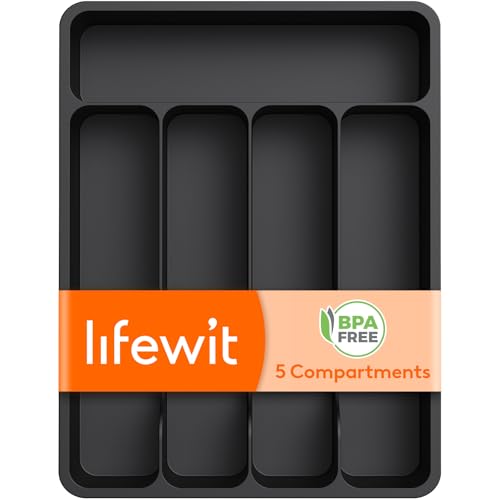


As an Amazon Associate we earn from qualifying purchases at no extra cost to you. Ratings are shown as listed on Amazon.
| Feature | Adjustable tray | Fixed tray |
|---|---|---|
| Typical width | 12–24 inches, often expandable | 12–20 inches in set sizes |
| Compartment count | 5–9, depending on dividers | 4–7 permanent sections |
| Typical utensil capacity | 40–70 everyday pieces | 30–55 everyday pieces |
| Common materials | Plastic, metal rails, bamboo, or a combination | Bamboo, molded plastic, steel, or wood composite |
| Typical weight | 1.5–4.5 lb | 1–3.5 lb |
| Best for | Mixed utensils, narrow gaps, changing storage needs | Standard drawers and simple daily organization |
| General price range | $20–$60 | $10–$40 |
Choose by Your Drawer Measurements
Measure the usable interior, not the outside of the cabinet. Record the drawer’s inside width, front-to-back depth, and height with the drawer fully closed. Subtract at least 1/4 inch from the width and depth measurements so the tray does not scrape the sides or jam when loaded.
For example, if the drawer interior is 19 1/2 inches wide and 17 inches deep, choose a tray no wider than 19 1/4 inches and no deeper than 16 3/4 inches. If the drawer has runners, a center support, or a raised base, measure around those obstructions rather than assuming the floor is flat.
- Drawers under 15 inches wide: Choose a compact four- or five-compartment tray, or a narrow adjustable model with a side section that can be removed.
- Drawers 15–22 inches wide: Most standard fixed trays fit, but check depth carefully. This is the easiest size range to organize.
- Drawers wider than 22 inches: An expandable tray or two separate trays usually prevents wasted side space.
- Drawers under 2 1/2 inches high: Avoid deep-sided trays and oversized handles. A low-profile tray is less likely to catch on the drawer above.
Best Choice by Kitchen Situation
| Your situation | Recommended tray | Why it fits |
|---|---|---|
| Small budget and standard utensils | Fixed molded plastic tray | Low cost, light weight, and easy to wash |
| Wide drawer with unused side space | Expandable adjustable tray | Uses extra width without leaving a dead zone |
| Many serving utensils and cooking tools | Adjustable tray with long compartments | Accommodates tongs, ladles, and larger knives |
| Frequent spills or messy cooking | One-piece plastic tray with rounded corners | Fewer seams and faster rinsing |
| Dry, carefully maintained kitchen | Finished bamboo or wood tray | Attractive appearance and solid compartment walls |
| Changing household or utensil collection | Tray with removable dividers | Can be reconfigured instead of replaced |
Compartment Layout Matters More Than the Number of Sections
A tray with six compartments is not automatically more useful than one with five. Look at the shapes and lengths. A practical layout usually includes separate sections for teaspoons, tablespoons, forks, knives, and miscellaneous tools. The knife section should be long enough for the handles and blades to lie flat without pushing against the drawer.
Short, narrow compartments are useful for teaspoons but frustrating for spatulas and serving spoons. If your kitchen has many cooking utensils, prioritize at least one compartment measuring 12–16 inches long and 3–4 inches wide. For a household that mainly stores tableware, five compartments between 2 1/2 and 4 inches wide are often sufficient.
Do not fill every compartment to the rim. A useful rule is to leave roughly 20% of each section empty. That gives you enough clearance to pick up one utensil without dragging several others out with it.
Materials: What Holds Up Over Time?
Plastic
Molded polypropylene or similar kitchen-grade plastic is the easiest material for households that deal with wet or sticky utensils. It does not absorb water, and many plastic trays can be washed in a sink. Look for thick walls, rounded corners, and a textured underside. Thin plastic can flex when lifted and may crack at the corners after repeated use.
Bamboo and wood
Bamboo trays look warmer and often have rigid, attractive dividers. However, they need more careful ownership. Standing water, damp utensils, and aggressive soaking can swell unfinished edges or loosen joints. Wipe them clean, dry them promptly, and follow the maker’s care instructions. A sealed finish helps, but it does not make wood maintenance-free.
Metal and hybrid designs
Metal rails can make adjustable trays feel sturdier, especially when the tray is expanded. The weak points are usually the sliding tracks, fasteners, and plastic end pieces rather than the metal itself. Check that the adjustment mechanism locks firmly and does not leave a gap where small utensils can fall underneath.
Ease of Cleaning and Common Ownership Problems
The easiest tray to clean is not necessarily the one with the fewest compartments; it is the one with accessible corners and limited crevices. Removable dividers are useful because they allow you to clean beneath them. Deep, fixed compartments can trap crumbs, while decorative grooves may collect grease.
- Empty the tray before cleaning rather than wiping around the utensils.
- Shake or vacuum out crumbs first; wet crumbs can form a paste in corners.
- Wash plastic with warm water and mild dish soap, then dry it completely.
- Wipe bamboo or wood with a damp cloth instead of soaking it.
- Inspect rubber feet and non-slip pads every few months; replace them if they become loose or sticky.
- Do not force an expanded tray into a drawer. Pressure can bend the sides or damage the drawer runners.
The parts most likely to wear first are rubber grips, sliding locks, thin corner joints, and decorative finishes. A tray that still looks attractive but slides around can damage the drawer and become difficult to use. If the base lacks grip, add thin, removable shelf liner rather than permanently gluing the tray in place.
A Simple Capacity Calculation
Suppose a household uses 12 forks, 12 spoons, 12 knives, 8 teaspoons, and 6 miscellaneous pieces each day: 50 utensils in total. A tray with five sections has an average theoretical capacity of 10 pieces per section, but the sections will not fill evenly. Allowing 20% spare room means planning for about 40 pieces of comfortable daily capacity.
That household should choose either a larger fixed tray with at least one extra section or an adjustable model rated for approximately 60 pieces. The extra space prevents the common mistake of buying a tray that technically holds everything but becomes difficult to use after only a few additions.
Final Buying Recommendation
Choose a fixed plastic tray if your drawer is a standard size, your utensil collection is stable, and easy cleaning matters most. Choose a finished bamboo or wood tray when appearance and rigid dividers are priorities and you can keep the tray dry. Choose an adjustable tray when every inch of drawer space matters, you own many different utensil shapes, or you expect your storage needs to change.
Before buying, confirm the interior measurements, account for drawer hardware, compare the length of the compartments with your longest utensils, and check how the tray can be cleaned. Those details matter more than the advertised compartment count and are the best way to find a cutlery tray that remains useful beyond the first week of organization.

Write Your Review
No reviews yet. Be the first to share your experience!