

Key takeaways
- The best automatic pet feeders are the ones that match your pet’s daily food volume, required portion accuracy, and tolerance for power interruptions: PetSafe Healthy Pet Simply Feed is a dependable choice for larger dogs and simple schedules, PETLIBRO Granary…
The best automatic pet feeders are the ones that match your pet’s daily food volume, required portion accuracy, and tolerance for power interruptions: PetSafe Healthy Pet Simply Feed is a dependable choice for larger dogs and simple schedules, PETLIBRO Granary models suit cats and small dogs that benefit from app scheduling and sealed storage, and a gravity-free, battery-capable feeder is the safest option when electricity is unreliable.
Our top picks


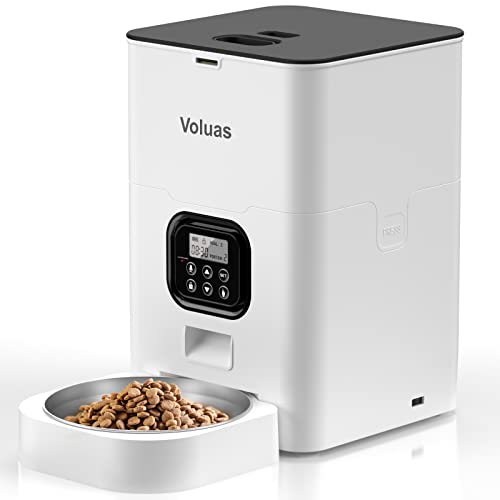
As an Amazon Associate we earn from qualifying purchases at no extra cost to you. Ratings are shown as listed on Amazon.
Quick picks by situation
| Situation | Best feeder type or pick | Why it fits | Watch out for |
|---|---|---|---|
| One cat, normal kibble, modest budget | 5-liter programmable dry-food feeder | Usually holds about 11 lb of dry food and supports several meals per day | Portion sizes vary with kibble shape |
| Large dog or multiple daily meals | PetSafe Healthy Pet Simply Feed | 24-cup hopper and portions from about 1/8 cup to 4 cups | It takes more counter or floor space than cat-focused models |
| Pet parent who wants phone alerts | PETLIBRO Granary smart feeder | App scheduling, meal notifications, and low-food or jam alerts on compatible models | Wi-Fi adds setup and another point of failure |
| Frequent power outages | AC feeder with battery backup | Continues dispensing when the adapter loses power | Battery operation may use a different schedule or fewer smart features |
| Wet food | Refrigerated or ice-pack compartment feeder | Designed for timed trays rather than a dry-food auger | Lower capacity and much more frequent washing |
What matters most when choosing an automatic feeder
Hopper capacity: calculate days, not just cups
A large hopper is useful only if the feeder can dispense your pet’s food accurately. A typical 5-liter hopper holds approximately 10 to 12 lb of dry kibble, but the actual weight depends on the food’s density and shape. A 24-cup hopper holds roughly 12 to 15 lb by volume, although it should not be filled beyond the manufacturer’s marked limit.
Use this calculation before buying:
Days of food = hopper capacity in cups ÷ total cups dispensed per day.
For example, if a cat eats 1 cup per day and a feeder holds 20 cups, the theoretical capacity is 20 days. In practice, plan on about 17 to 18 days because food should not be packed tightly into the hopper, and some residue remains around the dispensing mechanism.
For a 70 lb dog eating 3 cups daily, that same 20-cup feeder provides less than a week. Choose a larger-capacity unit or refill it every few days. A very large hopper is not automatically better for cats: food can become stale, and a pet may overeat if the portion mechanism is poorly calibrated.
Portion control: cups are estimates until you weigh them
Most automatic feeders divide food by auger rotations, wheel compartments, or timed motor cycles. “One portion” may mean 1/8 cup on one model and a smaller amount on another. Kibble size, shape, and oiliness can also change the amount released.
For a cat or small dog, look for a minimum setting of about 1/8 cup or less. For a medium or large dog, prioritize a feeder capable of dispensing larger meals without requiring many repeated cycles. A feeder that releases 1/8 cup per cycle would need 24 cycles to deliver 3 cups, which is inconvenient and may increase motor wear.
After setup, dispense the planned meal into a kitchen scale or measuring cup for at least three consecutive cycles. If the amounts differ substantially, adjust the schedule or choose a different food setting. This is particularly important when a pet must maintain a specific body condition; an automatic feeder is not a substitute for advice from a veterinarian or veterinary nutrition professional.
Head-to-head: common feeder designs
PetSafe Healthy Pet Simply Feed
The Healthy Pet Simply Feed is a strong fit for owners who want a relatively straightforward dry-food dispenser with a generous hopper. Its commonly listed capacity is 24 cups, and its programmable portions range from approximately 1/8 cup to 4 cups. The conveyor-style delivery is useful for larger meals and for dogs that need more than a few small scoops per feeding.
Its advantages are capacity, broad portion range, and a design that does not depend on a phone app. The trade-off is size: it can be excessive for a single cat in a small kitchen. It also needs a stable location because a determined dog may try to push or tip a tall feeder.
PETLIBRO Granary models
PETLIBRO Granary feeders are aimed mainly at cats and small-to-medium dogs eating dry food. Depending on the model, the Granary line includes approximately 5-liter hoppers, app-connected scheduling, voice recording, food-level notifications, and jam alerts. The sealed lid and desiccant compartment can help slow moisture exposure compared with an uncovered bowl.
These models make sense when you want several small meals, remote schedule changes, or notifications that a meal was dispensed. Check the exact model before purchasing: capacity, camera availability, battery backup, and portion increments differ across the Granary range. Smart features are helpful, but they should not replace checking the bowl when your pet depends on a meal arriving on time.
Battery-capable programmable feeders
A feeder with an AC adapter and battery compartment offers the most practical protection against short outages. Battery backup is different from a rechargeable battery: many units require you to install alkaline or rechargeable cells separately, and some smart functions may be unavailable while operating only on batteries.
If outages are common, choose a model that continues the normal feeding schedule from its internal memory, rather than one that needs constant Wi-Fi access. Replace or recharge the batteries on a fixed schedule—such as every six months—and test the backup by unplugging the adapter while the hopper is at least partly full.
Capacity and portion comparison
| Feeder category | Typical hopper | Useful daily food range | Suitable pets | Power backup expectation |
|---|---|---|---|---|
| Compact cat feeder | 2–3 liters; about 4–7 lb of kibble | About 1/4–1 1/2 cups per day | One cat or very small dog | Often battery-powered or battery backup |
| Standard smart feeder | 4–5 liters; about 8–12 lb | About 1/2–3 cups per day | Cats and small-to-medium dogs | Usually AC; backup varies by model |
| Large programmable feeder | 20–24 cups; about 12–15 lb | About 1–6 cups per day | Large dogs or longer refill intervals | Prefer AC plus replaceable batteries |
| Timed wet-food tray | 4–6 compartments | Several small wet-food servings | Cats and small dogs | Battery operation is common |
Setup steps that prevent most feeding errors
- Read the food compatibility range. Measure your kibble. Very small pieces can slip through too quickly, while large or irregular pieces may bridge over the outlet.
- Wash removable food-contact parts. Use mild dish soap and let every part dry fully before adding kibble. Moisture encourages food to clump.
- Program meals using the manufacturer’s portion unit. Do not assume one portion equals one tablespoon or one-eighth cup.
- Weigh several dispensed meals. Average the results and adjust the number of portions to match the feeding plan.
- Run a two-day trial while you are home. Confirm that the bowl is accessible, the motor is not jamming, and your pet does not knock the machine over.
- Set a manual backup. Keep a clean bowl and a measured emergency serving available if the feeder fails.
Ownership realities: cleaning, wear, and common mistakes
The parts most likely to cause trouble are the dispensing wheel or auger, the rubber or silicone outlet seal, the food bowl, and the power adapter. Oil from kibble can coat moving parts, while crumbs collect beneath the hopper. Clean the bowl daily or every few days, wipe the hopper regularly, and follow the manual before washing any motorized section. Never immerse the base.
Do not fill a feeder with food that is already dusty or damp. Avoid placing it beside a humidifier, sink, or outdoor door. Secure it against a wall for dogs that paw at the container, and use a shallow, wide bowl for cats that dislike their whiskers touching narrow sides.
For homes with multiple pets, a standard feeder may not prevent food stealing. Consider separate feeders, physical separation, or an access-contro



Write Your Review
No reviews yet. Be the first to share your experience!