

Key takeaways
- Capacity: A larger reservoir means fewer refills, but it does not replace daily checks. Cats’ water needs vary, and evaporation, spills, and other pets affect how long a fill lasts.
- Filtration: Many fountains combine a mesh or sponge that catches hair and debris with a replaceable carbon filter intended to reduce odors and some impurities. Filters need routine replacement; they do not make neglected water or a dirty fountain safe.
- Pump noise: A clean pump with enough water around its intake is usually quieter. Bubbling sounds can be more noticeable than the motor. Check the water level before assuming a pump is defective.
- Cleaning access: Look for a bowl, reservoir, and pump cover that come apart without awkward crevices. More parts and narrow channels can make thorough cleaning harder.
- Drinking height: A raised bowl may be convenient for some cats, but preference varies. A low fountain can be easier for kittens and small cats; watch whether your cat approaches comfortably.
- Power: Plug-in fountains provide continuous circulation but need an outlet and cord management. Battery-powered or rechargeable models allow more placement options, though runtime and charging needs vary by product.
Best Cat Water Fountains for Fresh Hydration
The best cat water fountains match your household’s size and cleaning routine: choose a stainless-steel model with an accessible pump for easy upkeep, a larger-capacity fountain for multiple cats, or a cordless model if you need flexible placement. Capacity and filter design matter, but a fountain is only a good fit if you can take it apart and clean it regularly.
What matters when choosing a fountain
- Capacity: A larger reservoir means fewer refills, but it does not replace daily checks. Cats’ water needs vary, and evaporation, spills, and other pets affect how long a fill lasts.
- Filtration: Many fountains combine a mesh or sponge that catches hair and debris with a replaceable carbon filter intended to reduce odors and some impurities. Filters need routine replacement; they do not make neglected water or a dirty fountain safe.
- Pump noise: A clean pump with enough water around its intake is usually quieter. Bubbling sounds can be more noticeable than the motor. Check the water level before assuming a pump is defective.
- Cleaning access: Look for a bowl, reservoir, and pump cover that come apart without awkward crevices. More parts and narrow channels can make thorough cleaning harder.
- Drinking height: A raised bowl may be convenient for some cats, but preference varies. A low fountain can be easier for kittens and small cats; watch whether your cat approaches comfortably.
- Power: Plug-in fountains provide continuous circulation but need an outlet and cord management. Battery-powered or rechargeable models allow more placement options, though runtime and charging needs vary by product.
Compare common fountain types
The figures below describe typical product specifications and market ranges, not measurements of every model. Always confirm the exact dimensions, materials, and replacement-filter compatibility on the product label.
Our top picks


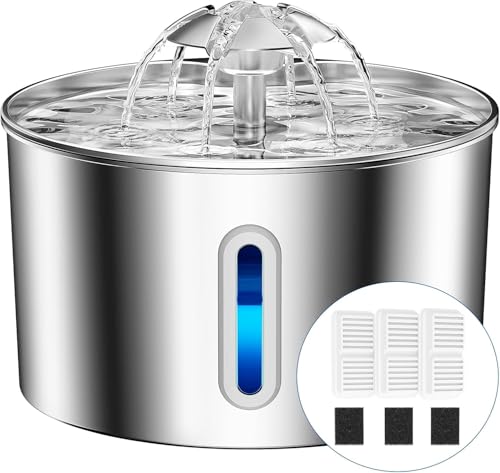
As an Amazon Associate we earn from qualifying purchases at no extra cost to you. Ratings are shown as listed on Amazon.
| Type | Typical capacity | Common construction | Power and upkeep trade-off |
|---|---|---|---|
| Compact plug-in fountain | About 1.5–2 L | Often plastic; usually 1–2 bowls or flow settings | Continuous circulation; frequent refills in a busy household |
| Large plug-in fountain | About 3–5 L | Plastic or stainless-steel drinking surface | Fewer refills; takes more counter or floor space |
| Ceramic fountain | About 1.5–3 L | Glazed ceramic bowl with a separate pump | Heavy and stable; bowl can be easier to wash, but ceramic can chip |
| Cordless fountain | About 1.5–3 L | Plastic or stainless steel, depending on model | Flexible placement; requires charging or battery replacement and runtime checks |
Capacity is not a guarantee of days between refills. A 3 L reservoir holds 3,000 mL, but two cats drinking from it may use water at different rates, and some water remains below the pump’s safe operating level. Treat listed capacity as a convenience measure, not a substitute for checking the bowl.
Best choices by household situation
For one cat in a small space
Choose a compact plug-in fountain with a removable drinking surface and a pump cover you can open for cleaning. A smaller reservoir saves space and is easier to lift to the sink. If your cat is wary of noise, prioritize adjustable flow and a stable base; a gentle stream is often less startling than a splashy spout.
For two or more cats
A 3–5 L model can reduce refill frequency, especially when several cats share one location. Prefer a wide drinking area with more than one approach point so one cat cannot easily block access. In a multi-cat home, a second water station may be more useful than simply buying the largest fountain. Keep an eye on water level and cleanliness, since shared water can collect hair and food debris faster.
For a cat that avoids appliances or moving water
Try a quiet, low-flow design with a still-water basin, or start with the fountain switched off and let your cat investigate it. Some cats prefer a plain bowl. A fountain should offer another option, not become the only available water source.
For flexible placement or travel
A cordless design can work where an outlet is inconvenient, but check the stated runtime and how the unit behaves when its battery is low. For travel, a familiar, stable bowl may be simpler than introducing a new pump and charging routine. Keep cords on plug-in units away from chewing and splashing.
Materials, filters, and long-term ownership
Plastic fountains are commonly the least expensive, often around $20–$50, and are lightweight. Scratches and seams can become harder to clean over time, so inspect the bowl during routine washing. Stainless-steel models are often around $30–$80, with premium or larger designs costing more. Their drinking surfaces are durable, but the pump, filter housing, and plastic reservoir may still need careful cleaning. Ceramic options commonly fall around $40–$100; they feel substantial and wash well, but can be heavy and break if dropped. Prices vary by size and features.
The pump is usually the part most sensitive to neglect. Hair and mineral deposits can reduce flow or make it louder. Filters are recurring expenses, and proprietary shapes may limit replacements, so check availability and the recommended change interval before buying. A filter that looks clean can still be due for replacement; follow the manufacturer’s schedule and adjust if water is cloudy or flow drops.
Hard water can leave scale on the pump and bowl. If your household has hard tap water, more frequent descaling may be needed. Use only cleaning products and methods allowed by the manufacturer, rinse thoroughly, and do not run the pump dry.
A practical cleaning routine
- Check water daily. Top up with fresh water and make sure the pump intake remains covered. This catches low-water noise before it becomes a pump problem.
- Wash the bowl and reservoir regularly. Disassemble the fountain as directed and wash the water-contact parts. Do not clean only the visible top; slime and debris can collect underneath.
- Open and rinse the pump. Remove hair and buildup from the intake and impeller area according to the manual. This is often the step that restores flow and quiet operation.
- Replace the filter on schedule. Rinse a new filter if its instructions call for it, and avoid washing or reusing disposable filter media unless the manufacturer says it is reusable.
- Reassemble and test. Fill to the indicated level before plugging in. Confirm that water circulates and that the pump is not vibrating against the reservoir.
How often to do a full wash depends on the fountain, household, and water conditions. A weekly cleaning is a reasonable starting point for many homes; inspect more often if you see film, fur, or reduced flow. Always keep a clean, separate water bowl available while the fountain is being washed or repaired.
Bottom line
For most homes, the best cat water fountains are not necessarily the biggest or most feature-rich; they are the ones that fit the available space, suit your cat’s preferred drinking style, and come apart easily enough to clean. Choose a larger reservoir for multiple cats, a stainless-steel or ceramic drinking surface if you prefer those materials, and cordless power when placement freedom matters more than continuous plug-in operation. Before buying, check filter availability, pump access, and replacement-part costs—those details shape the ownership experience long after setup.



Write Your Review
No reviews yet. Be the first to share your experience!