

Key takeaways
- What wears first: underside surfaces, welded seams, valve stems, fabric attachment points, and handles usually fail before the main top panel.
- Heat matters: direct sun expands the air inside an inflatable. Inflate it until firm, not rock-hard, and leave a little flexibility. Do not inflate or store it inside a hot vehicle.
- Cleaning: rinse chlorine, salt, sunscreen, and body oils off after use. Use mild soap and water, then dry completely before folding or covering.
- Storage: keep inflatables loosely folded in a cool, dry place. Avoid sharp creases, heavy objects, rodents, and prolonged ultraviolet exposure.
- Repair: find a slow leak with soapy water, mark the bubbles, dry the area, and use the manufacturer’s compatible patch material. A patch will not hold well on a dirty or wet surface.
- Common mistake: dragging the float along rough decking. Carry it by the body or by handles designed for carrying, never by a decorative strap or valve.
The best adult pool floats balance a supportive shape, puncture-resistant material, an appropriate weight capacity, and a size that fits your pool; for most adults, a 48–54-inch PVC lounge or a fabric-covered foam float is the strongest all-purpose choice.
Our top picks


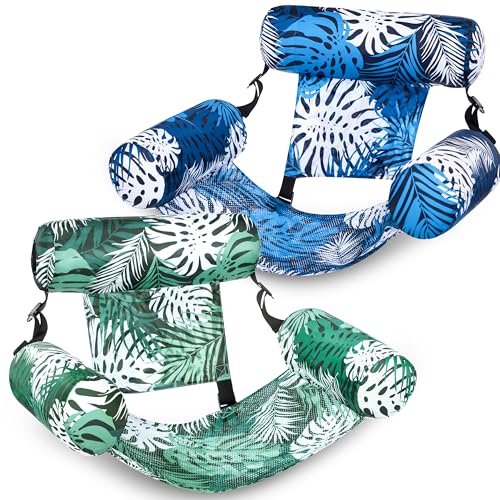
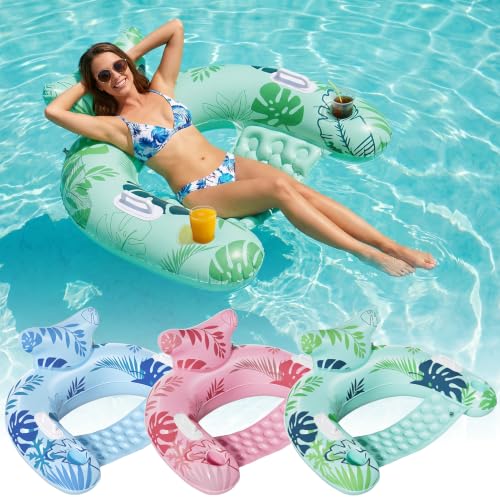
As an Amazon Associate we earn from qualifying purchases at no extra cost to you. Ratings are shown as listed on Amazon.
Quick picks by swimming situation
| Situation | Best float type | Why it fits | Main compromise |
|---|---|---|---|
| Occasional use on a budget | Inflatable PVC lounge, 48–54 inches | Low purchase cost, easy storage, adjustable firmness | Needs inflation and is more vulnerable to punctures |
| Frequent summer use | Closed-cell foam or fabric-covered foam float | Ready to use, buoyant, and resistant to small leaks | Bulkier and usually more expensive |
| Reading or reclining | Full-length chaise or headrest lounger | Supports the back and elevates the head | Longer turning radius and greater storage needs |
| Keeping the torso cool | Mesh hammock or sling float | Lets water circulate around the body | Provides less support for the neck and lower back |
| Large adults or shared use | Wide raft or reinforced two-person float | More surface area and a higher stated capacity | Harder to steer, carry, and store |
| Small above-ground pool | Compact single-seat float, 36–44 inches | Leaves room for swimmers and reduces collisions | Less stable and less comfortable for long lounging |
How to compare the best adult pool floats
1. Material: PVC, foam, mesh, or a combination
Most inflatable pool floats use flexible PVC. It is inexpensive, buoyant, and easy to wipe clean, but thin PVC is more likely to develop pinhole leaks from rough concrete, pets, sharp jewelry, or hot storage conditions. Look for welded seams, a repair patch, and a material thickness described as reinforced or heavy-duty rather than relying on the word “luxury.”
A practical PVC float should generally be at least about 0.25 mm thick for light seasonal use; thicker constructions around 0.35–0.50 mm typically offer better resistance to abrasion, although thickness alone does not guarantee a strong seam. Avoid dragging any inflatable across the deck, because the seam and underside usually wear before the top surface.
Closed-cell foam floats do not need inflation and cannot suffer an ordinary air leak. They are comfortable, quiet, and often durable when stored flat or vertically in a shaded place. Their weaknesses are bulk, higher cost, and possible surface wear from rough pool edges. Fabric-covered foam adds a softer, less slippery surface, but the cover can retain water and should be dried fully before storage.
Mesh and fabric sling floats are cooler in hot weather because water passes through the center. They are useful for upright lounging but may allow the hips to sink lower than the shoulders. Check the stitching, attachment points, and frame or perimeter structure carefully: these load-bearing areas matter more than the mesh itself.
2. Weight capacity: use a safety margin
Do not choose a float whose advertised capacity is equal to your body weight. Capacity figures can describe the maximum static load under ideal conditions, not a comfortable or stable limit while climbing on, shifting position, or sharing the float. A useful buying rule is to select a stated capacity at least 25% higher than the combined weight of everyone using it.
For example, a 190-pound adult should look for a float rated for at least 238 pounds:
190 × 1.25 = 237.5 pounds
For two adults weighing 155 and 185 pounds, the combined 340-pound load suggests a rating of at least 425 pounds. A two-person float rated for 400 pounds may technically be close, but it leaves too little margin for movement and uneven loading.
Capacity is not the only stability factor. Width, air pressure, chamber layout, and the height of the body above the water all affect tipping. A narrow, high-backed chair may have a generous capacity yet feel less stable than a broad, low raft.
3. Shape: comfort always involves a trade-off
Flat rafts provide the most room for stretching out and turning onto the stomach, but they offer limited neck support. They work well for relaxed sunbathing if you can reposition yourself without needing a backrest.
Chaise loungers raise the upper body and often include a pillow, headrest, or contoured back section. They are usually the best choice for reading or conversation, though they can be awkward to rotate and may catch wind when left unattended.
Sling or hammock floats support the head and knees while suspending much of the body in the water. They are compact and cooling, but the fabric may feel restrictive for taller users. Check the usable body length rather than the overall length, since curved ends and inflated pillows do not provide sleeping space.
Ring floats are easy to climb into and useful for casual drifting, but the central opening offers less back support. A ring is better for short periods of sitting or floating than for hours of reclining.
Two-person floats offer social comfort, but independent movement can be difficult. If both users shift to one side, the float may roll or ride low. Separate seating zones, multiple air chambers, and grab handles improve control.
Size and fit: measure the usable area
Manufacturers often list the outside dimensions, which can overstate how much room an adult actually has. On an inflatable chaise measuring 68 inches long, a 10-inch headrest and curved foot section might leave roughly 54–58 inches of relatively flat support. Compare that usable length with your height and preferred position.
Allow additional clearance around the float. In a 12-foot round pool, a 54-inch float leaves only about 9 feet of diameter for other occupants before accounting for the pool wall. In a smaller pool, a 36–44-inch seat may be more practical than a full-length lounger. Measure the pool’s narrowest usable width, not just its advertised diameter.
Durability and ownership realities
- What wears first: underside surfaces, welded seams, valve stems, fabric attachment points, and handles usually fail before the main top panel.
- Heat matters: direct sun expands the air inside an inflatable. Inflate it until firm, not rock-hard, and leave a little flexibility. Do not inflate or store it inside a hot vehicle.
- Cleaning: rinse chlorine, salt, sunscreen, and body oils off after use. Use mild soap and water, then dry completely before folding or covering.
- Storage: keep inflatables loosely folded in a cool, dry place. Avoid sharp creases, heavy objects, rodents, and prolonged ultraviolet exposure.
- Repair: find a slow leak with soapy water, mark the bubbles, dry the area, and use the manufacturer’s compatible patch material. A patch will not hold well on a dirty or wet surface.
- Common mistake: dragging the float along rough decking. Carry it by the body or by handles designed for carrying, never by a decorative strap or valve.
Foam floats reduce leak-related maintenance but still need rinsing and drying. Do not leave them compressed under heavy items, since permanent bends can develop. If a fabric cover is removable, wash it according to its care instructions and do not return it to storage while damp.
Decision guide: which specification should you prioritize?
| If your priority is… | Prioritize | Accept the trade-off |
|---|---|---|
| Lowest upfront cost | Standard PVC, single air chamber, 48–54 inches | More careful handling and occasional patching |
| Several seasons of frequent use | Foam construction or reinforced PVC with multiple chambers | Higher price or more storage volume |
| Back and neck support while reading | Chaise shape with a wide backrest and head pillow | Less freedom to lie flat or turn over |
| Easy carrying to a pool or holiday rental | Inflatable under about 8 pounds when dry | Setup time and greater puncture risk |
| Stability for a larger user | Wide, low profile; capacity at least 25% above body weight | More resistance when steering through the water |
Safety details that affect the buying decision
A pool float is a recreational aid, not a certified personal flotation device. It should not replace supervision, a properly fitted life jacket, or a safety plan. Do not use a typical lounge float in open water, strong wind, moving water, or where a user cannot easily exit the pool. Children and non-swimmers need close, active supervision even when a product is marketed as stable.
For adults with balance, mobility, or neck concerns, the safest choice depends on individual circumstances. A lower, wider float may be easier to stabilize, while a high-sided lounger may be harder to enter and exit. Ask a qualified healthcare or water-safety professional if you need advice related to a specific condition.
Bottom line
Choose a reinforced PVC chaise or broad raft for affordable, occasional lounging; choose closed-cell foam for frequent use and minimal leak maintenance; and choose a mesh sling when cooling and upright support matter more than a flat sleeping surface. The best adult pool floats are not necessarily the largest or most heavily marketed: they are the ones whose usable dimensions, weight capacity, material, and shape match your body, pool, and expected frequency of use.

Write Your Review
No reviews yet. Be the first to share your experience!