

Key takeaways
- The best barefoot shoes are the ones that match your transition experience and terrain: choose a thin, highly flexible sole for ground feel and efficient running, a slightly thicker sole for everyday walking, and the widest toe box you can…
The best barefoot shoes are the ones that match your transition experience and terrain: choose a thin, highly flexible sole for ground feel and efficient running, a slightly thicker sole for everyday walking, and the widest toe box you can comfortably secure without heel slip.
Barefoot shoes generally share four features: a low or zero heel-to-toe drop, a foot-shaped toe box, a flexible sole, and limited cushioning or structure. Those features are useful decision criteria, not guarantees that a shoe will suit every foot. The right choice depends on how often you walk or run, the surfaces you use, and how gradually your feet and lower legs can adapt.
Our top picks


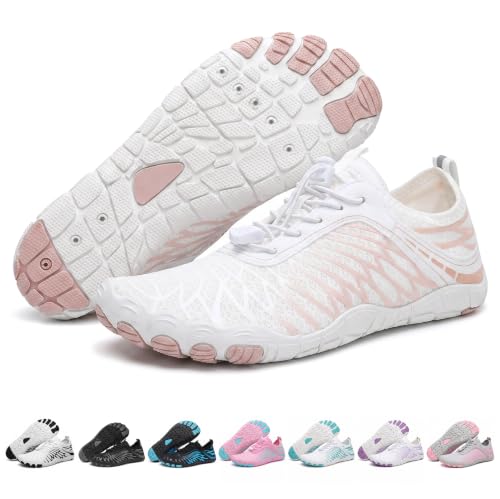
As an Amazon Associate we earn from qualifying purchases at no extra cost to you. Ratings are shown as listed on Amazon.
Quick picks by situation
| Situation | Best shoe type | Useful target specifications | Examples to investigate |
|---|---|---|---|
| New to barefoot footwear | Everyday minimalist trainer | 8–12 mm sole, zero drop, moderate flexibility | Xero Shoes Prio, Lems Primal 2 |
| Frequent walking on pavement | Roomy walking or lifestyle shoe | 10–14 mm sole, wide forefoot, protective rubber outsole | Lems Primal 2, Xero Shoes Forza Trainer |
| Experienced minimalist runner | Light running shoe | 5–8 mm sole, high flexibility, secure midfoot | Vivobarefoot Primus Lite, Merrell Vapor Glove 6 |
| Trails and loose ground | Minimal trail shoe | 8–12 mm sole, 3–5 mm lugs, reinforced upper | Vivobarefoot Primus Trail, Xero Shoes Mesa Trail |
| Maximum toe room but not a barefoot feel | Wide, low-drop cushioned shoe | 25–35 mm sole, 0–4 mm drop, flexible forefoot | Altra Lone Peak or Altra Escalante |
Specifications are approximate design ranges rather than universal standards. Brands measure stack height, weight, and width differently, and some publish only partial figures. A cushioned zero-drop shoe such as an Altra is not the same as a minimalist barefoot shoe, but it can be a sensible intermediate option for people who need more underfoot protection.
Sole thickness: protection versus ground feedback
Sole thickness is one of the clearest trade-offs. A sole around 5–8 mm usually feels more flexible and lets you notice gravel, slopes, and changes in the ground. That feedback can encourage a shorter stride and quieter landing, but hard pavement may feel demanding during a long walk or run.
A sole around 8–14 mm offers more protection from sharp surfaces and temperature while remaining considerably more flexible than a conventional trainer. This is often the most practical range for daily walking, commuting, and a first pair of minimalist shoes.
Soles above roughly 20 mm are usually cushioned rather than barefoot in feel. They may reduce the sensation of the ground, but they can make long-distance walking more comfortable for some users. Thickness alone does not determine comfort: rubber density, foam softness, tread pattern, and the shoe’s ability to bend under the toes matter too.
What works for walking?
Walking is repetitive but usually involves lower impact than running. For pavement, a 10–14 mm sole with a durable rubber contact layer is a useful compromise. Look for flex across the ball of the foot rather than only at the middle of the shoe. A shoe that bends sharply in the arch but stays stiff beneath the toes may not move naturally with your stride.
What works for running?
Running increases loading and repetition, so a very thin sole is not automatically better. Experienced minimalist runners may prefer 5–8 mm for lightness and ground feel, while newer runners often benefit from a more protective 8–12 mm model. Start with short run-walk sessions and increase either distance or frequency—not both in the same week.
Toe-box width: room where the toes actually spread
A wide-looking shoe is not necessarily foot-shaped. The important question is whether the widest part of the shoe sits near the ball of your foot and whether the toe area follows the natural fan of your toes. Many conventional shoes narrow toward the front, pressing the smaller toes inward even when the length is correct.
For sizing, measure both feet late in the day while wearing the socks you expect to use. Add about 10–12 mm of length for walking shoes and about 12–15 mm for running shoes, then compare that measurement with the brand’s internal size chart. The extra space allows normal forward movement and swelling. Do not compensate for a narrow toe box by buying an excessively long shoe; that can cause heel movement and tripping.
Width should be secure rather than loose everywhere. Your toes should be able to spread, but the heel and midfoot should not slide when you walk downhill or change direction. A wide toe box with an adjustable lacing system is usually easier to fit than a stretchy slip-on.
Flexibility and stability are not opposites
The best barefoot shoes flex at the forefoot and twist enough to follow uneven ground. However, an upper can still provide useful stability through a firm heel counter, a close-fitting midfoot, or a well-designed lacing system. For running, excessive movement inside the shoe wastes energy and can create rubbing; for relaxed walking, a little more freedom may be comfortable.
Perform a simple check in a shop or at home: hold the heel and bend the shoe at the toe area. It should flex where your toes bend, not fold in half behind the arch. Then twist it gently. A shoe that is completely rigid may feel protective but less natural; one that collapses without holding your foot may be difficult to control on uneven surfaces.
Decision matrix: which specification should you prioritize?
| Your priority | Prioritize | Accept this compromise |
|---|---|---|
| Lowest price | Simple mesh upper, replaceable insole, 8–12 mm sole | Less weather resistance and fewer fit adjustments |
| Daily use over 5 days per week | Durable rubber, stitched high-wear areas, 10–14 mm sole | Slightly more weight and less ground feel |
| First minimalist pair | Moderate sole thickness and adjustable laces | Not as light or flexible as an advanced running model |
| Fast road running | Light upper, secure heel, 5–8 mm flexible sole | Less protection from stones and rough pavement |
| Wet trails | 3–5 mm lugs, abrasion-resistant upper, quick-drying lining | More tread can feel less smooth on indoor floors |
| Broad forefoot | Foot-shaped last and a measurable wide option | Less sleek appearance and possibly more volume around the midfoot |
Ownership realities: what wears first?
On minimalist shoes, the outsole commonly wears under the heel’s outer edge and beneath the big-toe area. A smooth patch, exposed foam, or a noticeable difference between left and right can change how the shoe feels. Thin uppers may also develop holes at the little-toe side if the shoe is too narrow or the mesh is repeatedly flexed against a prominent toe.
Expect broad market prices of roughly $60–$110 for basic minimalist shoes and about $100–$180 for premium materials, specialized trail construction, or established barefoot brands. The cheapest pair is not always the lowest-cost choice. For example, a $90 shoe used 180 times costs $0.50 per use before replacement, while a $140 shoe used 350 times costs $0.40 per use. This calculation is only useful if the more expensive shoe actually fits and lasts longer.
Rotate pairs when possible, especially if you walk or run most days. Remove the insoles to dry, brush off grit before it enters the tread, and wash according to the care label. Avoid hot dryers, which can damage adhesives and shrink or distort uppers. If odor is a problem, allow the shoes to dry fully between uses rather than masking the moisture.
How to transition safely
- Wear the shoes indoors and for short, easy walks for several days.
- Add 10–20 minutes of outdoor walking while keeping your normal shoes available.
- Only after walking feels comfortable, introduce brief run-walk intervals.
- Increase duration gradually and stop if discomfort persists or changes your gait.
Calf, Achilles, foot, or joint discomfort can occur when footwear changes abruptly because stride and loading patterns may change. Persistent pain, swelling, numbness, or recurring injuries warrant advice from a qualified healthcare professional or running specialist.
Frequently asked questions
Are barefoot shoes suitable for long walks?
They can be, but the most minimal model is not automatically the best long-distance option. A moderately protective sole, secure fit, and enough toe room are usually more important than having the thinnest possible outsole.
Should barefoot shoes feel tight?
The midfoot and heel should be secure, while the toes need space to spread and move. Tightness across the toe joints is a fit problem, not something to “break in.”
Can I run in barefoot shoes immediately?
It is better to transition gradually. Begin with walking, then short run-walk intervals, and monitor how your feet and lower legs respond over the following day.
Is zero drop the same as barefoot?
No. Zero drop means the heel and forefoot are at the same height. A zero-drop shoe can still have substantial cushioning, a stiff sole, and a conventional shape. Barefoot shoes generally combine zero drop with a wider toe box and much greater flexibility.

Write Your Review
No reviews yet. Be the first to share your experience!