

Key takeaways
- Pre-filter: Captures fur, lint, and larger dust. A washable version reduces the load on replacement filters.
- Particle filter: Captures airborne dust and dander. Look for HEPA or a clearly specified high-efficiency particle filter.
- Activated carbon: Adsorbs some odor compounds and gases. More carbon generally matters more than a marketing label alone.
- Ionizer or plasma feature: This is optional, not a substitute for CADR and mechanical filtration. If you are concerned about emissions, choose a model with the feature disabled or verify its emissions information.
The best air purifiers for pet owners are the ones with enough smoke CADR for the room, a true particle filter for hair and dander, and a substantial activated-carbon stage for odors—not simply the model with the largest advertised coverage area.
Our top picks

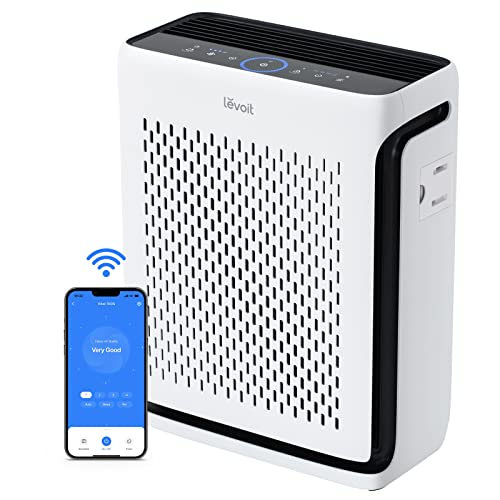


As an Amazon Associate we earn from qualifying purchases at no extra cost to you. Ratings are shown as listed on Amazon.
Quick picks for homes with pets
| Best for | Model | Published smoke CADR | Advertised room size | Filter approach | Typical market range |
|---|---|---|---|---|---|
| Most pet households | Coway Airmega 250 | About 249 CFM | Up to about 930 sq. ft. at 2 air changes per hour | Washable pre-filter, HEPA filter, deodorization filter | $200–$300 |
| Large, open living areas | Blueair Blue Pure 211i Max | About 410 CFM | Up to about 635 sq. ft. at 4.8 air changes per hour | Washable fabric pre-filter, particle filter, activated carbon | $250–$350 |
| Budget-conscious bedrooms | Winix 5510 | About 376 CFM | Up to about 1,881 sq. ft. at 1 air change per hour | Washable pre-filter, carbon filter, True HEPA filter | $150–$230 |
| Smaller rooms and smart controls | Levoit Core 400S | About 260 CFM | Up to about 403 sq. ft. at 4.8 air changes per hour | Fine-particle filter, activated-carbon layer, washable outer pre-filter surface | $150–$220 |
Coverage figures are not directly interchangeable: brands may use different air-change assumptions. For a pet room, compare CADR first, then check the filter design, noise, replacement-filter cost, and cleaning access.
How to match CADR to your room
CADR, measured in cubic feet per minute, indicates how quickly a purifier supplies filtered air. A useful buying target for homes with noticeable pet dander is roughly 4 to 5 air changes per hour. Use this calculation:
Required CADR = room length × room width × ceiling height × desired air changes per hour ÷ 60
For example, a 15-by-20-foot living room with an 8-foot ceiling contains 2,400 cubic feet. At four air changes per hour:
2,400 × 4 ÷ 60 = 160 CFM
A purifier rated around 160 CFM is the mathematical minimum for that room. Because doors open, homes have drafts, and pets add a continuous source of particles, choosing approximately 200 to 250 CFM gives more useful headroom. For severe shedding, multiple pets, or an open-plan space, use a larger model or two purifiers rather than relying on a small unit at its noisiest setting.
Choosing by pet problem
Hair and visible fur
Air purifiers do not replace brushing or vacuuming. Heavy fur is too large to remain airborne for long and usually lands on floors, furniture, and the purifier’s intake grille. Look for a removable, washable pre-filter. It catches hair before it clogs the finer filter and is one of the most valuable features for cats and long-haired dogs.
The Coway Airmega 250 and Winix 5510 are practical choices because their pre-filter can be cleaned regularly. The Blueair Blue Pure 211i Max also uses a washable fabric pre-filter, which adds a protective layer but still needs frequent lint and fur removal.
Fine dander and dust
For airborne dander, prioritize a sealed particle-filtration system with a HEPA or HEPA-style filter and enough CADR for the room. “HEPA” describes filtration performance, not how much air the machine moves. A very efficient filter in an undersized purifier may clean less air overall than a somewhat larger unit running at a moderate speed.
Keep the purifier near the pet’s main living area, but leave clearance around the intake. Placing it directly behind a sofa, against a curtain, or in a corner can sharply reduce airflow.
Persistent odor
Particle filters capture particles associated with some odors, but they do not remove most odor gases by themselves. Odor control depends on activated carbon. Thin carbon-coated sheets can help with mild smells; a thicker carbon bed generally has more useful capacity, though it also adds cost and may restrict airflow.
For litter-box odor, accidents, or several pets, choose the largest carbon stage available within your budget and keep expectations realistic. Source control—cleaning the litter box, washing bedding, ventilating, and removing contaminated materials—works faster than filtration alone. Carbon eventually becomes saturated and cannot be restored by vacuuming.
Head-to-head: which pick fits your situation?
| Your situation | Best fit | Why | Trade-off |
|---|---|---|---|
| One pet, medium bedroom, moderate shedding | Levoit Core 400S | Strong enough for many bedrooms, compact controls, and commonly available replacement filters | Carbon capacity is limited for strong household odors |
| Multiple pets or a frequently used living room | Coway Airmega 250 | Good balance of airflow, washable pre-filter, and a more substantial overall design | Larger and more expensive than basic bedroom units |
| Open-plan room or severe shedding | Blueair Blue Pure 211i Max | Highest airflow among these picks, making it better suited to larger spaces | Large footprint; high-speed operation is more noticeable |
| Strong airflow on a controlled budget | Winix 5510 | High published CADR for its price range and a washable pre-filter | Its odor-removal performance depends heavily on the condition of the carbon filter |
Filter types that matter for pet owners
- Pre-filter: Captures fur, lint, and larger dust. A washable version reduces the load on replacement filters.
- Particle filter: Captures airborne dust and dander. Look for HEPA or a clearly specified high-efficiency particle filter.
- Activated carbon: Adsorbs some odor compounds and gases. More carbon generally matters more than a marketing label alone.
- Ionizer or plasma feature: This is optional, not a substitute for CADR and mechanical filtration. If you are concerned about emissions, choose a model with the feature disabled or verify its emissions information.
Setup that improves results
- Measure the room. Use the actual enclosed room rather than the entire home unless the purifier is in a genuinely open area.
- Place the unit in the pet’s main zone. Keep at least several inches of clearance on all intake and exhaust sides; more clearance is better.
- Run it continuously at a moderate speed. A purifier removes particles over time. Short bursts on maximum speed are less useful than steady operation.
- Use high speed during shedding, cleaning, or after an odor source is removed. Return to a quieter setting afterward.
- Keep doors and windows in mind. Open windows can dilute odors but also introduce outdoor particles and make the purifier work harder.
Ownership costs and maintenance
The washable pre-filter is usually the first part to need attention. Inspect it weekly in a high-shedding home and clean it when fur forms a visible layer or airflow drops. Follow the manufacturer’s instructions: some pre-filters can be rinsed, while others should only be vacuumed or wiped and fully dried before reinstalling.
Do not wash a HEPA or carbon filter unless the manual explicitly says it is washable. Water can damage the filter media, and a damp filter can develop an unpleasant smell. Replacement intervals commonly range from about six months to one year, but pets, smoke, renovation dust, and continuous high-speed use can shorten that period. General replacement-filter pricing is often about $30–$100 per set, depending on the model.
A useful ownership calculation is to estimate annual filter cost before buying. If a replacement set costs $60 and lasts nine months, the filter budget is approximately $60 × 12 ÷ 9 = $80 per year, excluding electricity. A cheaper purifier can cost more over time if its filters are unusually expensive or difficult to find.
Common mistakes to avoid
- Buying by square-foot coverage without checking the air-change rate behind that number.
- Expecting a purifier to collect settled fur from carpets and furniture.
- Ignoring carbon quantity when odor is the main concern.
- Letting fur clog the pre-filter until airflow becomes weak.
- Placing the unit inside a cramped shelf or directly beside a wall.
- Using fragrance sprays to mask odors instead of removing the source.
Bottom line
For most pet owners, the Coway Airmega 250 is a balanced choice for a medium-to-large living area, while the Blueair Blue Pure 211i Max is better when maximum airflow matters. Choose the Winix 5510 for a high-CADR budget option and the Levoit Core 400S for a smaller room with smart controls. Whichever model you choose, size it by CADR, clean the pre-filter frequently, and treat odor control as a combination of ventilation, cleaning, and appropriately sized activated carbon. If someone in the household has persistent respiratory symptoms or suspected allergies, consult a qualified healthcare professional rather than relying on an air purifier as treatment.

Write Your Review
No reviews yet. Be the first to share your experience!