

Key takeaways
- Open wire shelves: best for visibility and ventilation, but small jars may need bins or shelf liners.
- Raised basket shelves: better for bottles and loose packages that could roll.
- Adjustable shelves: useful when storage changes between appliances and pantry goods.
- Drawers: convenient for utensils, but they reduce space for tall containers.
- Cabinet storage: tidier and better for light-sensitive goods, but usually heavier and harder to clean after leaks.
The best rolling kitchen carts for most small kitchens are the IKEA RÅSKOG for compact everyday storage, the IKEA RÅSHULT for the tightest floor plans, and a wider kitchen island cart with a solid wood or bamboo top when you need usable prep space rather than extra shelving.
The right choice depends less on the number of shelves than on four practical measurements: the cart’s loaded footprint, the clearance around its wheels, the weight limit of each shelf, and whether its countertop can tolerate moisture and heat. A narrow cart can add valuable storage, but a wide, top-heavy model may become awkward to move when loaded with appliances, cans, or cookware.
Our top picks


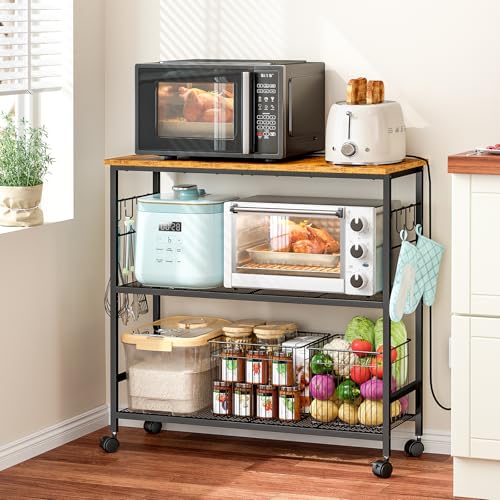

As an Amazon Associate we earn from qualifying purchases at no extra cost to you. Ratings are shown as listed on Amazon.
Best rolling kitchen carts at a glance
| Cart or type | Approx. dimensions | Storage layout | Weight capacity | Top and wheels | Best for |
|---|---|---|---|---|---|
| IKEA RÅSHULT | 28 × 38 × 65 cm | Three open wire shelves | About 6 kg per shelf | Powder-coated steel; four casters, two locking | Very narrow kitchens and small appliances |
| IKEA RÅSKOG | 35 × 45 × 78 cm | Three deeper open shelves | About 6 kg per shelf | Powder-coated steel; four casters, two locking | Best compact all-purpose storage |
| Three-tier utility cart | Approx. 40 × 30 × 75 cm | Three plastic or metal baskets | Usually 15–30 kg total | Plastic, steel, or a combination; locks vary | Low-cost pantry overflow and cleaning supplies |
| Folding metal utility cart | Approx. 45 × 35 × 85 cm open | Two or three shelves | Usually 20–45 kg total | Metal shelves; locking casters vary | Occasional entertaining or limited storage |
| Kitchen island cart | Approx. 80–110 × 40–55 × 85–95 cm | Cabinet, drawer, or one to three shelves | Usually 45–90 kg total | Wood, bamboo, engineered wood, or stone-look top; often two locking casters | Extra counter space and heavier equipment |
Dimensions and load ratings vary by finish, retailer, and production year, so treat the table as a comparison guide rather than a substitute for the current assembly manual. Capacity is also not the same as useful capacity: a cart rated for 30 kg may still flex if that weight is concentrated on one small shelf.
Our picks by kitchen situation
Best overall for a small kitchen: IKEA RÅSKOG
The RÅSKOG strikes the most useful balance between footprint and capacity. Its three steel shelves are deeper than those on the RÅSHULT, so it can hold mixing bowls, a toaster, cooking oils, or boxed pantry goods without wasting as much vertical space. The open sides make it easy to see supplies, while the raised shelf edges help prevent jars from sliding off during movement.
Its approximately 35 × 45 cm footprint is small enough for many gaps beside a refrigerator or cabinet, but measure the route to that gap first. A cart that fits beside the counter may not turn through a narrow doorway. Two locking casters are helpful when using the top as a temporary work surface, although they will not stop the cart from rocking on an uneven floor.
Best for the tightest gap: IKEA RÅSHULT
The RÅSHULT is the better choice when every centimeter matters. At roughly 28 × 38 cm, it occupies notably less floor area than the RÅSKOG while retaining three shelves. The trade-off is shallow storage: large plates, wide pans, and bulky countertop appliances may overhang or require careful placement.
Choose it for coffee supplies, spices, baking ingredients, fruit, or a compact air fryer rather than as a full pantry. Its lower height can also work beneath some windowsills or wall cabinets, but check the handle and wheel clearance before ordering.
Best for heavy or frequent use: a kitchen island cart
A kitchen island cart is worth the additional floor space when the cart needs to function as a work surface. Look for a top at least 80 cm wide, a stated total capacity of 45 kg or more, and a frame that does not rely only on thin particleboard side panels.
Bamboo and solid wood tops are attractive and can be refinished, but they need prompt drying after spills. Engineered wood with a laminate finish is easier to wipe clean and often less expensive, though damaged edges can swell. A stone-look or composite top may resist stains, but the complete cart can be substantially heavier and harder to reposition.
Best low-cost flexible option: a three-tier utility cart
Generic three-tier carts are often the least expensive option, commonly ranging from about $25 to $80 depending on materials and capacity. Plastic baskets are light and rust-resistant, while metal baskets generally feel more stable under cans and bottles. Confirm that the casters include at least two brakes; many inexpensive models roll freely on all four wheels.
This type is practical for pantry overflow, reusable shopping bags, pet-food containers, or cleaning products. It is less suitable for chopping or kneading because the shelves and frame may flex under sideways pressure.
How to compare a cart before buying
1. Measure the usable space, not just the empty gap
Measure width at the floor, halfway up, and at countertop height. Baseboards, cabinet handles, radiator covers, and protruding appliances can reduce the actual clearance. Then add at least 2.5 cm on each side so the cart does not scrape while moving.
For a 40 cm-wide cart in a 45 cm opening, the nominal clearance is 5 cm. That sounds sufficient, but a 2 cm baseboard projection leaves only 3 cm on one side, making the cart difficult to pull out without tilting it. If the cart must turn, measure the diagonal route as well.
2. Calculate the real load
List what will live on the cart and estimate each item’s weight. A countertop oven may weigh 10 kg, a cast-iron Dutch oven 5 kg, and six one-litre bottles roughly 6 kg before adding the shelf itself. Concentrating those items on one shelf can exceed a per-shelf rating even when the cart’s total rating appears adequate.
For frequent movement, keep heavy items on the lowest shelf. This lowers the center of gravity and reduces tipping when crossing a threshold. Do not treat a locking caster as a replacement for balanced loading.
3. Inspect the wheel locks
Two locking casters are usually enough for a compact cart parked against a wall. Four locking casters provide better stability but can make repositioning slower. Test whether the brake locks both rolling and swiveling: some casters stop the wheel but still allow the cart to pivot.
4. Match the shelf layout to your items
- Open wire shelves: best for visibility and ventilation, but small jars may need bins or shelf liners.
- Raised basket shelves: better for bottles and loose packages that could roll.
- Adjustable shelves: useful when storage changes between appliances and pantry goods.
- Drawers: convenient for utensils, but they reduce space for tall containers.
- Cabinet storage: tidier and better for light-sensitive goods, but usually heavier and harder to clean after leaks.
Ownership details that affect value
The parts most likely to wear first are casters, wheel stems, shelf liners, and fasteners. A cart that is frequently pushed over grout lines or thresholds can loosen over time. Re-tighten bolts after the first week and periodically afterward; over-tightening can strip threads in thin metal or engineered wood.
Clean powder-coated steel with a damp cloth and dry it promptly, especially around wheel brackets. Do not leave wet towels or leaking bottles on unsealed wood. Use removable plastic bins for flour, rice, and pet food so spills do not settle into wire joints or cabinet seams. Avoid abrasive cleaners on laminate and painted finishes.
Wire shelves often need liners for small items, but a fully solid liner can trap moisture. Choose a washable liner with a slightly raised edge, or leave air gaps around damp produce. Never place a hot pan directly on a wood or laminate cart top unless the manufacturer specifically permits it; use a heat-resistant trivet.
Decision matrix
| Your priority | Choose | Why | Main compromise |
|---|---|---|---|
| Less than 30 cm of width | Narrow three-tier cart or RÅSHULT | Fits gaps that wider island carts cannot | Shallow shelves and lower working capacity |
| Daily pantry access | RÅSKOG or raised-basket utility cart | Open shelves make frequently used items visible | Dust and visual clutter are more noticeable |
| Heavy appliances | Wide kitchen island cart | Stronger frame, larger top, and higher load rating | Costs more and consumes valuable floor area |
| Occasional use or moving storage | Folding metal utility cart | Can be stored flat or moved between rooms | Often less rigid when fully loaded |
| Lowest purchase cost | Basic plastic or metal utility cart | Usually the least expensive route to three shelves | Wheel locks, finish quality, and capacity may be limited |
Bottom line
Choose the IKEA RÅSHULT when a narrow footprint is the deciding factor, the IKEA RÅSKOG when you want the best balance of compact storage and everyday convenience, and a larger kitchen island cart when you need a genuine prep surface or must support heavy equipment. Before buying, measure the cart’s full route, confirm per-shelf capacity, check for two or more locking casters, and select a countertop material that matches how much moisture, heat, and cleaning it will encounter.

Write Your Review
No reviews yet. Be the first to share your experience!