

Key takeaways
- Rifle length: 40 inches
- Minimum target internal length: about 42 inches
- Likely suitable advertised size: 44–46 inches, after confirming the manufacturer’s internal measurement
The best rifle bags are the ones that match your rifle’s actual length, optic height, transport frequency, and storage environment—not simply the thickest or most heavily advertised case.
For most owners, a padded soft rifle bag is the practical choice for vehicle transport and short-term storage. Choose a hard case instead when the firearm will travel as checked baggage, face rough handling, or remain in a damp environment. Before buying, measure the rifle with its optic, muzzle device, and any stock adjustment set exactly as you intend to transport it.
Our top picks
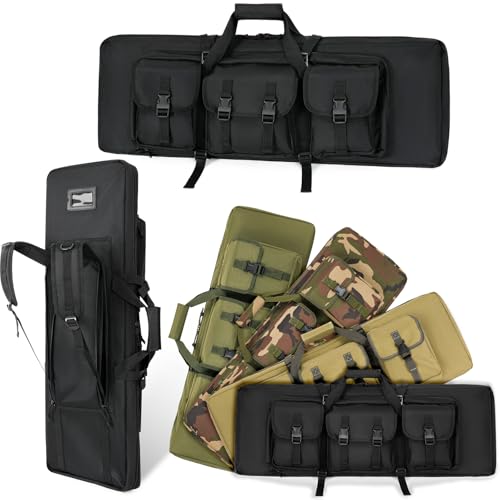


As an Amazon Associate we earn from qualifying purchases at no extra cost to you. Ratings are shown as listed on Amazon.
Quick picks by situation
| Situation | Best bag type | Useful specification | Why it fits |
|---|---|---|---|
| Occasional range trips on a budget | Single soft rifle case | 600D polyester, 18–25 mm padding, lockable zippers | Low cost and light weight without sacrificing basic protection |
| Frequent transport with an optic attached | Reinforced scoped-rifle bag | 46–52 inches long, 25–35 mm padding, adjustable retention straps | Protects the optic and prevents the rifle from sliding inside |
| Two rifles carried together | Double rifle bag | Two padded compartments, 52–54 inch internal length, 8–12 accessory pockets | Combines transport capacity while keeping firearms separated |
| Air travel or severe handling | Lockable hard case | Impact-resistant polymer, four or more locking points, padlock-compatible holes | Resists crushing and provides more consistent protection |
| Compact rifle or short-barreled configuration | Short rifle or carbine bag | 28–36 inches internal length, movable hook-and-loop dividers | Avoids excess empty space that lets the firearm move during transport |
What separates the best rifle bags from ordinary cases?
Padding that protects the vulnerable parts
Padding thickness matters, but its location matters more. A useful bag should have continuous padding beneath the receiver, stock, and barrel rather than thin fabric over the seams. Closed-cell foam is preferable for damp conditions because it absorbs less water than open-cell foam. Dense foam also recovers better after repeated compression.
Look for extra reinforcement around the muzzle, buttstock, optic area, and exterior corners. A bag advertised with 25 mm of padding may still provide weak protection if the foam is interrupted by large unpadded pockets. For a scoped rifle, prioritize padding above the optic and a divider that prevents the scope from pressing against another firearm or accessory.
Interior dimensions and firearm fit
The listed bag length is often the exterior length. Internal usable length can be 1–3 inches shorter because of seams, padding, and end compartments. Measure the rifle from the furthest point of the muzzle to the furthest point of the stock, with the stock and muzzle device installed.
For a practical fit, add approximately 2 inches to the rifle’s length. That provides room for the zipper path and a small amount of protective clearance without creating excessive movement. For example:
- Rifle length: 40 inches
- Minimum target internal length: about 42 inches
- Likely suitable advertised size: 44–46 inches, after confirming the manufacturer’s internal measurement
Do not rely on nominal labels such as “46-inch case.” A rifle with a large optic, adjustable cheek rest, bipod, or extended stock may need more width and depth than a conventional hunting rifle. Check the interior height around the receiver and optic, not just the end-to-end length.
Materials and construction
For regular range use, 600D polyester or nylon is a sensible minimum. Heavier 900D or 1000D fabrics generally resist abrasion better, although fabric weight alone does not guarantee quality. Examine the stitching, binding around the edges, and the way shoulder straps attach to the main body.
The strongest designs use bar-tacked or boxed stitching at handles and strap anchors. A long zipper should have large, smooth pulls and a protected track. Water-resistant fabric is useful for brief exposure to rain, but it is not the same as a waterproof case. If a rifle is stored in a humid vehicle or basement, ventilation and desiccant matter more than a water-resistant coating alone.
Soft rifle bags versus hard cases
| Feature | Soft bag | Hard case |
|---|---|---|
| Typical weight | 3–8 pounds | 10–25 pounds |
| Typical market range | About $30–$180 | About $90–$350 or more |
| Storage footprint | Can be folded or compressed | Rigid and space-consuming |
| Protection from crushing | Limited | Strong |
| Accessory capacity | Often excellent exterior capacity | Usually requires separate compartments or inserts |
| Best use | Vehicle transport, range trips, closet storage | Air travel, stacking, severe weather, long-term protection |
A soft case is not automatically unsafe or inadequate. It is often the better choice when you carry the rifle yourself and can control how it is placed. A hard case becomes more compelling when luggage may be stacked on it, when the rifle must be checked for air travel, or when the case may be exposed to impacts beyond normal range transport. Follow all applicable firearm transport laws and carrier requirements; a lockable soft bag may not satisfy every situation.
Features worth paying for
Carry options
A padded shoulder strap is useful for longer walks, while reinforced grab handles are better for lifting a loaded case into a vehicle. Backpack straps help when both hands are occupied, but they should be removable or stowable so they do not catch on equipment. The attachment points should connect to reinforced panels rather than a single line of stitching through the outer fabric.
Accessory storage
Accessory pockets are valuable when they keep small items organized, but excessive capacity can make a bag bulky and heavy. Look for separate spaces for magazines, eye and ear protection, tools, a sling, and a small cleaning kit. Avoid storing ammunition in a compartment that allows it to strike the rifle or optic during transport. Follow local rules for ammunition transport and storage.
A useful double rifle bag usually has two independently padded firearm compartments. A thin central divider is not enough if the rifles’ optics or controls can contact each other. Movable hook-and-loop straps are helpful for unusual configurations, but they should hold the rifle firmly without compressing delicate controls.
Lockable closures
Lockable zipper pulls are better than ordinary zippers, but they are not equivalent to a rigid locking system. For a soft bag, choose two zipper heads that meet at a reinforced lock point and use a compact lock that cannot easily pull through the fabric. For a hard case, inspect the actual locking holes, hinge design, and whether the case can be secured while the foam is under pressure.
A lock prevents casual access; it does not turn a soft case into an impact-resistant container. Never leave a loaded firearm in a bag unless local law and the storage situation specifically permit it. Keep the firearm unloaded during transport unless the law says otherwise, and separate or secure ammunition according to applicable rules.
Brands and product families to consider
Established options include soft cases from Savior Equipment and Voodoo Tactical, hard polymer cases from Plano, and heavy-duty protective cases from Pelican. These brands offer different sizes and configurations, so compare the stated internal dimensions rather than choosing by brand name alone. Hunting-oriented padded cases from brands such as Boyt can suit scoped sporting rifles when their interior length and optic clearance match your setup.
Prices vary widely: a basic padded soft case commonly costs about $30–$80, reinforced single cases about $70–$180, and double cases about $100–$250. Heavy-duty hard cases often cost $150–$350 or more. A higher price is justified when it buys stronger stitching, better foam, reliable hardware, and a fit that prevents internal movement—not merely extra pockets.
Ownership realities: what wears out first
- Zippers: Dirt and overstuffing are common causes of failure. Brush debris from the teeth and do not force a zipper around an overfilled corner.
- Strap anchors: These experience the highest load. Inspect bar tacks and surrounding fabric before every trip.
- Foam: Repeated compression can create thin spots, particularly beneath a heavy rifle or optic. Replace the bag when the firearm can contact the floor or another hard object.
- Hook-and-loop fasteners: Lint reduces grip. Clean the fastener surfaces and replace worn retention straps rather than relying on a loose fit.
- Moisture: Remove the rifle from the bag after wet transport, allow both to dry separately, and use a suitable corrosion-prevention routine for the firearm.
Bottom line
Choose a padded 600D–1000D soft case with at least 18–25 mm of continuous foam, a verified internal length about 2 inches longer than your rifle, reinforced carry points, useful but not excessive accessory storage, and zipper pulls that accept a lock. Move to a double bag when carrying two rifles, and choose a hard lockable case when crushing, checked baggage, or severe weather is the primary risk. The best rifle bags are the ones that hold the firearm securely, protect the optic, and remain easy enough to carry that you use them correctly every time.

Write Your Review
No reviews yet. Be the first to share your experience!