

Key takeaways
- Choose the Litter-Robot 4 if you want the most polished all-round experience and can afford its premium price. Choose the Neakasa M1 when entry anxiety, a low approach, or a large cat makes an open-top design more important than maximum odor containment. Choose the PetSafe…
The best self-cleaning litter boxes for most homes are the Whisker Litter-Robot 4 for mature all-round performance, the Neakasa M1 for cats that dislike enclosed entrances, and the PetSafe ScoopFree SmartSpin for a more compact, conventional design at a lower typical price.
Automatic litter boxes are not maintenance-free: they reduce scooping, but you still need to empty waste, top up litter, wipe sensors, and periodically wash the washable parts. The right choice depends less on the longest feature list than on whether your cat can comfortably enter, whether the waste drawer suits your household, and whether the cleaning cycle can run safely around your pet.
Our top picks

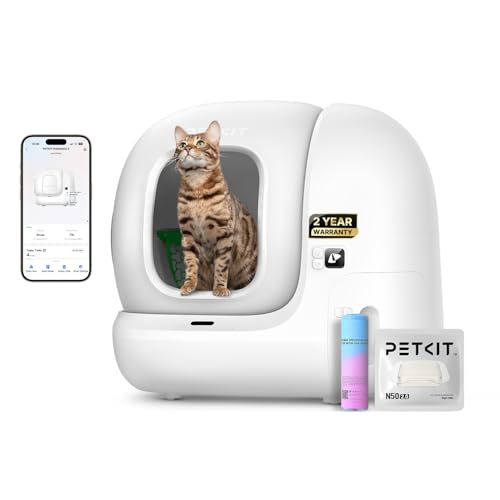

As an Amazon Associate we earn from qualifying purchases at no extra cost to you. Ratings are shown as listed on Amazon.
Quick comparison of the leading choices
| Model | Usable entry and litter area | Waste-bin capacity | Cleaning and odor control | App and safety features | Typical market range |
|---|---|---|---|---|---|
| Whisker Litter-Robot 4 | About 15.5 × 15.5 in entry; 8 lb minimum cat weight for reliable automatic cycling | About 9 L drawer | Automatic sifting; sealed drawer, carbon filter, and odor-trapping design | Wi-Fi app, weight monitoring, cycle control, drawer and bonnet sensors | About $700–$900 |
| Neakasa M1 | Open-top design; opening is approximately 15.7 × 15.7 in, with a low front entry | About 11.2 L drawer | Automatic sifting; enclosed waste drawer and deodorizing filter system | App connectivity, cat-weight tracking, infrared and anti-pinch protection | About $500–$700 |
| PetSafe ScoopFree SmartSpin | Approximately 8.5 in entry height; best suited to cats comfortable with a more enclosed unit | About 6 L waste drawer | Rotating rake-free sifting, covered drawer, replaceable odor filter | App monitoring, cycle scheduling, weight and drawer sensors | About $450–$650 |
| Casa Leo Leo’s Loo Too | About 9.5 × 8 in doorway; roomy internal globe | About 9 L drawer | Automatic sifting, sealed drawer, carbon-filter odor control | App controls, anti-pinch, cat-presence and jam detection | About $600–$800 |
Dimensions and capacities can vary slightly by revision and measuring method. Treat the table as a buying guide rather than a substitute for the current manufacturer specification. More importantly, compare the actual doorway and the cat’s shoulder and body width—not just the outside dimensions of the machine.
Best picks by situation
Best overall: Whisker Litter-Robot 4
The Litter-Robot 4 is the strongest general-purpose choice for households willing to pay for a mature ecosystem, detailed app data, and a large waste drawer. Its rotating globe separates clumps after a delay, while the sealed drawer and carbon filter help contain odor. The app can report cycle activity, drawer status, and cat weight, which is useful for noticing changes in routine.
Its enclosed entrance will suit many average-sized cats, but it is not automatically the best fit for a very large, nervous, or mobility-limited cat. The minimum weight requirement also matters: kittens or unusually small cats may need manual cycling until they are heavy enough for dependable detection. Allow roughly 30 × 27 in of floor space before adding a step or ramp.
Best for hesitant cats: Neakasa M1
The Neakasa M1 uses an open-top layout that feels less like a tunnel. That makes it a sensible choice for cats that refuse covered boxes or want a clear view while eliminating. Its low front entry is also easier to approach than a tall doorway, although the machine still needs a stable, level surface and enough clearance for the waste drawer.
The trade-off is that an open design can allow more litter tracking and may provide less visual odor containment than a fully enclosed globe. Use a large litter mat, keep the unit away from food, and check that the cat cannot reach moving parts from the opening. The M1’s larger waste drawer is helpful for multi-cat homes, but capacity still depends on how much each cat urinates and how aggressively the unit cycles.
Best compact conventional option: PetSafe ScoopFree SmartSpin
The SmartSpin is appealing when you want app control and automatic sifting without the footprint or price of the largest premium units. Its design is relatively familiar to cats that already use a standard covered litter box, and the rotating cleaning action avoids a traditional rake dragging through clumps.
Its waste drawer is smaller than those of the Litter-Robot 4 and Neakasa M1. A single cat may get several days between emptying, while two or more cats can fill it much sooner. Measure the approach area as well as the machine: a box that fits against a wall may still be awkward if the cat cannot turn comfortably before entering.
Best safety-focused alternative: Casa Leo Leo’s Loo Too
Leo’s Loo Too combines a large globe with app controls and multiple protections intended to stop movement when a cat is detected. It can be a good middle ground for owners who want an enclosed design but prefer a different shape and control system from Whisker.
Like any rotating box, it requires careful assembly and a level floor. A jammed mechanism, overloaded litter bed, or waste bag installed incorrectly can prevent a cycle. Its doorway is less generous than the open-top Neakasa M1, so compare the opening with your cat’s chest width and preferred posture.
How the important features affect daily use
Entry size is more important than external size
Measure your cat standing and turning: body length, shoulder width, and the height at which the cat naturally steps over a box rim. A generous internal chamber does not compensate for a narrow doorway. For a large cat, an open-top design is often easier than a small circular entrance. For a senior cat or one with limited mobility, prioritize a low step-in height and place the unit where the approach is unobstructed.
Waste capacity is a frequency calculation
Suppose a cat produces approximately 0.35 L of combined clumped waste and used litter per day. A 9 L drawer has a theoretical capacity of about 25 days:
9 L ÷ 0.35 L per day = 25.7 days.
That is not a realistic emptying interval. Bags occupy space, clumps are irregular, and odor becomes a concern before the drawer is physically full. A practical operating target is about one to two weeks for one cat and several days to one week for two cats, depending on litter type and cycle settings. Empty the drawer sooner if the app reports a full bin or odor increases.
Cleaning cycles balance freshness and litter use
A short post-use delay removes waste quickly but may capture a clump before it has hardened, causing smearing and extra litter consumption. A longer delay gives clumps time to set but leaves waste in the box longer. Start with the manufacturer’s default delay, then adjust only after observing the litter. If clumps break apart, increase the delay, use the recommended clumping litter, and confirm that the litter depth is within the marked range.
Safety sensors are essential, not decorative
Look for cat-presence or weight sensors, motor overload detection, anti-pinch protection, jam detection, and a cycle lockout while the cat is inside. These features reduce risk, but they do not make supervision unnecessary. Keep cords inaccessible, do not allow children to climb on the machine, and never bypass a sensor because a cycle is inconveniently delayed. After moving the box, recalibrate it if the instructions require this; an uneven floor can produce unreliable weight readings.
Setup and ownership checklist
- Place the box on a hard, level floor, not a thick rug. Weight-based detection can be inaccurate on soft or uneven surfaces.
- Run the unit beside the old litter box for several days. Mix in a small amount of familiar, unscented litter if the manufacturer permits it.
- Keep the automatic cycle disabled at first if your cat is cautious. Let the cat investigate the stationary box before enabling movement.
- Fill only to the recommended line. Too much litter increases motor load; too little lets waste adhere to the liner or globe.
- Empty the drawer before it is packed tight. Compressed waste can obstruct the chute and make odor control worse.
- Wipe the entry, sensors, and exposed surfaces weekly. Deep-clean the globe or drum on the schedule in the manual, using mild, pet-safe products and fully dry parts before reassembly.
The parts most likely to need attention are waste bags or liners, carbon filters, rubber seals, drawer gaskets, and moving-drive components. Litter dust can coat sensors, while urine outside the intended waste path can damage electronics or create persistent odor. Avoid harsh fragrances and do not pour water over the motor housing. Keep a conventional litter box available during maintenance, power failures, or an illness-related change in bathroom habits.
Bottom line
Choose the Litter-Robot 4 if you want the most polished all-round experience and can afford its premium price. Choose the Neakasa M1 when entry anxiety, a low approach, or a large cat makes an open-top design more important than maximum odor containment. Choose the PetSafe ScoopFree SmartSpin for a smaller, less expensive connected option, and consider Leo’s Loo Too when enclosed design and layered safety detection are your priorities.
Whichever model you select, confirm the entry dimensions, minimum cat weight, replacement-liner availability, and clearance for drawer removal before buying. Those ownership details determine whether an automatic litter box actually makes care easier.


Write Your Review
No reviews yet. Be the first to share your experience!