

Key takeaways
- Prefer several passive vents over one tiny decorative opening.
- Keep vents away from the cat’s direct exit path if you want odor to disperse gradually rather than blow toward a seating area.
- Use an activated-carbon filter only if it is replaceable. Plan on replacing it roughly every one to three months, depending on odor and use.
- Avoid heavily fragranced inserts. Strong fragrance can make the enclosure unpleasant for cats and people.
- Do not block ventilation with storage baskets, towels, or litter bags.
The best litter box enclosures are the ones that fit your cat’s actual litter box with room to turn, provide ventilation without leaking odor into the room, and open wide enough for daily scooping—not simply the prettiest cabinets.
For most homes, a ventilated cabinet-style enclosure with at least 24 inches of usable interior width, 18 inches of depth, and 18 inches of height is the most versatile choice. Choose a larger 30-inch-plus model for high-sided, automatic, or multi-cat boxes; choose a simple top-entry enclosure when litter tracking is the main problem; and choose an open-sided furniture enclosure when easy cleaning matters more than concealment.
Our top picks


As an Amazon Associate we earn from qualifying purchases at no extra cost to you. Ratings are shown as listed on Amazon.
Best litter box enclosures by situation
| Situation | Best enclosure type | Minimum useful interior | What matters most | Main compromise |
|---|---|---|---|---|
| Small apartment or tight hallway | Compact side-entry cabinet | 24 W × 18 D × 18 H in | Door clearance and ventilation | Less room for a large litter pan |
| Heavy litter tracking | Top-entry or maze-entry enclosure | 26 W × 20 D × 20 H in | Covered exit path and textured mat area | Some cats dislike climbing or bending |
| Large cat or high-sided pan | Wide furniture enclosure | 30 W × 22 D × 22 H in | Interior turning space and door width | Uses more floor space |
| Automatic litter box | Extra-deep cabinet or open console | 34 W × 28 D × 28 H in | Machine clearance, power access, service access | Usually expensive and harder to move |
| Multiple cats | Large enclosure or two separate stations | 30 W × 24 D × 22 H in | Unobstructed entry and cleaning access | One concealed box is not a substitute for enough toilets |
What to measure before buying
Measure the litter box itself, not just the space where you hope to place the enclosure. Add at least 3 inches of side clearance, 4 to 6 inches of clearance above the highest rim, and enough space in front for your cat to enter without rubbing against a door. A cat should be able to turn around inside without pressing its body against the walls.
For example, a pan measuring 23 inches wide by 17 inches deep by 9 inches high should generally go into an enclosure with at least 26 inches of internal width, 21 inches of internal depth, and 15 inches of internal height. If the entrance is only 8 inches wide, the overall cabinet dimensions are irrelevant: the usable access point is too restrictive for some large cats.
Check whether published dimensions are external or internal. Thick panels, shelves, hinges, and a raised base can reduce the available space by several inches. For automatic boxes, also account for the power cable, waste drawer removal, rotating components, and the manufacturer’s required clearance.
Head-to-head: the main enclosure designs
Furniture-style cabinets
These look like side tables, benches, or consoles and are the best choice when the litter area is in a living room. Look for a full-width front door or removable side panel. A narrow cleaning hatch may be enough for scooping but frustrating when changing litter or washing the pan.
Cabinet construction varies widely. Laminated engineered wood is affordable and attractive, but swollen edges and damaged laminate are common if wet litter remains on the floor. Plastic or coated composite panels are easier to wipe down. Solid wood can last well, although unfinished interiors absorb odor and moisture.
Top-entry enclosures
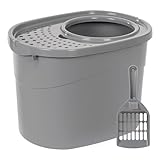
Top-entry designs can reduce litter tracking because the cat steps onto a lid or textured landing surface before jumping down. They work particularly well with cats that are comfortable climbing and with low-profile litter pans.
The limitation is access. Older, overweight, arthritic, or hesitant cats may find a top opening inconvenient. A top entry also makes it harder to lift out a tall litter box. Treat this as a tracking solution, not an automatic improvement for every cat.
Maze-entry and double-door designs
These use an offset entrance, partition, or short corridor to keep loose litter inside. They provide better containment than a straight-through doorway, especially when the exit includes a textured mat or raised threshold.
The extra turns reduce the space available for the pan and can trap clumps in corners. Choose a model with removable partitions or a generous front opening if you want practical cleaning rather than maximum concealment.
Open consoles and bench enclosures
An open console hides the litter box from some viewing angles while preserving excellent ventilation and access. It is often the safest option for a large box, a nervous cat, or a household that cleans frequently. The trade-off is weaker odor containment and less protection from tracking.
Ventilation and odor control: what actually helps
An enclosure should not be airtight. Vents near the upper rear or side panels allow humid air to escape and reduce the stagnant smell that develops when a damp litter box is sealed in a small compartment. Vents alone cannot compensate for infrequent scooping, an overfilled pan, or a box that has absorbed urine underneath.
- Prefer several passive vents over one tiny decorative opening.
- Keep vents away from the cat’s direct exit path if you want odor to disperse gradually rather than blow toward a seating area.
- Use an activated-carbon filter only if it is replaceable. Plan on replacing it roughly every one to three months, depending on odor and use.
- Avoid heavily fragranced inserts. Strong fragrance can make the enclosure unpleasant for cats and people.
- Do not block ventilation with storage baskets, towels, or litter bags.
A powered fan can improve air exchange, but it adds noise, a cable, and another part to clean. For most standard litter pans, passive ventilation plus consistent scooping is simpler and more reliable.
Access doors and cleaning access
Inspect the door design before focusing on appearance. A side-hinged door usually gives better access than a small front flap. Magnetic catches are convenient, but weak magnets may let a cat push the door open or allow odors to escape. Hinges and particleboard edges are often the first parts to show wear.
For routine care, you should be able to remove clumps without moving the entire enclosure. For a full litter change, the pan should come out through the largest opening—not through a gap that forces you to tilt and spill it. A removable top is helpful for oversized boxes, but only if it can be lifted safely in the available room.
Place a waterproof, washable mat beneath the enclosure even when the cabinet has a sealed floor. This protects the floor from urine misses, spilled litter, and condensation during cleaning.
Decision matrix: which features deserve priority?
| Your priority | Choose | Do not compromise on |
|---|---|---|
| Lowest upfront cost | Basic plastic or open-sided enclosure | Washable surfaces and a sufficiently wide entrance |
| Best appearance in a shared room | Furniture-style cabinet | Full cleaning door and internal ventilation |
| Least tracking | Top-entry or maze-entry design | Comfortable entry and a removable litter-catching surface |
| Fast daily maintenance | Open console or wide-front cabinet | Unobstructed pan removal |
| Large or automatic box | Oversized cabinet or purpose-built console | Internal dimensions, service clearance, and cable routing |
Ownership realities: what wears first
Door hinges, laminate edges, filter media, floor panels, and textured tracking surfaces usually need attention before the main frame. Fine litter can accumulate in hinges and sliding tracks, so vacuum those areas during weekly cleaning. Wipe plastic or coated panels with mild soap and water, then dry them fully. Avoid soaking engineered wood or using ammonia-based cleaners around the litter area.
Do not permanently seal the enclosure against the floor. A small gap or removable base makes it possible to inspect for leaks. If urine repeatedly reaches the cabinet, use a waterproof tray inside it rather than relying on the furniture finish.
Budget approximately 10 to 20 minutes for a full enclosure clean, excluding drying time. Remove the pan, vacuum loose litter, wipe the interior, wash the mat, and inspect corners before replacing fresh litter. A design that saves five minutes of visual tidying but adds twenty minutes to every deep clean is poor value over time.
How to set up an enclosure without creating problems
- Assemble it in the final location. Confirm that doors and panels can open without hitting walls or furniture.
- Leave the entrance unobstructed. Do not place a storage bin or litter-catching tray where it narrows the doorway.
- Introduce the enclosure gradually. Start with the familiar litter box outside or with the door removed, then add the cabinet once your cat uses the location confidently.
- Keep the same litter and box at first. Changing the box, litter, and location simultaneously makes it harder to identify what your cat dislikes.
- Check the box twice daily. Concealment can make missed odors less obvious to people, but it does not reduce the need for routine cleaning.
Typical price ranges
Simple plastic or open-frame enclosures commonly fall around $40–$100. Furniture-style cabinets are often about $80–$200, while larger, reinforced units for automatic boxes or multiple cats may cost $180–$400 or more. The higher price is worthwhile when it buys thicker water-resistant panels, removable partitions, stronger hardware, and genuinely useful interior space. It is less worthwhile when the extra cost is mainly decorative trim around a small, poorly ventilated compartment.
Bottom line
For the best balance, choose a ventilated furniture-style enclosure with at least 26 inches of internal width, a wide cleaning door, a sealed or removable floor, and enough front clearance for your cat to enter comfortably. Prioritize the largest practical interior over a compact exterior, and treat litter tracking as a matter of exit-path design and mat placement—not a reason to accept a cramped box. The right enclosure hides visual clutter while preserving the space, airflow, and access that make a litter station workable for both cat and owner.


Write Your Review
No reviews yet. Be the first to share your experience!