

Key takeaways
- Probe-tip limit: the maximum temperature at the metal sensor.
- Cable limit: the temperature the lead can tolerate continuously or briefly.
- Ambient or transmitter limit: especially important for wireless probes, whose electronics may be exposed inside the oven.
Best Leave-In Oven Thermometers for Roasting
The best leave-in oven thermometer for most home roasts is a wired dual-probe alarm thermometer with a heat-resistant probe, a readable display, and a cable rated for the temperature of your oven; choose a wireless probe instead when you need to close the oven door without routing a cable outside.
A leave-in thermometer is different from an instant-read thermometer. It stays in the meat during cooking and alerts you when the center reaches a target temperature. The important comparison is not just the advertised probe temperature: the cable, connector, display, and wireless transmitter may have lower limits.
Our top picks
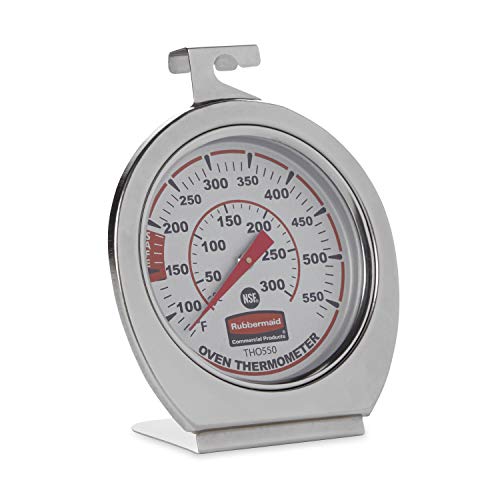

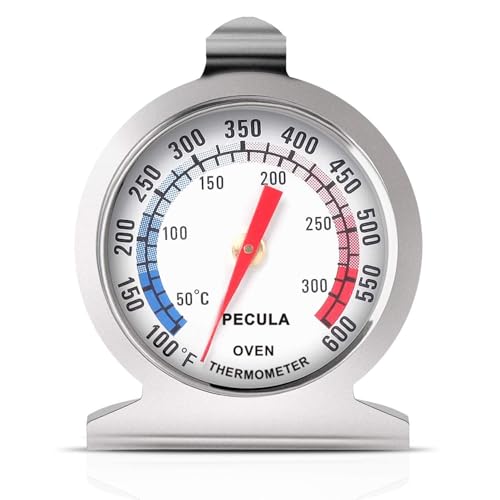

As an Amazon Associate we earn from qualifying purchases at no extra cost to you. Ratings are shown as listed on Amazon.
Quick picks by roasting situation
| Roasting situation | Best thermometer type | What to prioritize | Typical market range |
|---|---|---|---|
| Occasional chicken, beef, or pork in a standard oven | Single-probe wired alarm thermometer | Simple controls, large display, probe and cable rated to at least 500°F | $20–$40 |
| Frequent roasts or simultaneous meat and oven monitoring | Two-probe wired thermometer | Independent alarms, detachable probes, timer, backlight | $35–$70 |
| Rotisserie, Dutch oven, or awkward oven access | Wireless probe system | High ambient-temperature rating, signal range, charging case | $70–$150+ |
| Very high-heat roasting or grill-to-oven cooking | High-temperature probe with separate cable protection | Probe and cable ratings considered separately; metal braid or reinforced cable | $40–$100 |
Probe and cable heat limits: the specification that matters most
A thermometer can advertise a probe limit of 700°F while its cable must remain away from direct broiler heat. The stainless-steel probe may tolerate temperatures that the cable insulation, connector, or display cannot. Before buying, look for three separate ratings:
- Probe-tip limit: the maximum temperature at the metal sensor.
- Cable limit: the temperature the lead can tolerate continuously or briefly.
- Ambient or transmitter limit: especially important for wireless probes, whose electronics may be exposed inside the oven.
For ordinary roasting at 325–450°F, a wired probe rated around 500–700°F is usually suitable if the cable exits through the door seal and stays away from heating elements. For broiling, pizza-style temperatures, or a grill, use a model specifically rated for those conditions. Never let a cable touch a glowing element, oven wall, pan edge, or open flame simply because the probe itself has a high rating.
Best wired choice for frequent roasting: ThermoWorks ChefAlarm
The ThermoWorks ChefAlarm is a strong choice when you want a dedicated leave-in alarm thermometer rather than an app-dependent system. It supports a cooking probe and an oven or air probe, allowing you to monitor both the food and the surrounding cooking temperature. Its display separates the current temperature from the high and low alarm settings, which is useful when a roast needs a target range rather than one exact number.
Its practical advantages are a loud adjustable alarm, a countdown timer, a backlit display, and a detachable probe connection. The key ownership detail is that the probe and cable are replaceable consumable parts. A typical ChefAlarm probe is rated to approximately 700°F, but the cable still needs sensible routing and protection from direct heat.
Choose it if you roast several times a month, want physical controls, or need two temperature channels. It is less appealing if you only cook one small roast per year or strongly prefer phone notifications.
Best budget format: a basic single-probe wired alarm thermometer
A basic single-probe unit is the sensible low-cost choice for a turkey breast, pot roast, whole chicken, or pork loin. These thermometers commonly provide a stainless-steel probe, roughly 36–48 inches of cable, a magnetic or tabletop display, and high/low temperature alarms. Models in this category often cost about $20–$40.
The limitation is not necessarily accuracy; it is flexibility. A single probe cannot monitor both food and oven air, and cheaper displays may have smaller digits, weaker magnets, or less intuitive alarm controls. Check that the probe is long enough to reach the center of the food without the cable crossing a hot rack edge.
For a first purchase, look for a probe rated to at least 500°F, a cable rated for the same intended oven environment, a backlight, and a mute button that does not permanently disable the alarm.
Best for a cable-free oven: wireless probe systems
Wireless systems such as MEATER and Combustion Inc. products eliminate the cable passing through the oven door. That is convenient for rotisserie cooking, sealed Dutch ovens, and ovens with tight or delicate door seals. They also reduce the chance of a cable catching on a rack when you remove the pan.
The trade-off is heat management. A wireless probe contains electronics inside the food and usually has a separate ambient-temperature limit around its exposed end. The maximum internal-food temperature and maximum ambient oven temperature are not the same. Read the exact model’s limits before using it under a broiler or at grill temperatures.
Wireless systems are also more dependent on battery charge, Bluetooth or Wi-Fi range, and a clean charging contact. They can be excellent for frequent cooks who want alerts on a phone, but they are unnecessary complexity for a conventional roast in a nearby oven.
Display readability and alarm behavior
A leave-in thermometer is only useful if you can read and hear it at the moment you need it. Compare these features rather than assuming every digital display is equivalent:
- Digit height: digits around 0.5 inch or larger are easier to read across a kitchen.
- Backlight: valuable when the display sits beside a dark oven or in a dim kitchen.
- Separate channels: food and oven temperatures should be clearly labeled, not shown in a confusing rotating sequence.
- Alarm volume: a soft beep can be missed through a closed kitchen door or range hood.
- Pre-alarm: useful when carryover cooking will raise the meat temperature after removal.
- Temperature range alarms: helpful for slow roasting, where both an upper and lower limit matter.
For a large turkey or roast, a high alarm alone may be enough. For bread, low-temperature smoking, or long braises, high/low alarms are more useful because they warn you if the oven or food temperature falls outside the intended range.
Worked setup: choosing a probe for a 425°F oven
Suppose your oven runs at 425°F and the thermometer manufacturer permits a 75°F safety margin between normal oven temperature and the cable’s continuous rating. The minimum suitable cable rating is:
425°F + 75°F = 500°F.
A probe and cable rated to 500°F or higher is therefore a reasonable fit for that setup, provided the cable is not touching a heating element. If you plan to finish under a broiler at substantially higher heat, this calculation no longer makes the setup safe; use a thermometer and cable specifically approved for broiling, or remove the wired probe before switching modes.
Installation steps that prevent false readings
- Insert the probe into the thickest part. Aim for the center of the meat, avoiding bone, a cavity, or a large pocket of fat.
- Leave enough probe inside the food. The sensing area is usually near the tip, but the probe should not be barely inserted or it may measure the pan or surrounding air.
- Route the cable out through the hinge side. This commonly gives the cable a gentler path, but confirm that the door closes without pinching it.
- Keep the connector outside the oven. The connector and display are often less heat-resistant than the probe.
- Set the alarm below the final target. Dense roasts continue cooking after removal, so a 5–10°F early warning can be useful, depending on the food and cooking method.
- Verify with an instant-read thermometer. Check a second spot before serving, especially when the probe was near bone or the roast is irregularly shaped.
Durability, cleaning, and common ownership problems
The first parts to wear are usually the cable near the probe, the connector, battery contacts, and silicone buttons—not the stainless-steel sensing tip. Repeatedly bending the cable sharply at the probe can create intermittent readings. Coil it loosely for storage, and replace a probe if the display jumps, loses connection, or reads implausibly high or low.
Wash the probe by hand with warm soapy water and dry it before storage. Do not immerse the cable connection or the display unless the manufacturer specifically permits it. Avoid dishwasher cleaning unless the complete probe assembly is labeled dishwasher-safe. Grease inside the connector can cause dropouts, so wipe it rather than flooding it.
Common mistakes include putting a wireless probe in a self-cleaning cycle, exposing a wired cable to a broiler element, using an oven-air probe as a food probe, and assuming a displayed temperature is accurate simply because the number looks stable. A quick ice-water check near 32°F and a boiling-water check near 212°F can reveal a major calibration problem, although boiling-point readings vary with altitude.
Bottom line
Choose a wired dual-probe alarm thermometer for the best balance of price, readability, and dependable oven roasting. Choose a basic single-probe model for occasional cooking and a wireless system for rotisserie, sealed cookware, or situations where a cable is impractical. In every case, compare the probe, cable, and ambient-temperature limits separately; that distinction is more important than an extra timer feature or a longer advertised wireless range.

Write Your Review
No reviews yet. Be the first to share your experience!