

Key takeaways
- For most households, the best dog bark collars are adjustable tone-and-vibration models with dual bark detection, a comfortable size range, a safety pause, and at least IPX7 waterproofing for outdoor use. Choose automatic operation only when you can supervise and address the barking trigger separately.…
The best dog bark collars are vibration-and-tone models with reliable bark detection, a comfortable fit, and waterproof construction; static correction should be treated as an optional last-resort setting rather than the default training method.
Our top picks

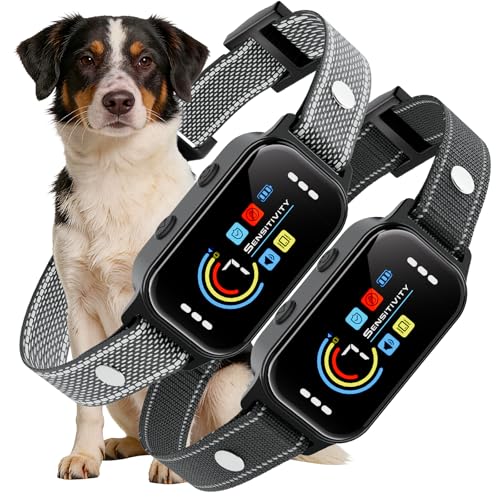


As an Amazon Associate we earn from qualifying purchases at no extra cost to you. Ratings are shown as listed on Amazon.
Quick picks by situation
| Situation | Best choice | Why it fits | Typical budget |
|---|---|---|---|
| First-time owner or sensitive dog | Vibration-and-tone collar | Gives you two lower-intensity cues without static correction | $30–$80 |
| Frequent barking in a yard | Waterproof automatic collar with adjustable sensitivity | Handles rain and repeated sessions while reducing false triggers | $45–$120 |
| Two or more dogs nearby | Collar with advanced bark discrimination | Better chance of responding to the wearer’s bark rather than another dog’s | $60–$150 |
| Owner-led training indoors | Remote-controlled tone and vibration collar | Lets you reward quiet behavior and cue the dog at the right moment | $50–$180 |
| Very persistent barking after training support | Professionally guided multi-mode collar | Offers graduated settings, but needs careful supervision and fit checks | $90–$250 |
What makes the best dog bark collars different?
A bark collar is only useful if it can distinguish barking from normal movement, tags jingling, whining, scratching, or another dog barking nearby. The most practical designs combine a microphone with vibration sensing or pattern analysis. Look for adjustable sensitivity rather than a single fixed threshold. Excessive sensitivity can produce false corrections; insufficient sensitivity may miss quiet or intermittent barking.
Automatic collars generally use a progression such as tone, vibration, and then a stronger setting if barking continues. A good model should allow you to disable any setting you do not intend to use. Some products reset after a short quiet period, while others pause after a maximum number of activations. That automatic safety pause matters when a dog becomes excited or the collar is triggered repeatedly.
Vibration, tone, and static: a head-to-head comparison
| Setting | Useful for | Advantages | Limitations | Recommended use |
|---|---|---|---|---|
| Tone | Attention and quiet cues | Non-contact, easy to pair with treats or praise | Some dogs ignore it; sound may be masked outdoors | Start here during calm, owner-led training |
| Vibration | Getting attention without a loud sound | Works in noisy areas and is usually more noticeable than tone | May startle sensitive dogs; intensity varies widely | Use the lowest effective level and observe body language |
| Static | Limited cases where other cues have failed | Can be adjusted in small increments on some models | Can cause fear, stress, confusion, or poor associations if misused | Do not use as a first step; seek qualified training guidance |
Tone and vibration do not automatically make training humane or effective: timing, fit, and reinforcement still matter. Static settings are particularly easy to misuse if the owner increases intensity because barking continues for an unrelated reason. Avoid using any bark collar on a dog that is ill, injured, highly fearful, or showing sudden unexplained vocalization without first discussing the behavior with a veterinarian or qualified behavior professional.
Features worth paying for
Accurate bark detection
Prioritize adjustable sensitivity, a dual-sensor system, and a short activation delay. A delay of roughly 0.5–2 seconds can help avoid triggering on a single cough or collar rattle, while still responding to sustained barking. If the collar reacts to every sound in a multi-dog household, it is not a good match regardless of its other features.
Fit and contact design
The collar should be snug enough that the sensors maintain consistent contact but loose enough to fit two adult fingers beneath the strap. Measure the dog’s neck rather than choosing by breed label. A typical small-dog collar may cover about 6–18 inches, while medium and large models commonly cover approximately 12–27 inches. Check the manufacturer’s minimum weight recommendation and avoid placing a heavy receiver on a small dog.
Rotate the collar’s position slightly every few hours of wear, inspect the skin, and remove the collar when the dog is sleeping unless the instructions specifically say otherwise. Continuous pressure and trapped moisture can cause irritation. Never compensate for poor contact by increasing intensity.
Waterproofing
For outdoor use, look for a clearly stated waterproof rating rather than “water resistant.” IPX7 generally indicates temporary immersion protection, while IP67 combines dust protection with temporary immersion protection. These ratings do not necessarily mean the collar is suitable for saltwater, shampoo, or underwater swimming. Rinse off mud and salt with fresh water, dry the contact area, and follow the manufacturer’s charging-port instructions.
Battery and controls
For occasional training, a rechargeable battery rated for 10–20 days of standby may be sufficient. Frequent outdoor use is easier with a device offering at least 8–12 hours of active operation and a battery indicator. Physical buttons are preferable to a phone-dependent interface when you need to change settings quickly. A lockout feature can prevent accidental changes in a pocket or during play.
Automatic versus remote-controlled collars
An automatic bark collar is convenient for short, supervised periods in a yard, but it cannot determine why the dog is barking or reward quiet behavior. A remote-controlled model takes more effort but gives the owner better timing: cue quiet, wait for a pause, then provide praise, a treat, or access to a preferred activity. For dogs barking at windows, visitors, or passing animals, that owner-led approach is usually more informative than leaving the collar to make every decision.
Do not leave an automatic collar on simply because barking is inconvenient. Identify triggers first. Territorial barking may need visual barriers and distance from the window; boredom barking may need exercise and enrichment; separation-related vocalization may require a behavior plan rather than an aversive device.
How to set up a bark collar safely
- Charge the unit and read the safety limits, minimum weight, and waterproof instructions.
- Fit it with two fingers of space under the strap, positioning the sensors against the side of the neck where they can detect vocalization.
- Begin with tone only. Pair the cue with a reward when the dog pauses barking.
- If tone is ineffective, introduce the lowest vibration level during a calm, supervised session.
- Use short sessions of about 5–10 minutes, then remove the collar and check the skin.
- Record triggers, activation frequency, and the dog’s body language. Stop if you see cowering, freezing, frantic scratching, tucked posture, or avoidance.
A useful training calculation is simple: if the dog barks 30 times in 10 minutes and the collar activates on 20 of those events, the problem may be detection accuracy rather than insufficient intensity. First lower sensitivity, change the fit, or move away from other barking dogs. Increasing the setting does not solve false activation.
Durability and ownership costs
The strap and contact covers usually wear before the receiver. Sweat, dirt, and repeated bending can weaken the strap within one to three years, depending on use. Silicone contact covers may need replacement sooner if they crack or become permanently dirty. Rechargeable batteries gradually lose capacity; a collar that once lasted 14 days may eventually need charging every few days.
Budget for replacement straps, contact covers, charging cables, and—on some designs—a separate remote battery. Clean the receiver with a slightly damp cloth, never submerge it unless its rating permits immersion, and keep charging contacts dry. Store the collar powered off when it will not be used for several weeks.
Bottom line
For most households, the best dog bark collars are adjustable tone-and-vibration models with dual bark detection, a comfortable size range, a safety pause, and at least IPX7 waterproofing for outdoor use. Choose automatic operation only when you can supervise and address the barking trigger separately. Treat static correction as optional, not essential, and select a qualified trainer or veterinarian when barking is sudden, fear-related, compulsive, or accompanied by other behavior changes.





Write Your Review
No reviews yet. Be the first to share your experience!