

Key takeaways
- PVC: light, affordable, quiet, and easy to replace. It is the best choice for temporary layouts and handlers who move equipment frequently. UV exposure, cold-weather brittleness, loose connectors, and wind are its main weaknesses.
- Steel: heavier, more stable, and better suited to repeated setup. It usually costs more to transport and store, and any damaged coating can become a rust point.
- Mixed construction: steel bases with PVC bars often provide the most practical compromise. The frame stays stable while the bar remains light and breakaway.
The best dog agility sets are the ones that match your available yard space, your dog’s experience, and how permanently you intend to leave the equipment outdoors: a portable PVC starter kit suits occasional training, while a steel-framed set is the better long-term choice for frequent sessions and larger dogs.
Our top picks



As an Amazon Associate we earn from qualifying purchases at no extra cost to you. Ratings are shown as listed on Amazon.
Best dog agility sets by training situation
| Best for | Recommended set type | Typical obstacles | Minimum practical yard area | Useful jump range | Typical market range |
|---|---|---|---|---|---|
| First-time handler or puppy foundation work | Compact PVC starter kit | 2–4 jumps, weave poles, tunnel | 400–600 sq. ft. | 2–12 in. | $45–$100 |
| Small yard and casual weekly practice | Adjustable PVC kit with carrying bag | 4–6 jumps, 6 weave poles, tunnel, pause box | 600–900 sq. ft. | 4–20 in. | $80–$170 |
| Regular training with a medium or large dog | Reinforced PVC or mixed PVC-and-steel set | 6 jumps, 6–12 weave poles, tunnel, tire, pause table | 900–1,500 sq. ft. | 6–26 in. | $150–$350 |
| Frequent outdoor use and multiple dogs | Steel-frame modular equipment | 6–10 jumps, weave poles, tunnel, tire, pause table, contact obstacle | 1,500–2,500 sq. ft. | 8–30 in. | $300–$800+ |
These are planning ranges rather than universal product specifications. A kit’s advertised footprint usually measures the equipment itself, not the running lanes, turning space, or safety buffer your dog needs.
Our top picks by use case
Best overall: an adjustable PVC set with six weave poles
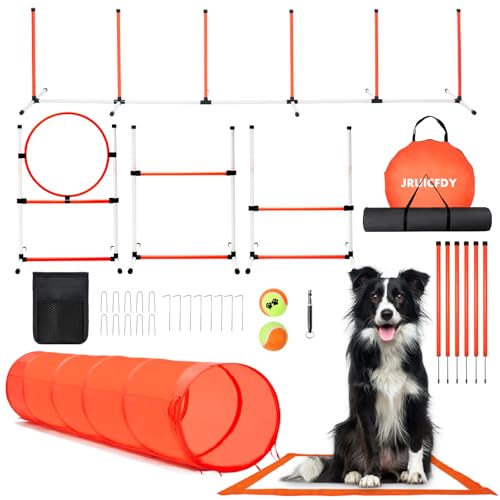
For most backyard handlers, the strongest balance is a medium PVC kit containing four to six adjustable jumps, six weave poles, a collapsible tunnel, and a pause target or square. It offers enough variety to teach sequencing without consuming an entire yard.
Look for jump bars that rest on removable cups rather than locking permanently into the uprights. A knocked bar should fall away instead of forcing a dog to twist or collide with the frame. A kit with height settings from roughly 4 to 20 inches can serve toy, small, and many medium dogs, although large dogs may outgrow it.
This type is best stored indoors after use. PVC is light, inexpensive, and easy to reposition, but thin tubing becomes brittle after prolonged ultraviolet exposure and can crack more readily in freezing weather.
Best budget choice: a compact PVC starter kit
A basic kit with two or three jumps, a short tunnel, and four to six weave poles is enough for foundation skills. It works particularly well when the available training area is under 600 square feet or the handler is not yet sure whether agility will become a regular hobby.
Use the jumps at low settings and focus on following a hand target, moving through poles, stopping on a mat, and changing direction. A small kit can teach useful handling skills without creating a crowded course.
The compromise is stability. Lightweight bases may slide on grass, and narrow poles can tip when a dog clips them. Sand-filled base sleeves or ground stakes can improve stability, but stakes should not be used where a running dog could land on exposed metal.
Best for frequent outdoor use: a steel-frame modular set
Steel uprights and base frames are preferable when the equipment will be assembled several times a week, shared by multiple dogs, or left in a sheltered outdoor training area. Steel handles repeated assembly better than thin PVC and is less likely to flex during fast approaches.
Choose powder-coated or galvanized steel, inspect welds and fasteners, and confirm that the jump bars are still lightweight and breakaway. A heavy steel bar is not an upgrade: it can increase injury risk if a dog hits it.
Steel equipment costs more and is less convenient to carry. It can also rust where the coating is scratched, particularly around bolt holes and ground-contact points. “Outdoor-ready” should mean corrosion-resistant construction, not permission to leave every component outside year-round.
Best for a narrow yard: a linear obstacle kit
If the yard is long but narrow, prioritize equipment that can be arranged in a straight or gently angled line: three or four jumps, a tunnel, and six weave poles. Avoid buying a large contact-obstacle package unless you have room for safe approaches and exits.
A narrow 10-by-50-foot area provides 500 square feet, but it does not behave like a 22-by-23-foot square. The dog has fewer options for turning, so place obstacles with generous run-outs and avoid sending the dog directly toward a fence, shed, or patio edge.
How much yard space does each obstacle need?
| Obstacle | Equipment footprint | Recommended working allowance | What changes the space requirement |
|---|---|---|---|
| Single jump | About 3–4 ft wide | At least 10 ft of approach and 10 ft of exit | Dog speed, surface traction, and jump height |
| Weave poles | About 6–12 ft long | 6 ft of clear space on each side | Pole spacing and whether the dog enters at an angle |
| Collapsible tunnel | 6–15 ft long | 3–5 ft around each opening | Curvature, tunnel length, and exit direction |
| Tire jump | 3–4 ft wide | 10 ft of approach and exit | Should be breakaway and carefully aligned |
| Pause box or table | 3–4 ft square | 8–10 ft of clear approach | Dog’s stopping speed and table height |
For a simple sequence of three jumps, a tunnel, and weave poles, a practical calculation is 3 jumps × 20 feet of combined approach and exit space, plus roughly 150 square feet for the tunnel and weave area. That produces about 210 square feet before turning room, side clearance, and obstacles between stations. In practice, plan on at least 600 square feet for comfortable beginner work.
PVC versus steel: which lasts longer outdoors?
- PVC: light, affordable, quiet, and easy to replace. It is the best choice for temporary layouts and handlers who move equipment frequently. UV exposure, cold-weather brittleness, loose connectors, and wind are its main weaknesses.
- Steel: heavier, more stable, and better suited to repeated setup. It usually costs more to transport and store, and any damaged coating can become a rust point.
- Mixed construction: steel bases with PVC bars often provide the most practical compromise. The frame stays stable while the bar remains light and breakaway.
For equipment left outside, cover tunnels and pause mats rather than only the metal frame. Fabric tunnels commonly collect moisture, dirt, and grass seeds at the folds. A dry storage bin or ventilated shed can extend the life of a kit more effectively than paying for thicker tubing.
Jump height and dog size
Jump height should be selected conservatively, especially while a dog is learning. Start with the bar on the ground or at the lowest setting, then increase gradually only when the dog can approach, jump, and land calmly. A portable set offering 2–12 inches is suitable for many early sessions; 4–20 inches covers more small and medium-dog training; 8–30 inches is generally aimed at larger dogs and more advanced work.
Do not choose a height solely from the kit’s maximum setting. Consider the dog’s shoulder height, age, conditioning, surface, confidence, and ability to turn safely. Puppies, senior dogs, and dogs returning after an injury need particularly cautious progression. A veterinarian or qualified canine professional can advise on individual limitations.
What wears out first?
- Tunnel fabric and stitching: inspect for fraying, torn loops, and dampness after every wet session.
- PVC connectors: repeated bending can loosen joints; replace cracked or sharply whitened tubing.
- Jump cups and clips: sunlight makes plastic brittle, and missing cups can turn a safe jump into a rigid obstacle.
- Steel fasteners: check for rust, stripped threads, and movement at welded joints.
- Ground anchors: confirm that bases have not shifted after rain, frost, or mowing.
Clean PVC and coated steel with mild soapy water, rinse, and dry fully. Do not use harsh solvents on plastic or fabric. Store bars flat rather than leaning them under tension, and keep tunnels loosely rolled instead of sharply folded.
Buying checklist
- Measure the usable training rectangle, not the total yard.
- Confirm the lowest and highest jump settings in inches.
- Prefer removable, lightweight, breakaway bars.
- Check whether weave poles are fixed, adjustable, or independently movable.
- Look for ballast or anchoring options if the set weighs under about 20 pounds.
- Choose corrosion-resistant steel for exposed frames.
- Budget for a storage container, replacement bars, and tunnel drying space.
For most homes, the best dog agility sets are not the biggest packages. A stable, adjustable kit that fits the yard with safe approach and exit lanes will provide more useful training than a full course compressed into too little space.



Write Your Review
No reviews yet. Be the first to share your experience!