

Key takeaways
- Use a sleeve or mat where the rope contacts the anchor.
- Keep the rope away from standing water, oil, solvents, and direct sunlight during storage.
- Shake out grit before coiling; trapped sand works like abrasive inside the braid.
- Clean with mild soap and water, then dry fully before storage.
- Coil loosely rather than tying tight knots that create permanent bends.
- Replace the rope if fibers are cut, the core is visible, the ends separate, or the anchor loop is distorted.
Best Battle Ropes for Home and Gym Workouts
The best battle ropes for most home users are a 30- to 40-foot rope with a 1.5-inch diameter, heat-shrunk end grips, and a padded anchor point that protects both the rope and the floor. Choose a 50-foot, 2-inch rope for a large training area and maximum resistance, or a 20- to 30-foot, 1-inch rope if space, budget, or conditioning experience is limited.
Quick comparison: which battle rope fits your workout space?
| Rope specification | Approximate weight | Space needed behind anchor | Best for | Main trade-off |
|---|---|---|---|---|
| 20 ft × 1 in | 4–7 lb | 10–12 ft | Beginners, apartments, short intervals | Less wave amplitude and lower resistance |
| 30 ft × 1.5 in | 10–15 lb | 15–18 ft | Most home gyms and general conditioning | Can feel light for powerful athletes |
| 40 ft × 1.5 in | 14–20 lb | 20–23 ft | Home garages, outdoor workouts, mixed users | Needs more storage and clear floor space |
| 50 ft × 2 in | 25–35 lb | 25–30 ft | Commercial gyms and advanced training | Expensive, heavy, and difficult to move |
These are practical market ranges rather than exact specifications: material, braid tightness, coating, and manufacturer tolerances change the final weight. The length refers to the complete rope. Once the rope is wrapped around an anchor, each working side is approximately half that length.
Our top picks

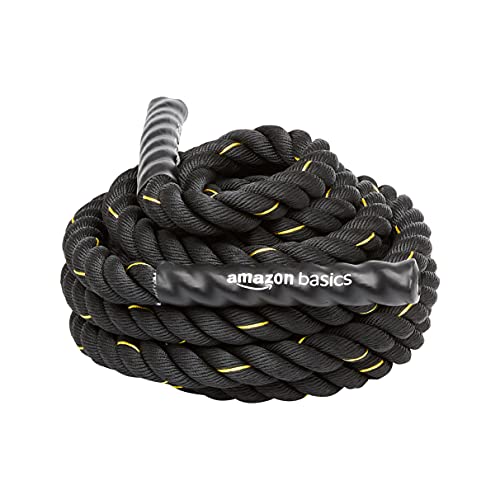


As an Amazon Associate we earn from qualifying purchases at no extra cost to you. Ratings are shown as listed on Amazon.
How to choose the right length
For a small room or apartment
A 20-foot rope is the most realistic option when the available distance from the anchor to the user is about 10 to 12 feet. A 30-foot rope can work in a narrow room, but it may force the user close to walls or furniture. Shorter ropes also create quicker, tighter waves, making them suitable for brief intervals and lighter equipment.
Measure the usable distance, not the room’s advertised dimensions. Leave at least 3 feet of clearance behind the user and enough side-to-side space to move both hands without hitting a wall, shelf, or exercise machine.
For a typical home gym
A 30-foot by 1.5-inch rope is the safest all-purpose choice. It offers meaningful resistance without requiring the long run of a commercial rope. A 40-foot model is preferable when you have roughly 20 feet of unobstructed working distance and want smoother, larger waves.
For a garage, studio, or gym floor
A 40- or 50-foot rope gives more rope mass and dampens the waves, so each repetition feels slower and more demanding. The 50-foot length is not automatically better: it is wasteful if the anchor is too close to the user, and dragging excess rope across a hard floor accelerates abrasion.
Diameter, weight, and training difficulty
Diameter changes resistance more than many first-time buyers expect. A 1-inch rope is easier to accelerate and usually better for beginners, high-repetition intervals, or users with smaller hands. A 1.5-inch rope is the middle ground for strength and conditioning. A 2-inch rope takes more grip force and upper-body effort, particularly when it is long enough to weigh 25 pounds or more.
Weight is affected by both length and diameter. For example, doubling a rope from 25 to 50 feet roughly doubles the rope mass if the diameter and construction stay the same. A heavy rope does not merely make the arms work harder; it also produces more pull at the anchor, so the attachment point must be stronger.
| Situation | Recommended specification | Why it fits |
|---|---|---|
| First battle rope | 20–30 ft × 1 in | Manageable grip, lower storage demands, easier technique practice |
| Regular home workouts | 30–40 ft × 1.5 in | Balanced resistance, useful wave length, broad exercise range |
| Advanced intervals or strong users | 40–50 ft × 2 in | Greater inertia and grip challenge |
| Shared gym equipment | 40–50 ft × 1.5–2 in | Durability and resistance for repeated users |
End grips: small feature, meaningful difference
Look for handles that are long enough to hold with both a neutral and overhand grip, commonly about 6 to 8 inches. Heat-shrunk plastic or rubber sleeves are preferable to loose tape because they resist unraveling and provide a more consistent grip when hands become sweaty.
Inspect how the handle meets the rope. A smooth, tightly sealed transition is less likely to catch fingers or expose the braid. Very soft foam can feel comfortable initially but may split, absorb sweat, or compress under frequent use. Hard plastic handles are easier to clean and tend to last longer, although they can feel less comfortable during long sessions.
Anchor requirements and floor protection
A battle rope needs a fixed anchor that can handle repeated pulling in multiple directions. Suitable options include a dedicated wall or floor anchor secured to structural material, a heavy sled or rack designed for rope work, or a substantial outdoor post. A lightweight door anchor, movable chair, or unweighted squat rack is not a reliable substitute.
Check the anchor’s rated capacity and installation instructions rather than judging strength by appearance. For a heavy 50-foot rope, the anchor, fasteners, and supporting structure all need a suitable safety margin.
The rope should pass through a protective anchor sleeve, carabiner system, or wear-resistant loop. Do not run bare rope over sharp metal, rough concrete, or a narrow edge. On indoor floors, place a thick rubber mat beneath the rope’s travel path. A mat protects vinyl, wood, and finished concrete from scuffing, while also reducing noise and preventing grit from grinding into the braid.
A useful space calculation is simple: a 40-foot rope generally gives about 20 feet from the anchor to each handle, so plan for approximately 23 feet of clear length when allowing a few feet for the user and movement. Add at least 3 feet of side clearance on both sides. If the available run is only 14 feet, a 30-foot rope is a better fit than a 40-foot rope dragged into a sharp bend.
Durability: what wears out first
The outer braid, end seals, and anchor contact point usually show wear before the rope loses its useful training resistance. Outdoor concrete, asphalt, sand, and wet grass are particularly hard on synthetic fibers. A rope intended for outdoor use should have a tightly woven polyester or similar abrasion-resistant sheath and protected ends, but no textile rope is immune to rough surfaces.
- Use a sleeve or mat where the rope contacts the anchor.
- Keep the rope away from standing water, oil, solvents, and direct sunlight during storage.
- Shake out grit before coiling; trapped sand works like abrasive inside the braid.
- Clean with mild soap and water, then dry fully before storage.
- Coil loosely rather than tying tight knots that create permanent bends.
- Replace the rope if fibers are cut, the core is visible, the ends separate, or the anchor loop is distorted.
Foam or rubber handles may be replaceable on some designs, but a damaged load-bearing loop should not be repaired with ordinary tape. The rope’s rated construction matters more than cosmetic handle wear.
Best choice by budget, experience, and frequency
| Your situation | Best type to buy | Typical market range |
|---|---|---|
| Occasional beginner use | 20–30 ft × 1 in, basic sealed handles | $25–$55 |
| Three or more sessions per week at home | 30–40 ft × 1.5 in, dense braid and anchor sleeve | $45–$100 |
| Frequent outdoor use | 30–40 ft × 1.5 in, abrasion-resistant cover and replaceable protection | $70–$140 |
| Commercial or advanced training | 40–50 ft × 2 in, heavy-duty anchor loop and durable handles | $100–$220 |
For example, a $70 rope used three times per week for two years provides about 312 sessions, or roughly $0.22 per use before replacing accessories. A cheaper rope that frays after a few months may cost less initially but more per workout, especially if the anchor sleeve and floor protection must also be replaced.
Setup and first-use checklist
- Measure the clear distance from the proposed anchor to the user’s feet.
- Choose a rope whose half-length fits that distance without sharp bends.
- Confirm that the anchor is fixed to a suitable structural point.
- Install a sleeve or mat at every contact point.
- Inspect the braid, loop, handles, and fasteners before the first session.
- Begin with short intervals, keeping the shoulders relaxed and the spine stable.
- Stop using the rope if the anchor shifts, the braid opens, or the handle separates.
Final recommendation
For the widest range of home and gym workouts, choose a 30- or 40-foot rope with a 1.5-inch diameter, sealed 6- to 8-inch handles, and a protected anchor loop. Downsize to 20–30 feet and 1 inch for limited space or beginner training. Choose 50 feet and 2 inches only when you have a strong anchor, roughly 25–30 feet of clear working distance, adequate floor protection, and a reason to use the extra resistance.

Write Your Review
No reviews yet. Be the first to share your experience!