

Key takeaways
- Interior length: nose-to-tail-base length + 4 inches
- Interior height: floor-to-head-or-ear height + 4 inches
- Interior width: enough for the dog to turn around without squeezing; usually shoulder width plus 4–6 inches
The best dog crates are chosen by your dog’s body length and standing height—not by breed name alone—with wire crates offering ventilation and value, plastic crates offering den-like security and travel practicality, and furniture-style crates offering better home integration.
Our top picks


As an Amazon Associate we earn from qualifying purchases at no extra cost to you. Ratings are shown as listed on Amazon.
Quick picks by situation
| Your situation | Best crate type | Why it fits | Typical market range |
|---|---|---|---|
| First-time owner or tight budget | Two-door wire crate with divider | Adjustable for growth, easy to inspect, usually the lowest cost | $40–$150 |
| Puppy that will outgrow one crate | Wire crate with full-width divider | One purchase can fit several growth stages | $50–$180 |
| Frequent car travel | Airline-style plastic kennel or crash-rated travel crate | More enclosed, easier to carry, and better suited to vehicle use than ordinary wire | $60–$1,000+ |
| Heavy chewer or escape-prone dog | Reinforced aluminum or heavy-duty steel crate | Thicker doors, stronger latches, and fewer exposed chew points | $200–$1,500+ |
| Crate stays in a living room | Furniture-style crate | Can function as an end table or console, with a less industrial appearance | $150–$700 |
| Hot climate or dog that overheats easily | Open wire crate with generous clearance around it | Usually provides better cross-ventilation than enclosed designs | $40–$200 |
How to calculate the right crate size
Measure your dog while standing naturally. For length, measure from the tip of the nose to the base of the tail; do not include the tail. For height, measure from the floor to the top of the head or the highest point of the ears, whichever is taller. Measure width at the widest part of the body.
Add approximately 4 inches to the length and 4 inches to the height. The resulting numbers are useful minimum interior dimensions:
- Interior length: nose-to-tail-base length + 4 inches
- Interior height: floor-to-head-or-ear height + 4 inches
- Interior width: enough for the dog to turn around without squeezing; usually shoulder width plus 4–6 inches
For example, if a dog measures 29 inches from nose to tail base and 24 inches from floor to the top of the ears, look for at least a 33-inch interior length and 28-inch interior height. A crate sold as “36 inches” may have only about 34 inches of usable interior length after accounting for the frame, so check interior dimensions rather than relying on the label.
The correct fit lets a dog stand without crouching, turn around, lie on its side, and stretch out. More space is not automatically better for a puppy: an oversized crate can make it easier to sleep in one end and eliminate in the other. A divider solves this by temporarily reducing the usable area while preserving the adult-size crate.
Wire vs. plastic vs. furniture-style crates
Wire crates: the practical all-rounder
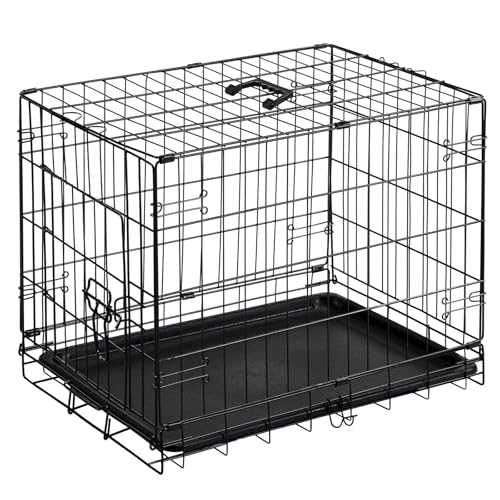
Wire crates are usually the best dog crates for growing puppies, multi-dog households, and owners who want visibility and airflow. Many include removable plastic pans, folding frames, one or two doors, and dividers. The open sides make it easy to monitor a dog and attach a cover for a darker resting space.
The trade-offs are noise, drafts, and exposed bars that determined chewers may bend or damage. Wire is also less protective during transport. A pan can crack or slide if a dog digs repeatedly, so inspect its edges and replace it when it develops sharp splits.
Plastic kennels: enclosed, portable, and easier to contain
Plastic kennels provide more visual separation and can feel secure to dogs that settle better in an enclosed space. They are commonly used for car trips, boarding, and airline-related transport, although airline requirements vary and must be checked directly before travel.
Look for ventilation openings on multiple sides, a door that cannot be pushed inward, metal hardware rather than weak plastic fasteners, and a floor that does not flex noticeably. Plastic is simpler to wipe down after accidents, but it can retain odors if urine reaches seams. It may also become warm in direct sun, so ventilation and shade matter.
Furniture-style crates: attractive but not universally durable
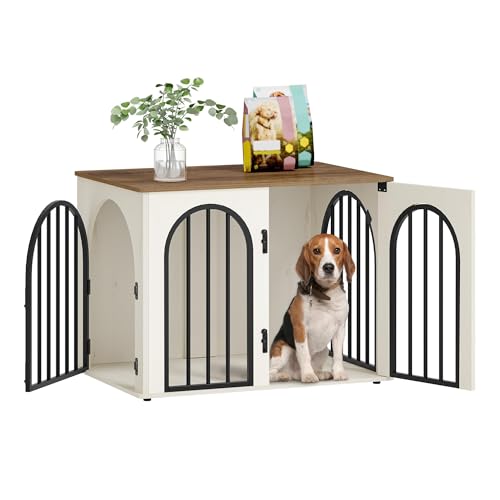
Furniture-style crates use wood, engineered panels, or decorative composite materials around a metal or mesh enclosure. They are suitable for calm dogs that already understand crate use and for homes where appearance matters. Their top surface can provide useful storage, but it should not hold heavy objects that could fall or destabilize the crate.
These crates are usually a poor first choice for puppies that chew, dogs that paw at doors, or dogs that have not learned to rest calmly. Moisture can swell wood-based panels, and decorative slats may create chewable edges. Treat the furniture feature as a bonus, not as evidence of stronger construction.
Best features for puppies and growing dogs
- Divider panel: choose a full-width divider that locks securely and cannot be pushed aside.
- Two doors: a front and side door make placement easier and offer another exit if furniture blocks one side.
- Flat, removable pan: avoid deep ridges that trap bedding, hair, or spilled water.
- Rounded frame edges: they reduce snagging risks on collars, tags, and bedding.
- Replaceable hardware: hinges, pans, and latches wear sooner than the main frame.
Remove collars, harnesses, and dangling tags before unattended crate time because they can catch on wire or door hardware. Introduce the crate gradually with the door open, then practice short closed-door periods while the dog is calm. A crate should not be used as punishment or as a substitute for exercise, training, and interaction.
What heavy chewers need
For a powerful chewer, focus on the weakest component rather than the advertised weight rating. Check the door frame, latch, welds, corner seams, and any accessible plastic. A heavy steel crate can still fail if the latch is easy to manipulate. Reinforced aluminum crates are lighter and resist corrosion, while heavy-gauge steel is often more resistant to bending but can be difficult to move.
A dog that repeatedly damages a crate may be showing distress, frustration, or poor confinement tolerance rather than simply needing a stronger box. Stop using any crate with bent bars, broken welds, sharp metal, or a door that no longer locks reliably. A qualified trainer or veterinarian can help assess escape behavior, especially if it includes frantic scratching, persistent vocalizing, or self-injury.
Size and ownership costs that listings often hide
A basic wire crate may cost less initially, but a growing puppy can require replacement pans, washable bedding, and a second divider or crate if the first model does not accommodate adult size. A simple planning example: a $100 adjustable crate used for four years costs about $2.08 per month before accessories. A $300 furniture-style crate used for three years costs about $8.33 per month, and that comparison changes if moisture or chewing forces an early replacement.
Measure the intended location before buying. Leave at least 6 inches of clearance around doors and vents, and confirm that the crate can pass through the room’s narrowest doorway. A 36-inch crate may require more than 36 inches of floor depth once the door is open. For vehicles, measure the cargo opening and interior—not merely the flat cargo floor.
Setup and maintenance checklist
- Level the crate: wobbling encourages rattling and can stress door hardware.
- Secure it in place: use a wall anchor or anti-slip mat at home, and approved tie-downs during transport.
- Check the fit weekly for puppies: growth can turn a suitable crate into a cramped one quickly.
- Wash the pan regularly: use mild soap, rinse thoroughly, and dry it before replacing bedding.
- Inspect high-wear parts: examine latches, hinges, welds, seams, and pan corners at least monthly.
- Keep bedding proportional: use enough padding for comfort without blocking airflow or making the dog overheat.
Bottom line
For most households, the best dog crates are adjustable wire models sized from actual measurements, especially when a puppy is still growing. Choose plastic when enclosure and portability matter, furniture-style construction when the dog is already calm and the crate must blend into a room, and reinforced metal or aluminum when ordinary doors and bars cannot withstand a heavy chewer. Whichever style you choose, prioritize accurate interior dimensions, reliable locking hardware, ventilation, and a setup that can be cleaned and inspected easily.






Write Your Review
No reviews yet. Be the first to share your experience!