

Key takeaways
- Textured rubber or PVC: Usually the best all-around choice. It offers traction, wipes clean, and handles water better than fabric.
- Rubber mat over a metal or plastic top: Provides good grip and can be replaced when worn. Confirm that the mat cannot slide or curl at the edges.
- Textured plastic: Lightweight and easy to clean, but some inexpensive surfaces become slippery when wet.
- Wood or laminated composite: Attractive and rigid, but exposed edges and seams can swell if water reaches them.
- Soft fabric or foam padding: Comfortable but harder to disinfect and more likely to retain hair, moisture, and odors.
Best Dog Grooming Tables for Home Use
The best dog grooming tables for home use are usually a non-electric folding table with a stable grooming arm, a non-slip waterproof surface, and a weight capacity comfortably above your dog’s current weight.
For small dogs, a 30-by-18-inch folding table is normally sufficient; medium and large dogs need more working area and a stronger frame. The most important buying decision is not the advertised maximum weight alone—it is whether the tabletop, legs, arm, and restraint points remain stable when your dog shifts position.
Our top picks
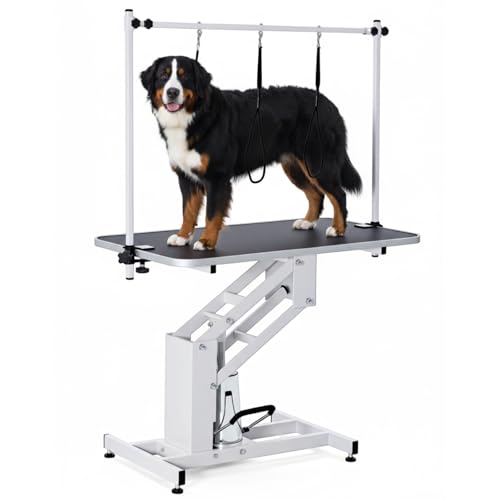
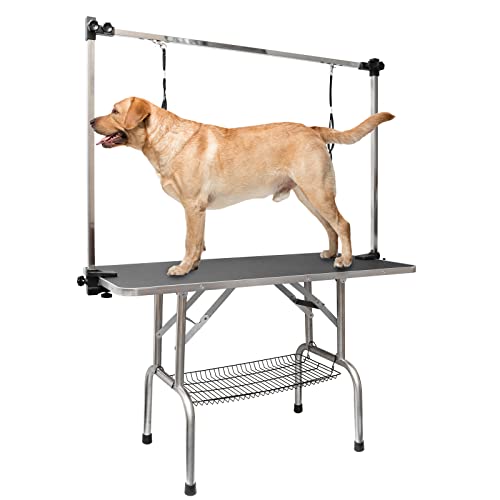
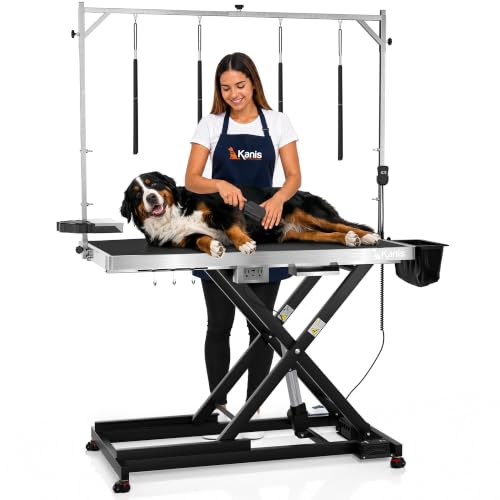
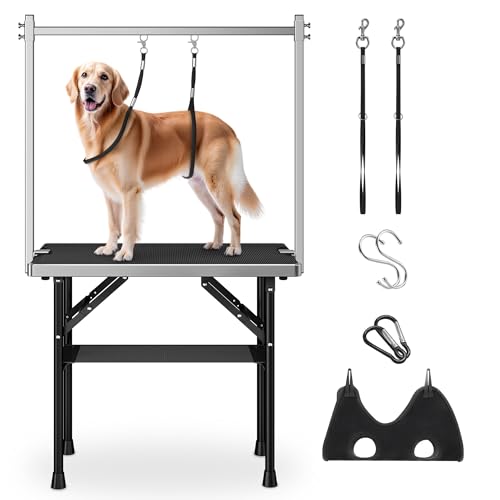
As an Amazon Associate we earn from qualifying purchases at no extra cost to you. Ratings are shown as listed on Amazon.
Quick comparison by dog size and grooming routine
| Dog size or use | Recommended tabletop | Useful weight capacity | Best table type | Typical market range |
|---|---|---|---|---|
| Toy and small dogs up to 15 lb | 24–30 in. long by 18 in. wide | 50–100 lb | Light folding table with adjustable arm | $60–$130 |
| Small to medium dogs, 15–40 lb | 30–36 in. long by 18–24 in. wide | 100–150 lb | Reinforced folding table with full-size grooming arm | $100–$220 |
| Medium to large dogs, 40–75 lb | 36–44 in. long by 22–24 in. wide | 150–250 lb | Heavy-duty folding table with wide leg base | $180–$350 |
| Large dogs over 75 lb | 44–48 in. long by 24–30 in. wide | 250 lb or more | Heavy-duty or hydraulic table | $300–$900+ |
These are practical target specifications rather than guarantees. Always check the manufacturer’s stated capacity, leg width, arm rating, and maximum dog length before buying. A dog’s body length matters as much as its weight: a long-backed breed can need a larger surface even when relatively light.
Best choice for most homes: a reinforced folding table
For occasional baths, brushing, nail care, trimming, or coat drying, a reinforced folding table offers the best balance of price, storage, and stability. Look for a steel or aluminum frame, locking folding legs, rubber feet, and a tabletop at least 30 inches long.
A good home-use model should include an adjustable grooming arm that attaches to the table rather than relying on a lightweight clamp. The arm should resist twisting when the dog leans sideways. A height-adjustable arm is useful for dogs with different neck heights, while a removable arm makes the table easier to store and clean.
For a dog under 20 pounds, a compact table can save space. For a 30- to 50-pound dog, the extra stability of a 36-inch table is usually worth the added storage footprint. If the table will be used weekly, choose a reinforced frame instead of the lightest available option.
Best option for frequent grooming: a heavy-duty table
Frequent use exposes weak points quickly. A heavy-duty table is preferable when you groom more than once a week, own multiple dogs, or have a dog that moves constantly during brushing. Prioritize wide-set legs, cross-bracing, strong hinges, and a load rating at least twice your dog’s body weight.
For example, a 55-pound dog may not need a table rated at exactly 55 pounds. A 150- to 200-pound capacity leaves room for movement and reduces flexing. The extra margin also helps the table remain steady when you apply pressure while brushing dense or matted areas.
Heavy-duty tables are often less convenient to carry. Check the folded dimensions and weight before ordering: a table weighing 35 pounds may be stable but difficult to move between a closet and a grooming area. If it will remain in one place, that trade-off is less important.
When a hydraulic or electric table makes sense
Height-adjustable hydraulic or electric tables are useful when bending over a low table is uncomfortable, when the dog is large, or when more than one person uses the table. Lowering the surface can make it easier for a dog to step on, while raising it can reduce repeated stooping during grooming.
These tables cost substantially more and are usually harder to store. Hydraulic mechanisms also add moving parts that may need occasional lubrication or adjustment. Electric models require a safe, dry power connection and should never be operated with wet hands or standing water nearby.
For a small dog used to grooming, an adjustable table is usually a convenience rather than a necessity. For a large dog, the reduced lifting may justify the cost, particularly if the table stays set up in a dedicated room.
Surface materials: what holds up best?
- Textured rubber or PVC: Usually the best all-around choice. It offers traction, wipes clean, and handles water better than fabric.
- Rubber mat over a metal or plastic top: Provides good grip and can be replaced when worn. Confirm that the mat cannot slide or curl at the edges.
- Textured plastic: Lightweight and easy to clean, but some inexpensive surfaces become slippery when wet.
- Wood or laminated composite: Attractive and rigid, but exposed edges and seams can swell if water reaches them.
- Soft fabric or foam padding: Comfortable but harder to disinfect and more likely to retain hair, moisture, and odors.
A slightly textured surface is safer than a smooth one, but aggressive texture can catch nails or irritate paw pads. Avoid tables with peeling coatings, exposed staples, sharp metal edges, or deep grooves that trap hair.
Grooming-arm stability matters more than arm height
The grooming arm should be rigid enough that it does not swing toward the dog when the dog pulls against the loop. A vertical arm with a broad mounting point is generally more stable than a thin arm attached by a single small clamp.
Check these details:
- The arm should lock securely at several height positions.
- The clamp or socket should attach to a reinforced part of the frame.
- The restraint loop should be adjustable and replaceable.
- The arm should not obstruct the dog’s exit path or create a snag point.
- The table should not tip when moderate sideways pressure is applied.
Use the loop as positioning support, not as a substitute for supervision. Never leave a dog unattended on a grooming table, even if the arm and restraint appear secure.
Decision matrix for common home situations
| Your situation | Choose | Why | Avoid |
|---|---|---|---|
| Limited closet space | 24–30-inch folding table, under 20 lb | Compact folded size and easy carrying | Permanent hydraulic bases |
| First-time home groomer | 30–36-inch table with adjustable arm and non-slip top | More room for learning and repositioning | Very small tables with fixed arms |
| Weekly grooming | Steel-frame table rated at least 2 times the dog’s weight | Less flexing and better long-term durability | Lightweight tables with narrow legs |
| Large or nervous dog | Wide heavy-duty table or height-adjustable model | More surface area and easier loading | Small tops and loosely clamped arms |
| Several dogs | Replaceable mat and washable arm accessories | Easier cleaning and lower ownership cost | Absorbent fabric-covered surfaces |
How to calculate the right size
Measure your dog from the front of the chest to the base of the tail while standing. Add at least 6 inches for working clearance. For example, if your dog measures 25 inches from chest to tail base, a tabletop about 31 inches long is a sensible minimum. Add width based on the dog’s shoulder and hip width, leaving enough room for your hands and tools.
For capacity, multiply the dog’s body weight by two for a useful minimum rating. A 45-pound dog therefore calls for a table rated at least 90 pounds; 120 to 150 pounds provides a more comfortable margin for movement. This calculation does not replace the manufacturer’s instructions, but it helps eliminate undersized options.
Ownership realities: what wears out first?
The grooming arm clamp, restraint loop, rubber feet, and tabletop coating typically show wear before the metal frame. Inspect them every few uses. Replace a frayed loop, cracked mat, missing foot, or loose clamp rather than improvising with cord or household straps.
After grooming, remove hair before it reaches hinges and leg locks. Wipe the surface with mild soap and water, then dry it fully. Avoid soaking folding joints and avoid harsh solvents that can soften rubber or damage the non-slip coating. If the table is used for wet grooming, open it fully until all seams and hinges are dry before folding it away.
Common mistakes include choosing a table based only on the dog’s weight, placing it on a slick floor, leaving the arm loosely clamped, and buying a tabletop too short for the dog’s body. A rubberized floor mat under the table can improve stability, but it should not compensate for a weak frame.
Final recommendation
For most households, choose a 30- to 36-inch folding dog grooming table with a waterproof textured surface, locking legs, a rigid adjustable arm, and a capacity at least twice your dog’s weight. Move to a 36- to 48-inch heavy-duty table for large dogs or frequent grooming, and consider hydraulic height adjustment when lifting or bending is a major concern. The best dog grooming tables are the ones that fit your dog’s body length, remain stable during movement, and can be cleaned and stored without becoming a chore.





Write Your Review
No reviews yet. Be the first to share your experience!