

Key takeaways
- Capacity: Usually the best option for two bodies, multiple lenses, a tablet or laptop, and clothing.
- Lens protection: Thick padded dividers and a structured camera insert protect gear better than an unpadded general backpack.
- Weather resistance: Water-resistant fabric helps with light rain, but a built-in or included rain cover is more useful in prolonged downpours.
- Carry comfort: The most comfortable design for heavy loads, provided the torso length and strap adjustment are suitable.
- Travel fit: A 20–30-liter backpack can often fit beneath an aircraft seat or in an overhead bin, but measure the packed bag because expanding pockets can push it beyond airline limits.
The best camera bags depend on how you shoot: choose a backpack for the largest kit and longest walks, a sling for fast access with one camera and a couple of lenses, a shoulder bag for street and event work, and a roller for frequent air travel or heavy studio equipment.
Our top picks
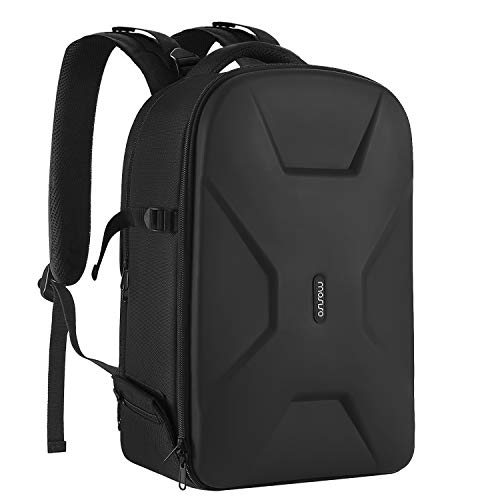

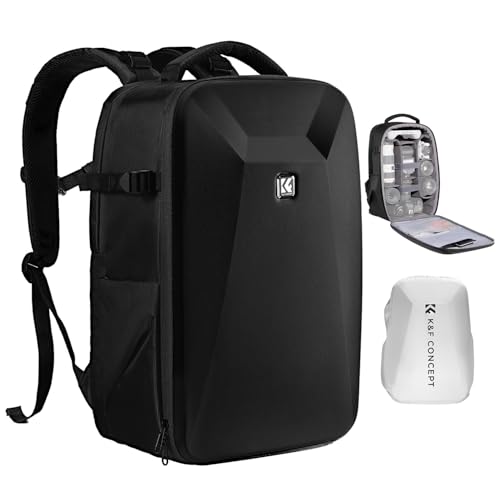

As an Amazon Associate we earn from qualifying purchases at no extra cost to you. Ratings are shown as listed on Amazon.
Quick picks by shooting situation
| Shooting situation | Best bag design | Recommended capacity | Why it fits |
|---|---|---|---|
| Daily walks with one camera | Sling | 5–10 liters | Quick lens access without the bulk of a full backpack |
| Travel with two bodies and several lenses | Camera backpack | 20–30 liters | Better weight distribution, laptop space, and personal-item flexibility |
| Street, documentary, or event shooting | Shoulder bag | 8–16 liters | Equipment can be reached while the bag remains on one shoulder |
| Air travel with a large kit | Rolling camera case | 30–40 liters | Wheels reduce strain on flat ground and protect equipment with a rigid frame |
| Hiking in changeable weather | Weather-resistant backpack | 20–25 liters | Stable carry, exterior rain cover, and room for clothing or food |
Backpacks: the most versatile choice for a complete kit
A camera backpack is usually the best starting point for photographers who carry more than one body, three or more lenses, a flash, and personal items. Both shoulder straps distribute weight across your torso, while a waist belt can keep the bag from swinging during hikes or crowded travel.
The Peak Design Everyday Backpack is suited to photographers who want camera protection combined with an everyday laptop-and-clothing layout. Its configurable dividers, side access, and expandable top compartment work well when the camera is only part of the load. The 20-liter version is more practical for daily use; the 30-liter version is better for travel or a larger mirrorless or DSLR kit.
The Lowepro ProTactic BP 450 AW II favors equipment capacity and modularity. Its padded interior and attachment points are useful for photographers carrying a camera, several lenses, a drone, or accessories. It is less discreet and can feel more technical than an everyday backpack, but it offers stronger organization for a dedicated kit.
For hiking and adventure photography, the Shimoda Explore V2 25 is designed around a removable camera insert and a hiking-style harness. That separation matters: you can take out the camera unit and use the outer pack for non-camera equipment. Look for the version and insert size that match your body and lens combination rather than assuming every configuration has the same capacity.
Backpack strengths and drawbacks
- Capacity: Usually the best option for two bodies, multiple lenses, a tablet or laptop, and clothing.
- Lens protection: Thick padded dividers and a structured camera insert protect gear better than an unpadded general backpack.
- Weather resistance: Water-resistant fabric helps with light rain, but a built-in or included rain cover is more useful in prolonged downpours.
- Carry comfort: The most comfortable design for heavy loads, provided the torso length and strap adjustment are suitable.
- Travel fit: A 20–30-liter backpack can often fit beneath an aircraft seat or in an overhead bin, but measure the packed bag because expanding pockets can push it beyond airline limits.
Slings: fastest access for a small, active kit
A sling is the right choice when access speed matters more than maximum capacity. It rotates from your back to your chest without requiring you to remove both straps. This makes it useful for street photography, family outings, museums, and short walks where you expect to change lenses occasionally rather than carry every lens you own.
The Peak Design Everyday Sling 6L is appropriate for a mirrorless camera with a standard zoom and one compact lens. The 10-liter version provides more room for a larger body, an extra lens, and small personal items, but it also becomes less comfortable when heavily loaded because the weight remains concentrated on one shoulder.
Choose a sling with a broad, padded strap and a stabilizer strap if you carry it for hours. A narrow strap can dig into your neck, while an overfilled sling can swing into furniture or other people. Keep the heaviest item closest to your back and avoid using the outer pocket for dense objects such as batteries or metal water bottles.
Shoulder bags: practical for working photographers
Shoulder bags offer the quickest equipment access because the opening stays in front of you. They are particularly effective for event, wedding, documentary, and studio photographers who need to change lenses repeatedly while standing or moving through a venue.
The Tenba DNA 16 DSLR Messenger provides a useful middle ground between a messenger bag and a dedicated camera case. It can accommodate a camera body, several lenses, and a laptop depending on the specific loadout. Its removable padded insert also makes the bag more adaptable for ordinary commuting.
The trade-off is uneven weight distribution. A shoulder bag that feels fine for 30 minutes can become tiring after several hours. Alternate shoulders during breaks, use the stabilizer strap when walking, and avoid carrying a full water bottle in the same compartment as delicate equipment.
Rolling bags: the best answer to heavy equipment and airport travel
A roller bag makes the most sense when the kit is too heavy for comfortable shoulder or backpack carry and most of your route is level flooring. It is especially convenient for commercial shoots, studio assignments, and airport transfers.
The Think Tank Airport Roller Derby is a dedicated rolling camera case designed for substantial equipment loads and travel organization. Its padded interior and trolley format suit photographers carrying multiple bodies and long lenses. Before flying, check the packed external dimensions and weight against your airline’s current cabin rules; a roller can be within the height limit but still exceed a weight allowance once fully loaded.
Wheels are less useful on stairs, gravel, sand, snow, and crowded sidewalks. A roller should therefore have a reliable top or side handle and enough structure to lift safely. The wheels and telescoping handle are usually the first parts to wear, not the padded interior.
Head-to-head comparison
| Design | Typical usable volume | Approximate empty weight | Best load | Weather protection | Main compromise |
|---|---|---|---|---|---|
| Sling | 5–10 L | 0.5–1.0 kg | 1 body, 1–3 lenses, batteries | Water-resistant fabric; covers vary | One-shoulder fatigue |
| Shoulder bag | 8–16 L | 0.7–1.3 kg | 1–2 bodies, 2–5 lenses, laptop | Flap and coated fabric; often not waterproof | Uneven weight distribution |
| Backpack | 18–35 L | 1.2–2.3 kg | 1–2 bodies, 3–7 lenses, personal gear | Rain cover or sealed zippers on better models | Slower access to the main compartment |
| Roller | 30–45 L | 2.8–4.5 kg | Multiple bodies, long lenses, lighting gear | Structured shell or padded fabric; covers vary | Heavy and awkward on stairs or rough ground |
These figures are typical ranges rather than universal specifications. Dividers, laptop sleeves, expandable sections, and camera inserts reduce the space available for equipment, so compare the internal dimensions of the padded compartment rather than relying only on the advertised total volume.
How to calculate the right capacity
Start with the gear you carry on a normal shooting day, not the largest collection in your cabinet. Write down the approximate volume of each item and add 20 percent for access and future expansion. For example:
- Camera body with attached lens: about 4 L
- Two additional lenses: about 3 L combined
- Flash, batteries, and charger: about 1.5 L
- Water, jacket, and personal items: about 4 L
- 20 percent working space: about 2.5 L
This gives a target of roughly 15 liters. A 6-liter sling is too small, while a 20-liter backpack gives useful room without forcing you into a bulky 30-liter travel pack. If you carry a tripod, remember that it usually occupies exterior attachment space rather than internal volume, but it still affects balance and comfort.
Durability and ownership realities
Most camera bags do not fail because the foam suddenly stops protecting a camera. Zipper pulls, seam binding, shoulder-strap stitching, wheel bearings, and telescoping handles typically show wear first. Do not overload a sling or shoulder bag beyond what its strap and stitching can comfortably support.
Clean dusty fabric with a soft brush or damp cloth, empty sand and grit from zippers, and let a wet bag dry fully before storing it. Do not machine-wash a structured camera bag unless the manufacturer specifically permits it. Rain covers should also be dried before being packed away, or they can trap moisture against the fabric.
Use dividers to stop lenses from touching one another, keep lens caps on during transport, and avoid storing batteries loose with coins or keys. A rain-resistant bag is not the same as a waterproof dry bag: for heavy weather, protect cameras inside sealed pouches and keep the bag’s cover accessible rather than buried under clothing.
Final buying decision
Choose a sling if you carry one camera and value instant access. Choose a shoulder bag if you work from the bag repeatedly and can tolerate one-sided weight. Choose a backpack for hiking, commuting, or a complete kit. Choose a roller when the equipment is heavy and most travel happens on smooth surfaces. The best camera bags are not the largest or most padded models; they are the ones that fit your actual equipment, route, weather, and shooting rhythm without forcing you to carry unused capacity every day.

Write Your Review
No reviews yet. Be the first to share your experience!