

Key takeaways
- Strengths: suitable for many bow types, weather-tolerant when covered, easy to carry compared with large bag targets, and available in replaceable-core designs.
- Drawbacks: arrow removal becomes harder as the face gets packed, exposed foam can deteriorate in sunlight, and repeated groups create deep channels.
The best archery targets for most backyard and range shooters are layered-foam targets for broad bow compatibility, bag targets for frequent practice and easy arrow removal, and 3D targets when realistic shot placement matters more than maximum lifespan.
The right choice depends on four practical questions: how powerful your bow is, how often you shoot, how much space you have, and whether you need to remove arrows quickly. A target that is excellent for a recurve may be unsuitable for a high-poundage compound, while a realistic 3D target can be unnecessary for repetitive sighting-in sessions.
Our top picks

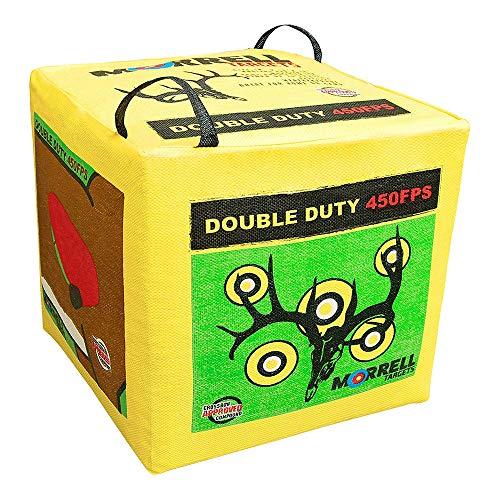


As an Amazon Associate we earn from qualifying purchases at no extra cost to you. Ratings are shown as listed on Amazon.
Quick comparison: foam, bag, and 3D targets
| Target type | Typical size and weight | Best for | Arrow removal | Typical service life | Bow compatibility |
|---|---|---|---|---|---|
| Layered or compressed foam | 20–28 in. square; 20–45 lb | Backyard practice, broadheads, mixed shooting | Moderate; easier when the target is new | About 1,000–5,000 arrows, depending on rotation and arrow speed | Recurve, longbow, compound; check the manufacturer’s broadhead rating |
| Bag target | 24–32 in. square; 25–50 lb | High-volume field-point practice | Usually easiest | About 5,000–15,000 arrows with regular rotation and proper cover | Most recurves and compounds using field points; not usually suitable for broadheads |
| 3D foam target | Life-size or reduced-size; 10–40 lb | Hunting-angle practice and realistic aiming | Moderate to difficult in dense vital areas | About 500–3,000 arrows in the highest-impact zones | Recurve and compound; use only the insert and arrow types specified |
These are useful planning ranges rather than guarantees. Arrow speed, draw weight, point type, weather, impact spacing, and target rotation can change lifespan substantially. A target hit repeatedly in one small group wears out much faster than one used across its entire face.
Best archery targets by shooting situation
| Your situation | Best choice | Why | What to avoid |
|---|---|---|---|
| New archer with a recurve or longbow | Medium layered-foam or bag target | Large aiming area, forgiving stopping performance, reasonable cost | A small 3D target that makes misses likely |
| High-volume compound practice | Large bag target or replaceable-core foam target | Lower arrow-removal effort and better long-term value | Thin foam targets that cannot handle the bow’s rated speed |
| Broadhead practice | Broadhead-rated layered foam target | Designed to accept cutting blades without trapping them permanently | Standard bag targets, unless explicitly rated for broadheads |
| Small backyard with limited depth | 24–26 in. square target with a substantial backstop | Provides useful face area without requiring a large range | Small targets placed where a miss could damage property |
| Bowhunting preparation | 3D deer, turkey, or similar target plus a flat target | Combines shot-angle practice with economical repetition | Using a 3D target for every arrow in a high-volume session |
| Lowest ownership cost | Replaceable-fill bag target | Worn filling can often be replaced instead of discarding the frame | A target with no available replacement parts |
Foam targets: the versatile middle ground
Layered-foam and compressed-foam targets are the safest general recommendation when one target must serve several purposes. They normally offer a printed face for sighting practice and enough density to stop arrows from a wide range of bows. Many are available in square, block, or cube formats, and some use replaceable sections or cores.
Foam is also the most flexible option for shooters who occasionally practice with broadheads. However, “foam” does not automatically mean “broadhead compatible.” Cutting blades can slice rather than compress the material, making removal difficult and accelerating damage. Confirm the target’s stated point compatibility before shooting broadheads.
Strengths and drawbacks
- Strengths: suitable for many bow types, weather-tolerant when covered, easy to carry compared with large bag targets, and available in replaceable-core designs.
- Drawbacks: arrow removal becomes harder as the face gets packed, exposed foam can deteriorate in sunlight, and repeated groups create deep channels.
For a first target, choose at least a 24-inch face if you have adequate space. That size gives beginners a more forgiving aiming area and reduces the chance that an early miss passes beside the target completely.
Bag targets: best for frequent field-point shooting
Bag targets contain layered fabric, synthetic fill, or another compressible stopping material. Their main advantage is arrow removal: the material closes around the shaft rather than gripping it as aggressively as dense foam. This matters during 100-arrow practice sessions, when difficult extraction can become the most tiring part of training.
Bag targets are particularly economical for compound-bow shooters who use field points. Many can be turned or rotated so arrows strike fresh sections, extending useful life. Some designs have replaceable covers or filling, which can make ownership less expensive than replacing an entire solid target.
Important limitations
- Do not assume a bag target accepts broadheads. Blades can catch internal fabric and may be damaged during removal.
- Keep the bag dry when possible. Water adds weight, encourages deterioration, and can change how tightly the fill stops arrows.
- Leave clearance behind the target. A lightweight bag can shift or tip when struck off-center.
- Inspect the outer cover regularly. A small tear can allow fill to escape and create a weak stopping area.
A bag is usually the strongest value for a shooter who practices three or more times per week with field points. Its lower extraction effort also makes it practical for coaching, family use, and high-arrow-count drills.
3D targets: realistic practice with a different cost equation
3D targets reproduce the outline of an animal and place scoring rings inside a vital zone. They help with judging angles, choosing an aiming point, and understanding how an arrow enters from uphill, downhill, quartering, or partially obstructed positions. Brands such as Rinehart and Delta McKenzie make widely recognized 3D target styles, but the important specifications are the replaceable insert, shooting-point compatibility, and target dimensions.
The tradeoff is concentrated wear. Shooters naturally aim at the vital zone, so the same small area absorbs most impacts. A 3D target may last for many seasons as a visual aid yet require an insert replacement much sooner. Replaceable vital-zone inserts can reduce long-term cost; a one-piece target with no replaceable section may be cheaper initially but more expensive after heavy use.
Use a flat bag or foam target for warm-up and repetitive form work, then reserve the 3D target for realistic shots. This approach preserves the 3D insert and usually costs less per arrow.
Worked ownership calculation
Suppose a $180 3D target receives 30 arrows per week, but its vital insert lasts 1,200 impacts. The insert is absorbing about 40 weeks of that practice, or roughly $4.50 per week before replacement parts. A $120 bag target that lasts 8,000 field-point arrows costs about 1.5 cents per arrow. The 3D target may still be the better purchase for hunting preparation, but it is not the economical choice for every practice arrow.
For a mixed schedule of 80 flat-target arrows and 20 3D arrows per week, using the bag for the 80 repetitive shots can substantially reduce wear on the 3D insert. The best setup is often two specialized targets rather than one target forced to do everything.
How to set up and maintain an archery target
- Measure the shooting lane. Choose a target that leaves room for a substantial backstop behind it. A target is not a substitute for a backstop net, earth berm, or other appropriate safety system.
- Confirm bow and point ratings. Check maximum arrow speed, draw-weight guidance, and whether field points or broadheads are allowed.
- Place the target square to the shooter. A tilted face can make arrows glance, bend, or penetrate unevenly.
- Spread impacts across the face. Move aiming points or rotate the target before one group creates a deep channel.
- Pull arrows correctly. Hold the target near the arrow, use a straight pulling motion, and avoid twisting hard at the nock or shaft. An arrow puller improves grip and reduces damage.
- Keep it covered when not in use. Shade and a waterproof cover protect foam, fabric, printed faces, and seams from ultraviolet light and rain.
- Retire it before failure. Replace a target when arrows pass through, stop inconsistently, expose internal material, or require unsafe force to remove.
Final recommendation
Choose a bag target if your priority is inexpensive, high-volume field-point practice and easy arrow removal. Choose layered foam if you want the broadest compatibility, especially when broadheads may be involved. Choose a 3D target when realistic hunting angles and vital-zone aiming are central to your training. For many archers, a durable bag plus a smaller replaceable-insert 3D target delivers the best balance of practice volume, realism, and long-term ownership cost.

Write Your Review
No reviews yet. Be the first to share your experience!