

Key takeaways
- Solid-wood crates: Attractive and heavy, but vulnerable to scratches, urine, moisture, and chewing unless well sealed. They can be difficult to clean if the base is fixed.
- Wood-composite or engineered-board crates: Usually more affordable and uniform in appearance. Look for sealed edges and a waterproof or removable floor because exposed board swells when it absorbs liquid.
- Metal crates with wood-style panels or covers: Often the safest choice for dogs that paw, push, or chew. The metal interior supplies strength while the exterior provides a furniture-like finish.
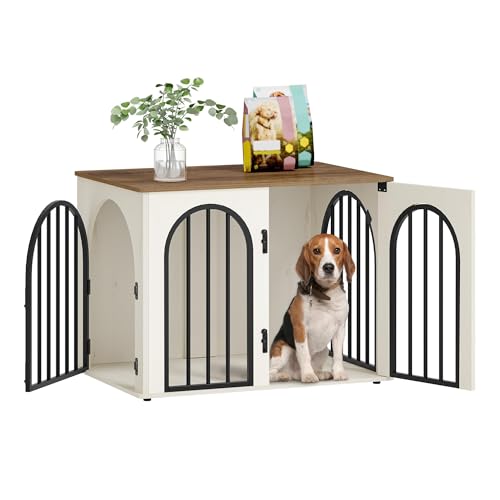
The best wooden dog crates for home use are furniture-style crates with a strong internal frame, ventilation on several sides, a securely latching door, and enough interior space for your dog to stand, turn around, and lie down naturally without wasting room.
Our top picks


As an Amazon Associate we earn from qualifying purchases at no extra cost to you. Ratings are shown as listed on Amazon.
Quick picks by household and dog
| Situation | Best crate type | What to prioritize | Typical budget |
|---|---|---|---|
| Calm adult dog, living-room use | Furniture-style wood or wood-composite crate | Finish, ventilation, removable tray, quiet latch | $120–$300 |
| Puppy or frequent confinement | Heavy-duty crate with a metal inner frame | Chew resistance, divider, washable base, escape-resistant door | $150–$400 |
| Large dog or powerful chewer | Metal crate with a separate furniture cover | Structural strength and door security over appearance | $180–$500+ |
| Small apartment or occasional use | Compact wood-composite end-table crate | Light assembly, usable top surface, adequate airflow | $80–$200 |
Wooden crates are most suitable for dogs that are already comfortable in a crate and are not determined chewers. A decorative enclosure can look substantially better than exposed wire, but appearance should not outweigh ventilation, safe construction, or escape resistance.
How to choose the correct crate size
Measure your dog rather than choosing by breed label. With the dog standing, measure from the floor to the top of the head or ears, whichever is higher. Then measure from the nose to the base of the tail. Add approximately 3–4 inches to both measurements for a practical minimum interior size.
For example, if a dog measures 27 inches from nose to tail base and 23 inches tall, a crate with an interior of about 30 inches long and 26–27 inches high is a reasonable starting point. Allow additional width for a broad-chested dog. The dog should be able to stand without ducking, turn around without squeezing, and lie on its side with legs extended.
Do not size a crate by its exterior dimensions. Thick side panels, trim, a raised floor, and an internal frame can reduce usable space by several inches. Check the listed interior length, width, and height before buying.
Typical size ranges
| Dog size | Approximate interior length | Approximate interior height | Common crate width |
|---|---|---|---|
| Small, up to about 25 lb | 24–30 in | 18–22 in | 18–22 in |
| Medium, about 26–50 lb | 30–36 in | 22–27 in | 20–24 in |
| Large, about 51–85 lb | 36–42 in | 26–31 in | 24–28 in |
| Extra-large, over about 85 lb | 42–48 in | 30–35 in | 28–32 in |
These are starting ranges, not substitutes for measuring. A growing puppy may benefit from an adjustable divider, but the divider must be firmly secured and leave only the amount of space the puppy currently needs.
Wood construction: attractive does not always mean durable
Wooden dog crates generally fall into three categories:
- Solid-wood crates: Attractive and heavy, but vulnerable to scratches, urine, moisture, and chewing unless well sealed. They can be difficult to clean if the base is fixed.
- Wood-composite or engineered-board crates: Usually more affordable and uniform in appearance. Look for sealed edges and a waterproof or removable floor because exposed board swells when it absorbs liquid.
- Metal crates with wood-style panels or covers: Often the safest choice for dogs that paw, push, or chew. The metal interior supplies strength while the exterior provides a furniture-like finish.
For a puppy, anxious dog, or dog that has escaped from a crate before, a fully wooden enclosure is usually a poor first choice. Chewing commonly starts at door edges, corner trim, ventilation slats, and the lower front rail. Once a dog exposes unfinished wood or splinters a panel, repair is difficult and the crate may no longer be safe.
Ventilation and door security matter more than the finish
A suitable crate should have airflow through at least two sides, preferably three, rather than relying on a few small decorative openings. Avoid designs with solid wooden sides on three or four faces, especially in warm rooms. Open slats should be narrow enough that a dog cannot get its jaw or paw trapped.
Inspect the door hardware before buying. A good door should:
- Close flush with the frame rather than leaving a pryable gap.
- Use a positive latch that cannot be opened by a nose or paw.
- Have hinges and fasteners protected from chewing where possible.
- Remain square after assembly, without rubbing against the frame.
- Open wide enough to remove the dog safely and clean the interior.
Some furniture-style crates use a single decorative latch that looks appropriate but provides limited security. For a dog that actively tries to exit, choose a model with a reinforced metal door and two-point locking hardware, or use a conventional heavy-duty crate with a separate wood furniture cover.
Cleaning access and everyday ownership
The most useful feature for hygiene is a removable, leak-resistant tray that can slide out without dismantling the crate. A fixed wooden floor may look more like furniture, but it turns an accident into a much larger cleaning job. Check whether the tray can be removed with the door closed and whether its edges are high enough to contain ordinary spills.
For routine care, remove bedding and vacuum hair from seams weekly. Wipe sealed surfaces with a lightly damp cloth and a pet-safe cleaner, then dry them fully. Do not saturate engineered wood. Wash a plastic or metal tray separately and inspect the underside for trapped moisture.
Use washable bedding that fits the floor without blocking the door or ventilation openings. Avoid thick cushions for dogs that shred fabric or ingest stuffing. If the crate develops a persistent urine odor, swelling, peeling laminate, or splintering, replacing the affected component is safer than repeatedly covering the damage.
Assembly: the overlooked source of instability
Furniture crates often arrive flat-packed. Assembly quality affects both security and noise. Before tightening anything, identify the front, back, floor, and door panels, and confirm that all fasteners are present.
- Assemble the frame on a level surface so the door does not become twisted.
- Install the floor and tray supports before fully tightening the side panels.
- Check that the door gap is even from top to bottom.
- Tighten fasteners firmly, but stop before crushing composite panels.
- Push the assembled crate from each side to check for rocking.
- Inspect every opening for exposed screws, sharp edges, or chewable plastic caps.
Recheck fasteners after the first week and periodically afterward. Doors, tray rails, and feet tend to loosen first because they receive repeated impact. Felt pads can protect flooring, but they should not allow the crate to slide when the dog moves inside.
Furniture-style finishes: what works in real homes
Dark walnut, espresso, white, and natural wood-look finishes coordinate easily with living-room furniture, but dark surfaces show hair and dust while pale finishes show muddy paw marks. A satin or matte finish usually hides minor scratches better than a high-gloss coating.
Prioritize rounded edges, sealed seams, and a top panel that is strong enough for its intended use. Treat the crate top as a shelf only if the manufacturer states its load capacity. Do not place heavy televisions, unstable lamps, or breakable objects above a crate where a dog could bump the structure.
Some products, including furniture-style crates from brands such as New Age Pet and Crown Pet Products, are designed around wood-composite or decorative-panel construction rather than solid timber. Their suitability depends on the individual dog and the specific model’s interior dimensions, ventilation, tray, and door hardware—not simply on the brand or finish.
Final buying decision
Choose a wooden crate when your dog is calm, the crate will remain indoors, and the furniture appearance is important. Select a wood-composite model with sealed edges and a removable tray for normal household use. Choose a metal-inner-frame design when the crate will be used daily, transported, or occupied by a young dog. For persistent chewing, escape attempts, or strong dogs, buy for containment first and add a furniture cover rather than relying on decorative wood for strength.
The best wooden dog crates are not the most ornate ones. They are the models that provide the correct interior size, reliable airflow, a secure door, cleanable surfaces, stable assembly, and enough resistance for the individual dog using them.




Write Your Review
No reviews yet. Be the first to share your experience!