

Key takeaways
- Learn how to choose dog digestive enzymes with confidence. Compare enzyme blends, formats and serving sizes, and find a supplement that fits your dog.
Digestive enzymes are proteins that help break down food into smaller pieces the body can absorb. Dogs make some on their own, but a supplement can add amylase, protease, lipase and cellulase. Owners usually reach for one when a dog changes diets or eats a heavily processed food.
Enzymes are a supplement, not a medicine, and they are not a substitute for veterinary care. Talk with your veterinarian before starting one, especially if your dog has pancreatitis, another diagnosed digestive condition, or takes medication. A vet can tell you whether it fits alongside a prescribed diet or treatment plan.
As an Amazon Associate, we earn from qualifying purchases.
Quick Answer
Choose a product that names its enzymes, states the activity of each one, suits your dog’s diet and size, and comes in a format your dog will accept every day. Powders mix into food, soft chews work as a treat, and plant-based blends suit dogs that avoid animal-sourced ingredients. Always read the label, follow the serving directions, and ask your veterinarian first.
NaturVet Digestive Enzymes Plus Probiotics and Prebiotics Soft Chews, 120 Count

NaturVet Digestive Enzymes Soft Chews combine four named enzymes with a probiotic and a prebiotic in one veterinarian-formulated chew. The blend covers alpha-amylase, protease, lipase and cellulase, listed as helping to break down starches, proteins, fats and cellulose, while Bacillus coagulans adds a probiotic and fructooligosaccharides add a prebiotic. Serving is by weight with each meal, from one chew up to 20 pounds to four over 81 pounds, and the 120-count jar lasts well for a small dog.
Specs
| Spec | Detail |
|---|---|
| Format | Soft chews given with each meal |
| Enzyme blend | Alpha-amylase, protease, lipase, cellulase |
| Probiotic | Bacillus coagulans |
| Prebiotic | Fructooligosaccharides |
| Extra ingredients | Papaya, flaxseed, brewers dried yeast |
| Count | 120 soft chews |
| Best for | Owners who want an easy chew format |
Nusentia Enzyme Miracle Powder, 364 Scoops
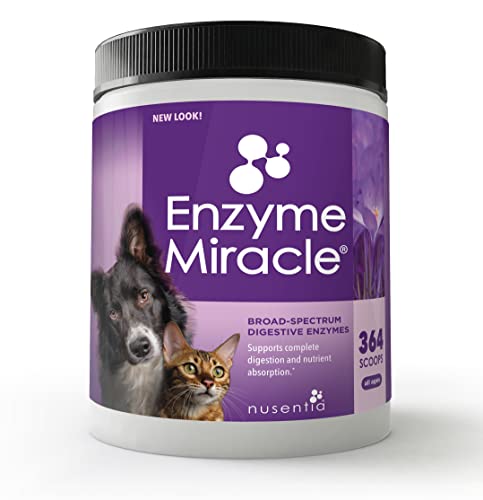
Nusentia Enzyme Miracle is a broad-spectrum plant-based powder with eleven named enzymes, the widest blend here. The list covers three proteases, amylase, diastase, lipase, cellulase, bromelain, beta-glucanase, peptidase and hemicellulase, plus calcium, magnesium, copper, manganese and beet root fibre. The formula is fully vegetarian, with no animal-based materials. One scoop goes into every cup of food, the powder has virtually no taste, and the 364-scoop tub suits multi-dog households. It contains no probiotics, so owners who want live cultures would need a separate product.
Specs
| Spec | Detail |
|---|---|
| Format | Powder mixed into food |
| Enzyme blend | Eleven enzymes including three proteases, amylase, lipase, cellulase and bromelain |
| Probiotic | None |
| Prebiotic | Beet root fibre |
| Extra ingredients | Calcium, magnesium, copper, manganese |
| Count | 364 scoops |
| Best for | Owners who want the broadest plant-based enzyme blend |
Wholistic Pet Organics Digest-All Plus, 4 oz

Wholistic Pet Organics Digest-All Plus is a concentrated powder pairing seven plant-based enzymes with a high-strength probiotic blend. The enzymes are protease, amylase, cellulase, hemicellulase, lipase, bromelain and papain, and the maker publishes the activity of each one per gram. Lactobacillus acidophilus and Bifidobacterium longum add 10 billion CFU per gram combined, plus fructooligosaccharide as a prebiotic. The formula is free of soy, corn, wheat and fillers, and the maker is NASC certified. Serving is one quarter-teaspoon scoop per cup of food.
Specs
| Spec | Detail |
|---|---|
| Format | Powder sprinkled on food |
| Enzyme blend | Protease, amylase, cellulase, hemicellulase, lipase, bromelain, papain |
| Probiotic | Lactobacillus acidophilus and Bifidobacterium longum, 10 billion CFU per gram |
| Prebiotic | Fructooligosaccharide, 30 mg per gram |
| Extra ingredients | None listed beyond the enzyme and probiotic blend |
| Count | 4 oz powder |
| Best for | Owners who want published enzyme activity and a strong probiotic pairing |
Animal Essentials Plant Enzyme and Probiotics, 10.6 oz

Animal Essentials Plant Enzyme and Probiotics is a plain, budget-friendly powder that publishes the activity of every enzyme per gram. The analysis lists amylase at 3,150 DU, protease at 20,500 HUT, lipase at 265 LU, cellulase at 110 CU and hemicellulase at 100 HCU per gram, plus bromelain at 20,000 FCC per gram, and Bacillus coagulans adds 100 million CFU per gram. All enzymes come from plant and microbial sources, none from animals. The 10.6-ounce tub is generous, though no prebiotic is listed and there is no flavouring, so fussy dogs may notice it on plain kibble.
Specs
| Spec | Detail |
|---|---|
| Format | Powder sprinkled on food |
| Enzyme blend | Amylase, protease, lipase, cellulase, hemicellulase, bromelain |
| Probiotic | Bacillus coagulans, 100 million CFU per gram |
| Prebiotic | Not stated |
| Extra ingredients | Calcium sulfate, dried fermentation products |
| Count | 10.6 oz powder |
| Best for | Owners who want published enzyme activity at a budget-friendly size |
Dr. Mercola Bark and Whiskers Digestive Enzymes, Meat-Based Diet, 150 Scoops

Dr. Mercola Bark and Whiskers Digestive Enzymes for a meat-based diet is built on pancreatin from porcine pancreas, unlike the plant-based powders above. Each 500 mg scoop lists alpha-amylase and protease at 14,400 U USP each, trypsin at 6,000 and lipase at 1,200, plus a fungal protease, bromelain and a fungal lipase, with betaine hydrochloride in the blend. The formula is veterinarian formulated, non-GMO and certified organic. Serving is by weight, from one scoop for toy breeds to four for giant breeds, but it is not suitable for dogs with a pork allergy.
Specs
| Spec | Detail |
|---|---|
| Format | Powder mixed into food |
| Enzyme blend | Pancreatin-based alpha-amylase, protease, trypsin and lipase, plus fungal protease, bromelain and fungal lipase |
| Probiotic | None |
| Prebiotic | Not stated |
| Extra ingredients | Betaine hydrochloride |
| Count | 150 scoops |
| Best for | Owners feeding a meat-based diet who want animal-sourced enzymes |
How to Choose Dog Digestive Enzymes
Start with the enzyme list. A useful product names each enzyme and states its activity, not just the word blend. Look for amylase, protease, lipase and cellulase as a baseline, then check for bromelain, papain or hemicellulase. Vague labels are harder to compare, so treat them with caution. Note whether the product also contains probiotics or a prebiotic, and whether the enzymes come from plants or animal pancreas.
Next, match the product to your dog’s diet. A plant-based blend suits dogs on kibble or a mixed diet and dogs that avoid animal-sourced ingredients. A pancreatin-based formula suits dogs on a meat-based or raw diet, but not dogs with a pork allergy. Match the format too: powders suit dogs that eat meals reliably, while chews suit dogs that like chewable supplements. Check the serving directions, and work out how long a tub lasts for your dog before you compare sizes.
Finally, talk with your veterinarian before you start. This matters most for dogs with pancreatitis, dogs on medication and dogs with a diagnosed digestive condition, since the wrong enzyme or dose can work against a treatment plan. Introduce it as directed, watch appetite, stool and comfort over several weeks, and keep the routine steady. If your dog develops ongoing digestive upset, vomiting, loss of appetite or lethargy, stop it and seek veterinary advice promptly.
Who Should Skip Dog Digestive Enzymes
Some dogs should not start an enzyme supplement without veterinary guidance. Dogs with pancreatitis need a veterinarian to weigh in first, because enzyme supplements interact with how the pancreas is managed. The same applies to puppies, pregnant dogs, senior dogs, dogs with immune problems, dogs taking medication and dogs recovering from surgery.
Skip a product if its label does not name its enzymes, state their activity, or give clear serving directions. Skip a pancreatin-based product if your dog is allergic or sensitive to pork. Skip a powder if your dog refuses food with anything sprinkled on it, and skip a chew if your dog has chewing difficulties. A supplement your dog will not eat will not help, no matter how good the label looks.
An enzyme supplement is not a substitute for veterinary care. It does not replace a diagnosis, a prescribed diet or prescribed medication, and it should not delay a vet visit when a dog is unwell. If digestive signs keep returning or worsen, seek veterinary care rather than switching supplements.
Frequently Asked Questions
How are digestive enzymes different from probiotics?
Enzymes and probiotics do different jobs. Enzymes break down food into smaller pieces so the body can absorb nutrients, while probiotics are live bacteria that support the balance of gut microbes. Many products combine the two, but an enzyme-only powder and a probiotic-only chew are not interchangeable. Ask your veterinarian which one fits your dog’s needs.
Do dogs on kibble need digestive enzymes?
Not necessarily. Healthy dogs make their own digestive enzymes, and a complete kibble is designed to be digested without added help. Enzymes are usually considered when a dog changes diets, eats a heavily processed food, or has a digestive condition. If your dog is doing well on kibble, there may be no reason to add one.
Can dogs with pancreatitis take digestive enzymes?
Only with veterinary guidance. Pancreatitis is a serious condition, and enzyme supplements can interact with how it is managed. Some dogs with pancreatic problems use enzyme products under a vet’s direction, while others should not. Never start one for a dog with pancreatitis, or any diagnosed digestive condition, without asking your veterinarian first.
Are powders or chews better for dogs?
Neither format is better for every dog. Powders mix into food and suit dogs that eat meals reliably, while chews suit dogs that like chewable supplements. Powders make it easier to adjust the serving by cups of food, while chews give a fixed serving per chew. Choose the format your dog will accept every day.
Final Verdict
For the broadest plant-based enzyme blend, Nusentia Enzyme Miracle is the clearest pick, with eleven named enzymes and a 364-scoop tub that lasts. For published enzyme activity at a budget-friendly size, Animal Essentials is the strongest value, with every activity level stated per gram. Wholistic Pet Organics Digest-All Plus sits between them, pairing seven named enzymes with the strongest probiotic level here.
NaturVet Soft Chews are the best fit when a chew format matters most, and Dr. Mercola Bark and Whiskers is the pick for a meat-based diet, with animal-sourced pancreatin enzymes. Whichever product you choose, compare the named enzymes and their activity, match the source to your dog’s diet, and confirm the choice with your veterinarian, especially if your dog has pancreatitis or takes medication.
More from Amazon
Programs that pair well with the guide above. Offers and eligibility are set by Amazon and may change.
Set up recurring deliveries of everyday items on eligible products. Terms and savings are set by Amazon.
Explore Subscribe & SaveFree shipping on eligible items, Prime Video and more. Eligible new members can start with a free trial.
Start a Prime free trialAudiobooks and podcasts to listen to on the go. Eligible new members can start with a free trial.
Try Audible freeRead from a large library of eBooks and audiobooks on any device. Check Amazon for current plans.
Explore Kindle UnlimitedAs an Amazon Associate we earn from qualifying purchases.




Write Your Review
No reviews yet. Be the first to share your experience!