

Key takeaways
- 48–54 inches: suitable for screening a seated balcony chair, low table, or pet resting area.
- 60–72 inches: the most versatile range for patios, decks, and balconies; it blocks many direct sightlines while remaining manageable in wind.
- 84 inches or more: useful under a pergola or where local regulations permit it, but more vulnerable to wind and more likely to feel visually enclosed.
Best Outdoor Privacy Screens for Patios
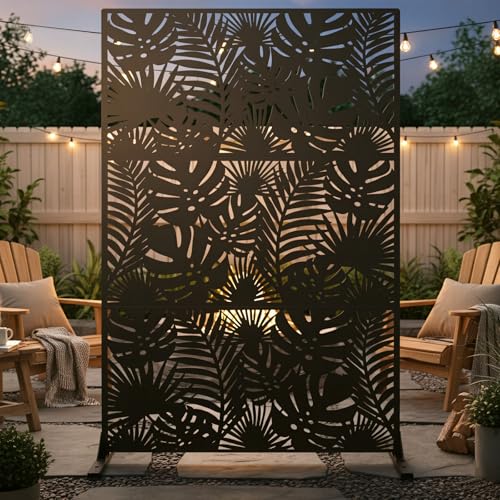
The best outdoor privacy screens for most patios are freestanding slatted panels or retractable side screens: choose a 5.5–6.5-foot height for seated privacy, a weighted base or permanent anchor for windy locations, and a screen wide enough to cover the sightline rather than simply the area beside your chair.
Quick Comparison: Which Screen Fits Your Space?
| Screen type | Typical size | Materials | Approx. weight | Wind stability | Best use | Typical price range |
|---|---|---|---|---|---|---|
| Freestanding slatted panel | 70–72 in high × 35–48 in wide | Powder-coated aluminum, steel, wood, or composite | 20–55 lb | Good with a bolted base; fair when weighted only | Decks and patios where a permanent-looking divider is wanted | $120–$450 per panel |
| Retractable side-awning screen | 60–72 in high × 120–200 in extension | Polyester fabric, aluminum cassette, steel post | 25–50 lb | Fair to good when fully tensioned and anchored | Wide balcony or patio coverage when the screen is used selectively | $100–$350 |
| Outdoor curtain panel | 84–96 in high × 50–54 in wide | Solution-dyed polyester, grommets, steel or aluminum rod | 5–15 lb per panel | Fair with bottom weights; poor in strong gusts | Covered patios and pergolas with an existing frame | $25–$100 per panel |
| Folding privacy screen | 60–72 in high × 72–144 in total width | Wicker, resin, fabric, wood, or metal | 15–45 lb | Fair; better when folded into a zigzag | Renters and occasional-use spaces | $80–$300 |
| Artificial hedge or reed roll | 48–72 in high × 96–144 in long | PVC foliage, polyethylene, reed, bamboo, wire backing | 10–35 lb | Depends almost entirely on the supporting frame | Covering railings or disguising an unattractive boundary | $40–$250, excluding the frame |
These are general 2026 market ranges, not fixed prices. Shipping, anchors, planter bases, and installation hardware can add considerably to the total.
Our top picks


As an Amazon Associate we earn from qualifying purchases at no extra cost to you. Ratings are shown as listed on Amazon.
How Tall Should an Outdoor Privacy Screen Be?
Height should be selected from the eye level you want to block, not from the screen’s advertised maximum. A seated adult’s eye level is commonly about 42–50 inches above the floor, while a standing adult’s eye level is often 60–66 inches. A 48-inch screen can therefore hide a seated conversation from a nearby neighbor, but it will not provide standing privacy.
- 48–54 inches: suitable for screening a seated balcony chair, low table, or pet resting area.
- 60–72 inches: the most versatile range for patios, decks, and balconies; it blocks many direct sightlines while remaining manageable in wind.
- 84 inches or more: useful under a pergola or where local regulations permit it, but more vulnerable to wind and more likely to feel visually enclosed.
Check building, condominium, and rental rules before installing a tall screen. Balcony railings and exterior walls may have limits on attachments, weight, and projection beyond the railing.
Coverage Matters More Than the Panel Count
Measure the sightline you need to block. If a neighbor can see into a 10-foot-wide seating area from one angle, a single 3-foot panel will only hide part of it. Two 48-inch panels provide approximately 8 feet of nominal coverage, but allow for a small overlap or angled arrangement.
For a retractable screen, measure from the cassette to the post, not diagonally across the patio. A screen advertised as extending 180 inches requires a reasonably straight, unobstructed run. If the post must be placed 12 inches inward from the edge, the usable coverage may be closer to 168 inches.
A simple sizing calculation helps: if the privacy zone is 10 feet wide and each panel covers 4 feet, divide 10 by 4 and round up. You need three panels, or two panels plus a narrower return section. Planning around the sightline prevents buying an attractive screen that leaves a large gap.
Best Choices by Situation
Best for a windy, exposed deck: anchored aluminum or steel panels
Rigid metal screens with a broad footplate are usually more dependable than lightweight fabric in exposed locations. Look for corrosion-resistant aluminum or galvanized, powder-coated steel, slats with some spacing, and a base that can be bolted to masonry or a structural deck surface. Spaced slats reduce, but do not eliminate, wind pressure.
A heavy planter-style base is convenient, but it is not automatically safe. Water or sand ballast can shift, and a tall solid panel can still overturn if the base is narrow. On a deck, attach only where the structure and surface permit it; do not rely on thin deck boards or a balcony railing as the sole anchor point.
Best for a balcony: a retractable side screen
A cassette-mounted side screen uses less space when retracted and avoids leaving a large rigid panel on the balcony. Polyester fabric is generally lighter and easier to handle than a metal divider, while the spring-loaded or manually tensioned mechanism keeps the fabric reasonably flat.
Choose a model with a lockable post, a top-and-bottom mounting option where appropriate, and UV-resistant outdoor fabric. On a high balcony, retract the screen before leaving home if the manufacturer warns against unattended wind exposure. Never attach a screen in a way that obstructs emergency access or interferes with the balcony drain.
Best for renters or occasional use: a folding screen
Folding panels offer the simplest installation: unfold them, angle the sections into a shallow zigzag, and store them when the space is not in use. The zigzag is important because it gives the screen a wider support footprint than a straight line.
This type works well for a dinner table, hot tub changing area, or temporary pet boundary, but it is not a substitute for an anchored fence. Choose hinges that move smoothly, feet with nonmarking pads, and panels that can be repaired or replaced individually.
Best for a covered patio or pergola: outdoor curtains
Curtains provide broad coverage at low cost when a sturdy overhead frame already exists. Solution-dyed polyester generally resists fading better than untreated fabric, while rust-resistant grommets and a washable finish simplify maintenance. Add bottom weights or tiebacks so the panels do not repeatedly slap against posts in moderate wind.
Curtains are a poor choice for a completely open deck. Without a top track or rod fixed to a substantial structure, they can bunch, tear, or pull hardware loose.
Materials: What Wears Out First?
- Fabric: often fades, mildews, or frays at hems and grommets before the frame fails. Clean it with mild soap and water, allow it to dry completely, and avoid storing it damp.
- Wood: can warp, split, or develop surface checking. Recoat according to the finish instructions and keep end grain elevated from standing water.
- Powder-coated metal: usually needs little care, but scratches and cut edges can rust. Touch up exposed metal promptly with a compatible exterior coating.
- Plastic and composite: do not rust, but can become brittle after prolonged UV exposure or crack if folded while cold.
- Retractable mechanisms: springs, rollers, latches, and fabric seams are common failure points. Retract the screen during severe weather rather than treating it as a permanent wind barrier.
Artificial foliage and reed rolls need a frame. Zip ties alone may hold the covering but do not provide structural stability. Use UV-resistant ties or outdoor clips, leave drainage paths open, and inspect the backing for broken wires that could create sharp edges.
Installation Checklist
- Map the sightline. Sit and stand where privacy is needed, then mark the direction of the unwanted view.
- Measure height and width. Include the height of the deck or balcony floor and allow room for posts, hinges, and overlap.
- Check the surface. Identify masonry, structural framing, pavers, soil, or hollow decking before selecting anchors.
- Plan for drainage. Do not block balcony drains or trap water against a wall, wood post, or deck board.
- Install with two people. Tall panels and extended retractable screens can act like sails during installation.
- Test movement and clearance. Open doors, walkways, grills, lighting, and pet paths should remain unobstructed.
- Inspect after the first storm. Tighten hardware, check for base movement, and look for pulled grommets, bent posts, or new rust.
Final Buying Recommendation
For a permanent patio or deck, choose a 60–72-inch anchored slatted panel made from aluminum, coated steel, composite, or well-maintained wood. For a balcony or a space where privacy is occasional, choose a retractable side screen with a secure post and a clearly stated wind limit. Renters should favor a folding screen or outdoor curtain that can be removed without drilling, while open, windy locations should avoid tall solid fabric unless it can be firmly supported.
The most durable screen is not necessarily the heaviest or tallest. It is the one whose coverage matches the actual sightline, whose base suits the surface, and whose owner can retract, clean, anchor, and inspect it before weather turns severe.

Write Your Review
No reviews yet. Be the first to share your experience!