
Our Short List of 3

- Best for: A planted tank you intend to keep running for years without a substrate swap.
- Porous fired-clay gravel
- Naturally iron-rich
- High CEC, stores and releases nutrients to roots
- Lasts the life of the tank
- Best for: Heavily planted aquascapes whose keeper wants fed roots and mildly acidic water.
- Baked-clay aqua soil in porous pellets
- Nutrient-rich with high CEC
- Buffers pH to about 6.5
- Pellets stay stable in the tank

- Best for: A dark inert cap over a nutrient base, or a soft floor for bottom-dwelling fish.
- Fine black sand with mineral flecks
- Uniform 0.5-1mm grain
- Inert, carries no nutrients
- Gentle on bottom dwellers
All 3 Picks at a Glance
| Product | Specs | Action |
|---|---|---|
| Seachem Flourite Black Clay Gravel |
| Check price on Amazon |
| LANDEN Aqua Soil Substrate |
| Check price on Amazon |
| Aqua Natural Galaxy Sand |
| Check price on Amazon |
Key takeaways
- Compare clay gravel, black sand, aqua soil and inert sand for planted tanks, with rooting, nutrient and cycling notes for each substrate type.
The substrate decision in a planted tank is really two decisions at once: what your plants’ roots will feed from, and what your water chemistry will do for the next several years. An inert gravel asks you to supply every nutrient yourself, a fired-clay gravel stores nutrients and hands them back to roots, and an active aqua soil feeds plants directly while shifting pH and demanding a fishless cycling period first.
This guide serves three kinds of buyers: first-time plant keepers who want a forgiving base that will not fight their tap water, aquascapers building carpeted foregrounds who need a fine grade plants can root through, and experienced keepers weighing an active soil against a long-life clay gravel. Every pick below was chosen from the product names and specifications on its Amazon page.
Quick Picks
As an Amazon Associate we earn from qualifying purchases
| Product | Best for | Key spec from title |
|---|---|---|
| Seachem Flourite Black Clay Gravel | A long-term planted tank you never want to rescape | Porous fired-clay gravel with high CEC |
| Seachem Flourite Black Sand | Carpeting plants and fine foreground detail | Fine sand grade of the same fired clay |
| LANDEN Aqua Soil Substrate | Heavily planted scapes that want fed roots and softer water | Nutrient-rich baked-clay pellets, buffers pH to about 6.5 |
| Aqua Natural Galaxy Sand | A dark inert cap or a gentle floor for bottom dwellers | Fine black sand, 0.5-1mm uniform grain |
How to Choose
Decide whether the substrate should feed the plants
Some substrates are active: they carry nutrients in the material itself and release them where roots can reach them. Aqua soil is the clearest example, and fired-clay gravel sits in between, storing nutrients from the water column and fertilisers in its pore structure thanks to a high cation exchange capacity. A fully inert sand feeds nothing at all, which is not a flaw if you plan to dose the water column and push root tabs under heavy root feeders. Decide which feeding strategy you will actually maintain before you buy, because swapping substrate later means tearing down the whole scape.
Match grain size to your planting style
Roots need a grade they can push through and anchor in. Coarse, chunky gravel suits larger rooted plants with thick root systems, while fine sand grades let delicate carpeting plants spread runners without working around big particles. Foreground plants with tiny roots struggle in coarse material, and deep-rooted swords can look sparse in very fine sand if the layer is shallow. Think about the plants you named on your stocking list, not the ones you might buy someday, and pick the grade that matches the finest-rooted plant you genuinely plan to keep in the foreground.
Check what the substrate does to your water
A planted substrate can be chemically quiet or chemically busy, and both are useful. Fired-clay gravel and inert sand leave pH and hardness where your tap water puts them, which suits fish and shrimp already matched to your local supply. An active aqua soil pulls pH down toward mildly acidic levels and softens the water, which many tropical plants and fish appreciate but which can surprise a keeper whose livestock expects harder, alkaline conditions. Read your tap water first, then choose the substrate whose chemistry moves you toward your target instead of away from it.
Plan for setup day and the first month
Substrates differ sharply in how much work they demand before fish arrive. Dusty fired-clay products need thorough rinsing or the tank runs cloudy. An active soil releases ammonia as it settles, so the tank must cycle for roughly two weeks before livestock goes in. Inert sand needs only a rinse and careful depth planning. None of this is difficult, but it changes your timeline, so factor rinsing time, cycling time and cap-layer planning into the purchase rather than discovering them with a full tank and fish waiting in a bucket.
The 4 Best Options
Seachem Flourite Black Clay Gravel
- Best for: A planted tank you intend to keep running for years without a substrate swap.
- Porous fired-clay gravel
- Naturally iron-rich
- High CEC, stores and releases nutrients to roots
- Lasts the life of the tank
A planted tank you intend to keep running for years without a substrate swap.
It arrives dusty, so rinse thoroughly before use or the water will cloud.
This is the set-it-and-forget-it choice for a keeper who wants one substrate to serve for the life of the tank. The porous fired clay is naturally iron-rich and holds nutrients in its pore structure, releasing them to roots over time instead of exhausting itself in a season or two. Because it does not alter pH, it pairs safely with whatever livestock your tap water already suits. Stem plants, swords and crypts all root well in it, and its dark colour makes green foliage stand out while showing less debris than pale gravels between cleanings.
Seachem Flourite Black Sand
Keepers who want the Flourite clay’s nutrient-storing behaviour in a much finer grade should look here. This is the same fired-clay material milled down to a sand, so carpeting plants and fine foreground species can root and spread without fighting coarse particles. It also works as a cap layer over a nutrient soil, giving delicate roots an easy surface to establish in while the richer base below does the feeding. The trade-off is preparation: fine clay sand holds a great deal of dust, and patient rinsing before it goes in the tank is what keeps the water clear afterwards.
Specs
- Same fired-clay material in a fine sand grade
- Suited to carpeting and foreground plants
- Can double as a cap over nutrient soil
- Needs heavy rinsing before use
Best for: Carpeted foregrounds and fine-rooted plants that need a small grain size.
Watch out for: Budget real time for rinsing, since the fine grade carries plenty of dust.
ASIN: B00GYXB2W2
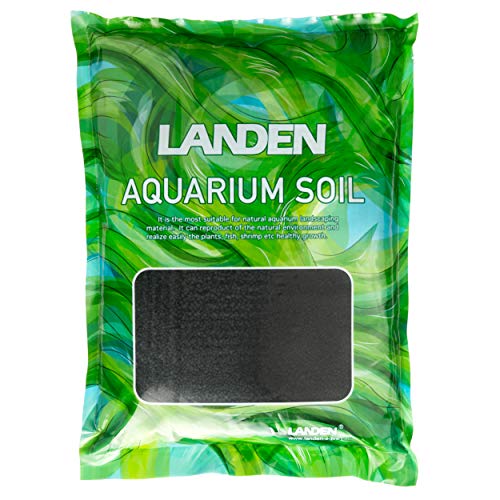
LANDEN Aqua Soil Substrate
- Best for: Heavily planted aquascapes whose keeper wants fed roots and mildly acidic water.
- Baked-clay aqua soil in porous pellets
- Nutrient-rich with high CEC
- Buffers pH to about 6.5
- Pellets stay stable in the tank
Heavily planted aquascapes whose keeper wants fed roots and mildly acidic water.
Cycle the tank before adding fish, because the soil leaches ammonia for about the first two weeks.
Strictly speaking this pick is not a gravel at all: it is an active aqua soil, included because many planted-tank buyers comparing gravels are really choosing between inert media and a soil that feeds plants directly. The baked-clay pellets are porous and nutrient-rich, with a high CEC, and they buffer the water to about 6.5, a mildly acidic range many tropical plants favour. The pellets hold their shape rather than crumbling quickly. In exchange for that feeding power, the soil leaches ammonia during roughly the first two weeks, so the tank must cycle before any fish are added.
Aqua Natural Galaxy Sand
- Best for: A dark inert cap over a nutrient base, or a soft floor for bottom-dwelling fish.
- Fine black sand with mineral flecks
- Uniform 0.5-1mm grain
- Inert, carries no nutrients
- Gentle on bottom dwellers
A dark inert cap over a nutrient base, or a soft floor for bottom-dwelling fish.
Plants get nothing from it directly, so plan root tabs or a nutrient base beneath.
This fine black sand takes the opposite approach to the soil above: it is completely inert and carries no nutrients at all. Its uniform 0.5-1mm grain, flecked with minerals, gives a clean dark floor that suits aquascapes built around hardscape and water-column feeding. Bottom dwellers rest comfortably on the smooth, fine particles. Planted use is entirely possible, but the feeding has to come from somewhere else: push root tabs beneath rooted plants or lay the sand as a cap over a nutrient base. Keep the layer modest rather than deep, since fine sand compacts when piled too thickly.
Which One Fits Your Situation
You are planting your first tank and want low risk
Start with the Flourite Black Clay Gravel. It feeds roots from its stored nutrient reserves, never touches your pH, and lasts the life of the tank, so a beginner mistake rarely traces back to the substrate. It forgives irregular fertilising far better than an inert sand and asks for nothing more than a thorough rinse on setup day.
You are building a carpeted aquascape
Choose the Flourite Black Sand for the foreground, since its fine grade lets carpeting plants root and send runners freely. If the scape is heavily planted throughout, pair that fine surface with the LANDEN soil’s feeding underneath in deeper areas, and remember the soil needs its cycling period before fish join the layout.
You keep fish that prefer soft, mildly acidic water
The LANDEN Aqua Soil Substrate fits, because it buffers pH to about 6.5 while feeding plants directly. Plan the setup around its ammonia release: plant heavily from day one, run the filter, and wait out roughly two weeks of cycling before stocking. Keepers whose fish want hard alkaline water should skip it and pick an inert or clay option instead.
You keep corydoras or other bottom dwellers
The Aqua Natural Galaxy Sand gives them a fine, gentle floor to sift and rest on. Feed your rooted plants with root tabs pushed into the sand, or lay the sand over a nutrient base in the planted zones while leaving open sand in the areas where the bottom dwellers forage most.
Common Mistakes
- Skipping the rinse on fired-clay substrates and then fighting cloudy water for days.
- Adding fish to a fresh aqua soil tank before the ammonia release has finished and the cycle is complete.
- Expecting an inert sand to feed plants on its own, without root tabs or a nutrient base beneath it.
- Piling fine sand too deep, which lets it compact and suffocate the roots it was meant to cradle.
- Choosing a substrate for its colour alone while ignoring what it does to pH and hardness.
Frequently Asked Questions
Can plants grow in plain inert sand?
Yes, provided the feeding comes from elsewhere. Rooted plants draw nutrients from root tabs pushed into the sand near their crowns, and stem plants feed mainly from the water column anyway. An inert sand like the Galaxy Sand works well as a cap over a nutrient base, which combines easy rooting at the surface with real feeding below it.
How long does an aqua soil tank need before fish go in?
Plan on roughly two weeks. Fresh aqua soil leaches ammonia as it settles, and that release has to peak and clear through the filter’s cycle before livestock is safe. Test the water rather than trusting the calendar: ammonia and nitrite should both read zero on consecutive days before the first fish are introduced to the tank.
Does Flourite need to be replaced like other planted substrates?
No. The fired-clay gravel is not consumed by the tank and is made to last the life of the aquarium. Its nutrient storage works through cation exchange, taking up nutrients from the water and fertilisers and releasing them to roots, so it keeps functioning rather than exhausting itself the way a nutrient-loaded soil gradually does over time.
Can I mix a sand cap with a soil or gravel base?
Yes, and it is a common planted-tank layout. A fine sand cap over aqua soil gives delicate foreground roots an easy surface while the soil feeds below, and sand over a nutrient base works the same way. Keep the cap thin enough that roots reach the feeding layer, and expect some gradual mixing at the boundary over time.
More from Amazon
Programs that pair well with the guide above. Offers and eligibility are set by Amazon and may change.
Set up recurring deliveries of everyday items on eligible products. Terms and savings are set by Amazon.
Explore Subscribe & SaveFree shipping on eligible items, Prime Video and more. Eligible new members can start with a free trial.
Start a Prime free trialAudiobooks and podcasts to listen to on the go. Eligible new members can start with a free trial.
Try Audible freeRead from a large library of eBooks and audiobooks on any device. Check Amazon for current plans.
Explore Kindle UnlimitedAs an Amazon Associate we earn from qualifying purchases.



Write Your Review
No reviews yet. Be the first to share your experience!