

Key takeaways
- Compare five cat doors for indoor and outdoor cats, from a simple 4-way flap to microchip and electronic models, and pick the right fit for your home.
- Top Pick: Cat Mate 4-Way Locking Cat Flap 235W
- Runner-up: PetSafe Cat Corridor Interior Pet Door
- Also consider: SureFlap Microchip Cat Flap
A good cat door ends the daily doorkeeper routine. Your cat comes and goes on its own schedule, you keep your hands free, and the house stays closed to drafts, bugs, and wandering animals. The wrong door, though, can turn into a flap that rattles all night, a hole that lets in the neighbor’s cat, or a cutout that never quite fits the door you own.
The five doors below cover the full range of what a cat door can be. There is a simple manual flap for a back door, an interior door for room-to-room access, a microchip flap that only opens for your cat, an RFID door with a timer for keeping cats in overnight, and a large electronic door for multi-pet homes. Each suits a different kind of household.
As an Amazon Associate, we earn from qualifying purchases.
Quick answer
For most cats and most homes, the SureFlap Microchip Cat Flap solves the most problems at once, since it reads your cat’s implanted chip and keeps other animals out. If you want the simplest option, the Cat Mate 235W flap does the job with a manual 4-way lock. For curfews and multi-cat control, the Cat Mate Elite 305W adds a timer and RFID discs.
The 5 Best Cat Doors
Cat Mate 4-Way Locking Cat Flap 235W

The Cat Mate 235W is the plain, honest option in this lineup. It is a manual flap with a tamper-proof 4-way lock, so you set it to in only, out only, locked, or unlocked with a twist of the dial. There are no batteries to change, no collar tags to program, and nothing electronic to fail. The flap itself is a brush-sealed polymer panel that helps keep drafts and rain on the outside, and the frame self-lines to doors up to 2 inches thick.
Installation is straightforward in UPVC, wood, and wall panels, and the liner gives a neat finish on both sides of the door. It suits a single-cat home where the main worry is weather, not visiting animals. If a neighbor’s cat wanders in through it, that is the trade-off you accept for the simplicity.
Specs: Model 235W; 4-way lock with in only, out only, locked, and unlocked settings; brush-sealed polymer flap; self-lining to 2 inches; fits UPVC, wood, and wall panels; flap opening not stated; color White; brown version is model 235B, a separate listing
PetSafe Cat Corridor Interior Pet Door

The Cat Corridor is not an exterior door at all, and that is exactly its point. It is a frame that fits into an interior door so your cat can move between rooms while a dog stays out. The opening is shaped for a cat, the frame is paintable white plastic, and the kit includes screws and finishing plugs for a tidy install in solid or hollow interior doors. It is rated for cats up to 20 lb.
The most common use is a litter box room. Put the litter box behind a closed door, fit the Corridor, and the cat gets private access while the dog cannot reach the box. There is no flap and no lock, so it offers no weather sealing and no control over which cat passes. It is a room-to-room passage, and it does the job well.
Specs: Model ZPA19-17227; for cats up to 20 lb; plastic frame with paintable white finish; fits solid or hollow interior doors; 4 screws and 4 finishing plugs included; no flap and no lock; opening size not stated
SureFlap Microchip Cat Flap
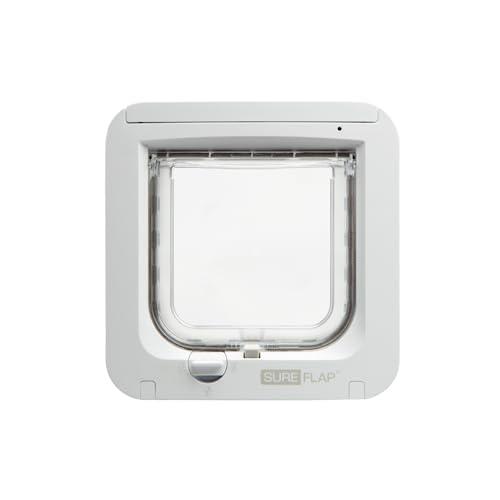
The SureFlap Microchip Cat Flap is the door that made selective entry normal. It reads your cat’s implanted microchip as the cat approaches, unlocks for that chip alone, and keeps every other animal outside. It learns up to 32 identities, so a multi-cat household needs only one door. It works with 9, 10, and 15-digit microchips, and cats without a chip can use a programmable RFID collar tag, sold separately.
The flap opening measures 4 3/4 inches high by 5 5/8 inches wide, which suits small and average cats, so measure a large cat before you cut. It runs on 4 AA batteries, not included, with battery life up to 12 months per the maker. It installs in doors, windows, and walls, with accessories sold separately for wall and glass fitting. The microchip control applies to entry only.
Specs: Model SUR001; flap opening 4 3/4 in H by 5 5/8 in W; reads 9, 10, and 15-digit microchips; learns up to 32 identities; 4 AA batteries, not included; battery life up to 12 months per the maker; selective entry only; installs in doors, windows, and walls
Cat Mate Elite Super Selective Cat Door 305W

The Cat Mate Elite 305W takes the microchip idea further and adds a clock. It uses RFID I.D. discs on the collar, with 2 supplied, and it also reads implanted microchips. Each cat gets individual entry and exit control, and the timer can lock the door on a schedule, which is the way to keep cats indoors overnight without remembering to turn a dial. An LCD display shows the lock status, each cat’s location, and how long it has been since the flap was last used, for up to 3 cats.
The door runs on 4 AA batteries, not included. The listing gives battery life as 6 to 9 months, while the manual gives about 12 months with good quality alkaline batteries, so treat the listing figure as the cautious one. The frame self-lines to 2 inches and suits doors, panels, single and double glazing, and metal, with a wall liner sold separately for wall installation. One point to confirm at import is the cat count. The listing says up to 8 cats, while the manual says up to 9.
Specs: Model 305W; RFID I.D. discs, 2 supplied, plus microchip reading; timer function with LCD display; 4-way locking system; 4 AA batteries, not included; battery life 6 to 9 months per the listing; self-lining to 2 inches; overall size 10.50 x 3.50 x 9.75 inches per the listing; cat count up to 8 per the listing, up to 9 per the manual
PetSafe Electronic SmartDoor, Large

The PetSafe Electronic SmartDoor is the heavyweight of this lineup, in both senses. It is a rigid, collar-activated door that unlocks when it senses a SmartKey on your pet’s collar, then locks again once the pet has passed through. The detection range adjusts up to 3 feet, and it can learn up to 5 SmartKeys, so a multi-pet home can give each animal its own key. It also runs in locked and unlocked modes for times when you want the door fully shut or fully open.
The flap opening on the Large model measures 11 inches by 16 inches, which is far bigger than a cat needs. That is because this door is built for dogs and cats together, and it is rated for pets up to 100 lb. If your household has a large dog and a cat sharing one door, this is the model that covers both. It runs on 4 D-cell batteries, not included. A wall conversion kit, sold separately, allows installation in walls up to 7 1/4 inches thick. Avoid fitting it in a metal door, since metal can interfere with the radio signal from the SmartKey.
Specs: Model PPA11-10709; flap opening 11 in by 16 in; SmartKey collar-activated with up to 5 SmartKeys; detection range adjustable up to 3 ft; automatic, locked, and unlocked modes; 4 D-cell batteries, not included; fits pets up to 100 lb; wall conversion kit sold separately for walls up to 7 1/4 in thick
How to choose
Measure your cat first, then measure your door. The flap opening has to clear your cat’s shoulders and belly with room to spare, and the frame has to suit the thickness and material of the door, window, or wall you plan to cut. A flap that is too small will go unused, and a frame that does not line the cutout will look rough and let in drafts.
Next, decide how much control you need. A manual 4-way lock is enough when the only animal in the neighborhood is yours. If other cats visit, a microchip or RFID door is the fix, since it only opens for a programmed chip or disc. A timer adds a curfew, which matters if you want the cats in overnight. An interior door needs none of this, since its job is to let a cat through and keep a dog out.
Finally, think about power and upkeep. Battery doors need fresh batteries on a schedule, and the battery life figures vary by brand and by how often the door cycles. If the door will go in glass, confirm that a glazier can cut the panel, since that job is not a do-it-yourself cut in most homes.
Who should skip
Skip the microchip and electronic doors if your cat is not microchipped and you do not want to fit a collar tag. A selective door that cannot recognize your cat is just a locked door, and a cat that will not wear a collar tag will not use it either. A manual flap is the better buy in that home.
Skip the large electronic door if you only have cats. Its opening is sized for a large dog, and a cat-sized flap gives better draft control and a tidier cutout. Skip any exterior door if you rent and the landlord has not agreed to a cutout in writing, since a cat door is a permanent change to the door. In that case, an interior door or a free-standing solution is the safer path.
FAQ
Do microchip cat doors work with any microchip?
Most microchip doors read the common 9, 10, and 15-digit chip formats, and the SureFlap model lists all three. If you are unsure which chip your cat carries, ask your veterinarian or shelter for the number before you buy, since a chip the door cannot read will not unlock it.
Can a cat door go in a glass door or a wall?
Yes, with the right accessories. The SureFlap and Cat Mate models list glass and wall fitting, but glass usually needs a glazier to cut the panel, and wall fitting needs a liner kit that is sold separately. Measure the thickness first, since liners only cover a set range.
How do I keep other cats from coming in?
Use a selective door. A microchip flap or an RFID door only opens for a programmed chip or disc, so a visiting cat cannot push through. A manual 4-way lock cannot do this, since any animal strong enough to push the flap can enter when it is set to open.
How long do the batteries last in an electronic cat door?
It depends on the model and how often the door cycles. The SureFlap lists up to 12 months on 4 AA batteries, while the Cat Mate Elite listing gives 6 to 9 months on 4 AA batteries and its manual gives about 12 months. Check the low-battery indicator on a schedule rather than waiting for the door to stop.
Final verdict
Buy the SureFlap Microchip Cat Flap if you want the best balance of control and simplicity for an exterior door. It keeps other animals out, needs only batteries, and suits most cats. Buy the Cat Mate 235W if you want the simplest door possible and other animals are not a worry. Buy the Cat Mate Elite 305W if you want a curfew and individual control for several cats. Buy the PetSafe Cat Corridor if the job is room-to-room access and keeping a dog away from the litter box. Buy the PetSafe Electronic SmartDoor Large only if a large dog shares the door with your cat.
More from Amazon
Programs that pair well with the guide above. Offers and eligibility are set by Amazon and may change.
Set up recurring deliveries of everyday items on eligible products. Terms and savings are set by Amazon.
Explore Subscribe & SaveFree shipping on eligible items, Prime Video and more. Eligible new members can start with a free trial.
Start a Prime free trialAudiobooks and podcasts to listen to on the go. Eligible new members can start with a free trial.
Try Audible freeRead from a large library of eBooks and audiobooks on any device. Check Amazon for current plans.
Explore Kindle UnlimitedAs an Amazon Associate we earn from qualifying purchases.




Write Your Review
No reviews yet. Be the first to share your experience!