

Key takeaways
- Rinse after every saltwater dive: use fresh water to remove salt from buttons, straps, charging contacts and transmitter fittings. Do not press buttons repeatedly while rinsing unless the manufacturer permits it.
- Inspect the strap and buckle: silicone straps can stretch, crack or tear near the buckle. Replace a damaged strap before a dive rather than relying on a backup clip.
- Protect the display: a screen protector can reduce scratches, but do not cover sensors or obstruct charging contacts.
- Maintain transmitters: check the transmitter battery, inspect its O-ring, and install it with the regulator depressurized when the manufacturer specifies that procedure.
- Update software before travel: install updates at home, then perform a dry review of gas settings, conservatism, units and time format.
- Use a backup depth and pressure method: electronics can fail. A properly maintained analog pressure gauge and an agreed dive plan remain sensible redundancy.
The best dive computers of 2026 depend on three practical questions: whether you need nitrox or multiple gases, whether you want tank-pressure data on your wrist, and whether you prefer a rechargeable or user-replaceable battery. For most recreational divers, the Shearwater Peregrine is the clearest screen-first choice; the Shearwater Peregrine TX is better if air integration matters; and the Garmin Descent Mk3i is the most capable crossover watch for divers who also want extensive topside features.
Our top picks


As an Amazon Associate we earn from qualifying purchases at no extra cost to you. Ratings are shown as listed on Amazon.
Best dive computers of 2026: quick picks
| Best for | Recommended model | Nitrox / gas support | Air integration | Battery type |
|---|---|---|---|---|
| Most recreational divers | Shearwater Peregrine | Air and nitrox, up to 40% oxygen | No | Rechargeable lithium-ion |
| Recreational diving with tank data | Shearwater Peregrine TX | Air, nitrox and multiple gas support | Yes, with transmitter | Rechargeable lithium-ion |
| Technical and advanced recreational diving | Shearwater Perdix 2 | Air, nitrox and trimix | Yes, with transmitter | User-replaceable AA battery |
| Premium watch-style computer | Shearwater Teric 2 | Air, nitrox and trimix | Yes, with transmitter | Rechargeable lithium-ion |
| One watch for diving and daily wear | Garmin Descent Mk3i | Air, nitrox and multiple gas support | Yes, with compatible Garmin transmitter | Rechargeable lithium-ion |
| Large-color-screen recreational diving | Suunto Ocean | Air and nitrox | Yes, with Suunto Tank POD | Rechargeable lithium-ion |
1. Shearwater Peregrine: best for readable recreational diving
The Shearwater Peregrine is the strongest all-around pick when screen readability and uncomplicated operation matter more than air integration. Its 2.6-inch color LCD has a 320-by-240-pixel resolution, large numerals and a simple two-button interface. That combination is easier to read at depth than many small watch-style displays, particularly when visibility is poor or a diver is wearing thick gloves.
It supports air and nitrox diving up to 40% oxygen, with a recreational decompression algorithm and a rechargeable battery rated for roughly 30 hours of dive time under typical conditions. It does not display tank pressure, so it suits divers who are comfortable checking a traditional submersible pressure gauge.
Choose it if: you make occasional to regular recreational dives, want a wide screen, and do not need multiple gases or wireless tank data.
Ownership reality: recharge it fully before a trip, rinse the charging contacts after saltwater use, and avoid storing it at zero charge for long periods. The strap and charging cable are more likely to need replacement than the computer itself.
2. Shearwater Peregrine TX: best recreational computer with air integration
The Peregrine TX keeps the Peregrine’s highly legible format but adds wireless air integration and broader gas capability. It is the better buy for divers who want tank pressure, gas remaining estimates and cylinder tracking without moving to a technical-style computer.
Its large color display remains the main advantage. Air integration requires a compatible transmitter attached to the first-stage regulator, so budget for that accessory as well as the computer. Wireless pressure data is useful, but it should complement—not replace—basic gas planning and an independent pressure gauge.
Choose it if: you dive frequently, use your own regulator setup, and want the convenience of seeing cylinder pressure alongside depth, time and decompression information.
Skip it if: you rent different regulators often or rarely dive. A transmitter adds cost and another battery-powered component to maintain.
3. Shearwater Perdix 2: best for advanced and technical divers
The Perdix 2 is the best choice in this group for divers who expect to progress into advanced decompression, trimix or multi-cylinder diving. It supports air, nitrox and trimix, offers multiple-gas planning, and can display wireless pressure from up to four transmitters. Its approximately 2.6-inch color screen is designed for quick reading rather than watch-style compactness.
Its user-replaceable AA battery is a major advantage on remote trips. A lithium AA battery can provide approximately 35 hours of dive time, while actual runtime varies with water temperature, brightness, Bluetooth use and battery quality. Carrying a correctly specified spare is easier than finding a charging outlet on a liveaboard or expedition.
Choose it if: you need trimix or multiple transmitters, want a dependable expedition-friendly power system, or prefer a computer that can grow with your training.
Important limitation: it is physically larger than a recreational wrist computer. For casual warm-water diving, its extra capability may add bulk and complexity without providing a practical benefit.
4. Shearwater Teric 2: best premium compact computer
The Teric 2 puts advanced capability into a watch-style form. It supports air, nitrox and trimix, includes air integration with compatible transmitters, and uses a bright color AMOLED display. The roughly 1.39-inch screen is sharp and attractive, but its smaller physical area cannot present information as spaciously as the Peregrine or Perdix 2.
The rechargeable battery provides about 30 hours of dive use in typical conditions. It is a strong choice for divers who want one computer for decompression diving and daily wear, including surface navigation and fitness-style functions.
Choose it if: compactness, premium display quality and advanced gas support are equally important.
Consider another model if: you have reduced near vision, routinely dive in dark water, or want the largest possible numbers while task-loaded.
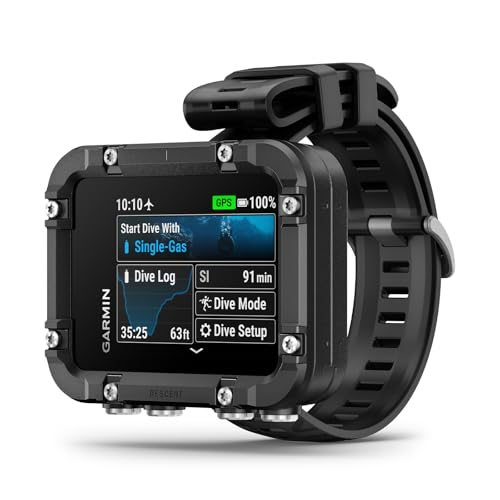
5. Garmin Descent Mk3i: best crossover dive smartwatch
The Garmin Descent Mk3i is the most versatile option for someone who wants a dive computer that also functions as a sophisticated everyday sports watch. It supports recreational and advanced gas modes, including nitrox and multiple gases, and the Mk3i version can receive tank pressure from compatible Garmin transmitters.
The 1.4-inch AMOLED display is vivid and highly configurable. Bright color improves glanceability, although battery consumption rises with brightness and smartwatch use. Garmin quotes up to about 30 hours of dive-mode battery life for relevant configurations, while topside battery life depends heavily on GPS, screen settings and notifications.
Choose it if: you will wear the watch daily and value navigation, training metrics, GPS activity tracking and smart functions as much as diving.
Trade-off: it costs more than a dedicated recreational computer, and its feature-rich interface takes longer to learn. The smaller screen may also be less comfortable than a large-format computer for divers who prioritize maximum legibility.
6. Suunto Ocean: best color-screen alternative for recreational divers
The Suunto Ocean combines a large, bright AMOLED display with recreational dive modes, nitrox support and wireless tank-pressure integration through the Suunto Tank POD. It is also designed for everyday sports tracking, making it a practical crossover option.
Its rechargeable battery is rated for approximately 40 hours of dive use in a performance-oriented configuration, though display brightness, GPS activity and temperature affect real-world endurance. The large color interface is especially appealing to divers who prefer modern watch displays over monochrome instruments.
Choose it if: you want a modern color screen, tank integration and substantial topside sports functions without moving to a technical computer.
Check before buying: confirm that the computer’s current software supports the exact gas modes and transmitter arrangement you plan to use. Compatibility can depend on the specific transmitter and firmware version.
Decision matrix: match the computer to your dive style
| Your situation | Best fit | Why | What you give up |
|---|---|---|---|
| Fewer than 10 dives a year; no tank transmitter | Peregrine | Large screen and simple operation | No wireless cylinder data |
| Weekly diving with your own regulator | Peregrine TX | Readable display plus air integration | Higher total cost with transmitter |
| Technical training or multiple cylinders | Perdix 2 | Trimix, multiple gases and replaceable AA battery | Larger and more expensive |
| One device for daily wear and diving | Teric 2 or Descent Mk3i | Compact form and extensive surface functions | Smaller dive display and rechargeable-only power |
| Preference for bright AMOLED screens | Suunto Ocean or Descent Mk3i | Color, contrast and configurable watch interfaces | Battery life depends more on display settings |
Rechargeable versus replaceable batteries
Rechargeable computers are convenient for frequent travel because you avoid opening the battery compartment and disturbing a case seal. They do require charging discipline: a computer left unused after a trip can be empty when the next dive arrives.
A replaceable-battery computer such as the Perdix 2 is more practical for extended expeditions. The calculation is simple: if a dive day uses about four hours of computer runtime, a 35-hour battery rating provides roughly eight full dive days before replacement, with some reserve. Cold water, high brightness and frequent backlight use reduce that margin, so a spare battery should still travel with the diver.
What wears out first and how to maintain a dive computer
- Rinse after every saltwater dive: use fresh water to remove salt from buttons, straps, charging contacts and transmitter fittings. Do not press buttons repeatedly while rinsing unless the manufacturer permits it.
- Inspect the strap and buckle: silicone straps can stretch, crack or tear near the buckle. Replace a damaged strap before a dive rather than relying on a backup clip.
- Protect the display: a screen protector can reduce scratches, but do not cover sensors or obstruct charging contacts.
- Maintain transmitters: check the transmitter battery, inspect its O-ring, and install it with the regulator depressurized when the manufacturer specifies that procedure.
- Update software before travel: install updates at home, then perform a dry review of gas settings, conservatism, units and time format.
- Use a backup depth and pressure method: electronics can fail. A properly maintained analog pressure gauge and an agreed dive plan remain sensible redundancy.
Bottom line
For the best combination of price, readability and recreational simplicity, choose the Shearwater Peregrine. Select the Peregrine TX when wireless tank pressure is important. Choose the Perdix 2 for technical progression and field-swappable power, the Teric 2 for compact premium capability, and the Garmin Descent Mk3i or Suunto Ocean when a dive computer must also serve as a daily sports watch. Whichever model you buy, confirm its current gas limits, transmitter compatibility and battery rating against your actual equipment before entering the water.

Write Your Review
No reviews yet. Be the first to share your experience!