

Key takeaways
- Feet: Rubber feet wear, harden, or collect grit. Clean them with mild soap and water and replace damaged feet with the correct model-specific parts.
- Hinges and spreaders: Dust and paint can prevent full locking. Keep moving joints clean; do not lubricate a locking mechanism unless the manufacturer permits it.
- Steps and platforms: Paint, grease, and cleaning products reduce traction. Remove spills before the next use and avoid abrasive cleaning that smooths textured surfaces.
- Fiberglass rails: Fiberglass can become rough, chalky, or visibly damaged after exposure and impact. Do not sand structural damage or cover it with tape; replace the ladder.
- Labels: Capacity and safety labels are important operating information. If they become unreadable, obtain replacement labels from the manufacturer or retire the ladder.
The best step ladders for most homes are a 3-step ladder for everyday reach, a 4-step platform ladder for painting and storage tasks, or a lightweight 6-foot fiberglass stepladder when you need more height without sacrificing stability. Choose by the highest standing level you can use comfortably—not simply the tallest advertised height—and compare capacity, folded size, tread grip, handrails, and storage space together.
Our top picks

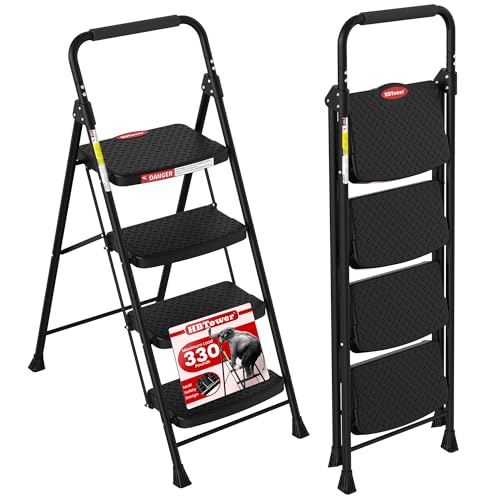


As an Amazon Associate we earn from qualifying purchases at no extra cost to you. Ratings are shown as listed on Amazon.
Best step ladders by household situation
| Situation | Best choice | Why it fits | Main compromise |
|---|---|---|---|
| Small kitchen, apartment, or frequent light tasks | 2- or 3-step aluminum or steel ladder | Usually 24–34 inches tall when closed and easy to store in a closet | Limited reach; the top step is often not a standing step |
| Changing bulbs, reaching cabinets, and cleaning | 3-step ladder with a broad top platform and handrail | Typically provides a 26–30 inch standing height and better balance than a stool | Heavier than a basic folding step stool |
| Painting, decorating, or working with both hands | 4-step platform ladder | A large standing platform, rear rail, and tool tray reduce repeated climbing | Often 15–25 pounds and needs more floor and storage space |
| High ceilings or occasional upper-wall work | 6-foot Type IA fiberglass stepladder | About 300-pound capacity and a standing height around 4 feet, depending on design | Bulky when folded and excessive for ordinary cabinet access |
| Very frequent use or heavier tools | Type IA or Type IAA industrial platform ladder | 300- or 375-pound rated capacity and more robust hinges and rails | Higher cost and weight; not the most convenient choice for quick indoor jobs |
What makes a step ladder safe and useful?
Platform height and useful reach
A ladder’s overall height is not the same as its safe standing height. On a conventional stepladder, the top cap and the highest marked step are generally not intended for standing. A 3-step ladder may give you a platform roughly 26–30 inches above the floor, while a 4-step platform ladder may provide approximately 36–40 inches. A 6-foot stepladder commonly has a standing level near 4 feet.
Your practical reach is usually about 5–6 feet above the standing level, but this varies with your height, arm length, and the task. Do not select a ladder by stretching to the highest possible point. If you must stand on tiptoe, lean sideways, or reach behind your shoulder, the ladder is too short or poorly positioned. Moving the ladder is safer than extending your body outside its rails.
Weight capacity is the whole load
Capacity includes your body, clothing, shoes, tools, paint, and anything you carry. A 200-pound user carrying a 20-pound toolbox needs at least a 220-pound rating before allowing any margin. A 300-pound Type IA ladder is a sensible general-purpose minimum for many households; Type IAA ladders are rated to 375 pounds and are useful when heavier equipment or a larger safety margin is important.
Do not confuse a higher capacity rating with permission to use a ladder on unsuitable surfaces. A strong ladder can still slip on wet tile, settle into soft ground, or tip if it is opened incompletely.
Folded dimensions and storage convenience
Measure the storage location before buying. A compact 3-step ladder may be around 4 feet long when folded and 3–5 inches deep, whereas a 6-foot stepladder can be roughly 6–7 feet long and 5–8 inches deep. Platform ladders are often wider because of their rear rails and larger standing surface.
For a narrow utility closet, a slim aluminum step ladder or folding step stool is usually more practical than a wide platform model. For a garage, basement, or workshop, the extra depth of a platform ladder may be worthwhile because it is easier to stand on for several minutes. Look for a top handle, a recessed tool tray, or a design that can hang securely from a rated wall hook. Never hang a ladder by a fragile plastic accessory.
Tread grip and floor protection
The safest steps have deep, textured treads rather than narrow smooth rungs. Serrated aluminum treads provide strong traction but can feel uncomfortable during long jobs. Molded plastic or rubber-covered platforms are kinder to indoor footwear and often quieter on hard floors.
Inspect the feet as carefully as the steps. Nonmarking rubber or elastomer feet should sit flat and remain attached without wobbling. Replacement feet are available for some established ladder lines, including products from Werner, Little Giant, Louisville Ladder, and Gorilla Ladders, but availability varies by model. If the feet are cracked, hardened, missing, or worn smooth, retire the ladder or replace the parts before use.
Handrails and upper support
A tall front handrail makes a meaningful difference when stepping on or off the ladder, especially while carrying a light object. Three-step designs with a high grab bar are often easier to control than low step stools. For painting or extended work, choose a platform ladder with a rear safety rail, a wide top platform, and a tool tray so that both hands remain available while climbing.
A handrail is not a substitute for three points of contact. Keep two hands and one foot, or two feet and one hand, in contact with the ladder whenever possible. Do not carry bulky objects that block your view of the steps.
Head-to-head: compact step ladder versus platform ladder
Compact folding ladder
A compact 2- or 3-step ladder wins on storage, speed, and price. It is the better choice for putting away dishes, reaching a closet shelf, or changing a low light bulb. Aluminum models are often light enough to move with one hand, while steel models may feel more planted but weigh more.
The trade-off is a smaller standing area, lower maximum reach, and less support near the top. Choose one with a locking spreader, slip-resistant feet, and a handhold rather than a design that relies only on a small top cap.
Platform ladder
A platform ladder is the better choice when you will stand in one position for more than a few minutes. Its larger platform reduces foot fatigue, and its rail or guard gives you a stable upper grip. Products such as the Little Giant Flip-N-Lite and platform-style ladders from Werner are examples of the lightweight, household-oriented category; heavier fiberglass platform ladders are designed for more demanding work.
The disadvantages are storage width, weight, and a larger turning radius in a crowded room. A platform ladder is not automatically safer if you cannot open it fully or place all four feet on a level surface.
How to choose using a simple fit calculation
Start with the highest surface you need to reach, then subtract your standing height on the ladder. For example, if the highest cabinet shelf is 8 feet above the floor and your comfortable hand reach is about 6 feet above a standing platform, a platform around 2 feet high may be sufficient. If you need to work at the ceiling, however, you need a much taller standing level and a ladder designed for that height.
Do not use the calculation to justify standing on a prohibited top step. Check the manufacturer’s labeled standing level and keep your belt buckle between the side rails. If the task requires reaching beyond that position, select the next appropriate ladder size.
Ownership realities: what wears out first?
- Feet: Rubber feet wear, harden, or collect grit. Clean them with mild soap and water and replace damaged feet with the correct model-specific parts.
- Hinges and spreaders: Dust and paint can prevent full locking. Keep moving joints clean; do not lubricate a locking mechanism unless the manufacturer permits it.
- Steps and platforms: Paint, grease, and cleaning products reduce traction. Remove spills before the next use and avoid abrasive cleaning that smooths textured surfaces.
- Fiberglass rails: Fiberglass can become rough, chalky, or visibly damaged after exposure and impact. Do not sand structural damage or cover it with tape; replace the ladder.
- Labels: Capacity and safety labels are important operating information. If they become unreadable, obtain replacement labels from the manufacturer or retire the ladder.
Common buying and setup mistakes
Buying the lightest ladder is a mistake when it has tiny treads, no handrail, or a capacity too close to the user’s total load. Buying the tallest ladder is also inefficient: it takes more space and can encourage unsafe overreaching from a high position.
Before climbing, open the ladder completely, lock both spreaders, place all feet on a firm level surface, and face the ladder. Keep it away from doors unless the door is locked, guarded, or otherwise prevented from opening. Never place a stepladder on a box, chair, or another ladder to gain extra height.
Final recommendation
For most homes, a 3-step ladder with a broad nonslip platform, a handrail, a 300-pound rating, and a folded depth under 6 inches offers the best balance. Choose a 4-step platform model when you regularly paint, clean high areas, or work with both hands. Choose a 6-foot fiberglass Type IA ladder only when its additional reach is necessary and you have adequate storage. The best step ladders are the ones whose standing height, capacity, grip, and folded dimensions match the job—without requiring you to stretch, balance, or improvise.

Write Your Review
No reviews yet. Be the first to share your experience!