

Key takeaways
- Best overall for repeated indoor use: a 100-inch tripod screen with a locking height mechanism, a metal case, and a matte-white surface.
- Best image quality: a folding-frame screen with a separate black backing and a low-gain matte-white fabric.
- Best for travel: a 60- to 80-inch pull-up or compact folding screen weighing under 15 pounds.
- Best for large outdoor movie nights: an inflatable screen with a 120- to 150-inch viewing area and a continuous-duty blower.
- Best for a tight budget: a basic tripod screen in the 80- to 100-inch range, provided you can protect it from wind and uneven flooring.
The best portable projector screens depend on where you will use them: choose a tensioned foldable screen for the flattest image, a tripod screen for fast indoor setup, a lightweight pull-up screen for travel, or an inflatable screen for large outdoor gatherings.
Our top picks


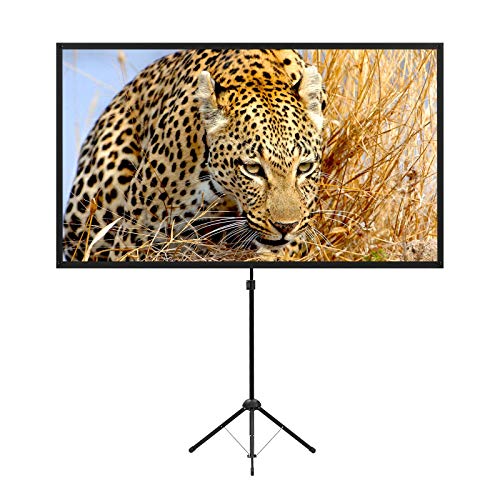

As an Amazon Associate we earn from qualifying purchases at no extra cost to you. Ratings are shown as listed on Amazon.
Quick picks by situation
- Best overall for repeated indoor use: a 100-inch tripod screen with a locking height mechanism, a metal case, and a matte-white surface.
- Best image quality: a folding-frame screen with a separate black backing and a low-gain matte-white fabric.
- Best for travel: a 60- to 80-inch pull-up or compact folding screen weighing under 15 pounds.
- Best for large outdoor movie nights: an inflatable screen with a 120- to 150-inch viewing area and a continuous-duty blower.
- Best for a tight budget: a basic tripod screen in the 80- to 100-inch range, provided you can protect it from wind and uneven flooring.
Portable projector screen comparison
| Screen type | Common sizes | Aspect ratio | Typical setup time | Typical packed weight | Wrinkle resistance | Best use |
|---|---|---|---|---|---|---|
| Tripod pull-down | 60–120 inches | 4:3 or 16:9 | 2–5 minutes | 8–25 lb | Good after careful storage | Living rooms, classrooms, occasional presentations |
| Folding frame | 80–150 inches | 16:9 or 16:10 | 10–20 minutes | 15–45 lb | Excellent when tensioned | Frequent movie nights and dedicated setups |
| Pull-up tabletop or floor-rising | 40–100 inches | 16:9 or 16:10 | 1–3 minutes | 4–20 lb | Fair to good | Travel, desks, small rooms |
| Inflatable | 100–200 inches | 16:9 | 5–15 minutes | 12–35 lb, plus blower | Very good | Backyards and large groups |
What to compare before buying
Screen size and viewing distance
A larger screen is not automatically better. A useful starting point is a viewing distance of about 1.2 to 1.6 times the image width for movies. A 100-inch diagonal 16:9 screen has an image approximately 87 inches wide. That puts a comfortable seating range at roughly 9 to 12 feet, although individual preference and projector resolution matter.
Remember that the advertised diagonal is not the same as the screen width. A 120-inch 16:9 screen is about 105 inches wide, while a 120-inch 4:3 screen is about 96 inches wide and substantially taller. Measure the wall, ceiling height, seating distance, and projector throw before choosing a size.
Aspect ratio
For current films, streaming shows, and most home-theater projectors, 16:9 is the safest choice. A 16:10 screen suits many business and computer projectors. A 4:3 screen can be useful for older presentations, classroom documents, or legacy video, but widescreen content will leave unused space or require cropping.
Do not select a screen merely because its diagonal matches your projector’s maximum image size. Check the projector’s native resolution and throw distance first. A screen cannot correct a projector that is too dim, too close, or unable to fill the chosen format.
Stand stability
Tripod screens are convenient, but their narrow center support is also their weak point. Look for a wide three-leg base, a rigid central column, a positive height lock, and a case that does not flex when carried. A 100-inch screen may be manageable indoors but unstable on a soft lawn or in a breeze.
For outdoor use, a folding frame with ground stakes and guy lines is usually more secure than a tall tripod. Inflatable screens distribute their weight differently, but the blower must run continuously and the screen still needs tethering. Never rely on the screen’s weight alone in windy conditions.
Setup time and transport
Tripod screens generally win for spontaneous use. They open quickly, but the fabric can develop side curl if it remains rolled tightly for long periods. Folding frames take longer to assemble because the frame, fabric, legs, and case are separate, but they produce a flatter image.
Weight is only part of portability. A 20-pound screen in a long, awkward case may be harder to move than a 25-pound frame in a compact wheeled case. Check packed length, handle quality, wheel clearance, and whether the case protects the fabric from dust and crushed edges.
Wrinkle resistance
Screen material and storage determine whether the image looks smooth. Tensioned fabrics, especially those attached to a folding frame with snaps or hook-and-loop fasteners, usually resist wrinkles best. Non-tensioned vinyl is more likely to show waves, particularly when it is cold or stored compressed.
Wrinkles are not merely cosmetic: they can distort subtitles, straight lines, and presentation charts. Avoid folding the viewing surface sharply, placing heavy objects on it, or storing it damp. If a screen arrives with mild waves, allow it to hang or remain tensioned for several days before judging it.
Decision matrix for different buyers
| Your situation | Recommended format | Target specifications | Why it fits |
|---|---|---|---|
| First-time buyer on a budget | Tripod | 80–100 inches, matte white, under 20 lb | Simple operation and broad availability |
| Weekly indoor movie use | Folding frame | 100–120 inches, 16:9, tensioned fabric | Better flatness and long-term image consistency |
| Frequent travel | Pull-up | 60–80 inches, under 12 lb, protective case | Small packed size and minimal assembly |
| Backyard gatherings | Inflatable | 120–150 inches, stakes, tether kit, spare blower fuse | Large image with relatively low frame weight |
| Bright room or porch | Controlled-gain surface or ambient-light-resistant design | 80–100 inches, black backing, suitable viewing angle | Reduces light passing through the fabric |
Notable product lines and what to expect
Established portable lines such as the Elite Screens Tripod Series are designed around quick pull-up deployment and are available in several sizes and formats. They are a sensible choice when convenience matters more than maximum wrinkle control.
The Elite Screens Yard Master 2 is a better match for people who want a freestanding outdoor screen with a frame and a more cinema-like presentation. Its frame-based design generally requires more storage space and assembly than a tripod, but tensioning can improve flatness.
Other brands sell similar tripod, folding-frame, and inflatable designs. Compare the actual packed dimensions, fabric attachment method, replacement-part availability, and warranty terms rather than relying on the brand name alone. Market prices commonly range from about $50–$150 for basic tripod screens, $150–$500 for better frame systems, and $200–$700 for larger inflatable packages.
Setup steps that prevent common problems
- Measure before unpacking. Confirm that the projected image will fit between furniture, windows, or ceiling fixtures.
- Place the screen on level ground. A small floor slope can twist a tripod column and make the image appear uneven.
- Raise the screen gradually. Do not yank a pull-down handle past its locking point; the roller and spring are common failure points.
- Tension frame fabric evenly. Attach opposite corners first, then work around the sides to avoid diagonal strain.
- Secure outdoor screens. Use every supplied stake and guy line. Add weight to legs only where the manufacturer permits it.
- Align the projector after the screen is stable. Keystone correction can reduce image quality, so physical alignment is preferable when possible.
Ownership costs and durability
The fabric is usually not the first part to fail. Tripod mechanisms, spring rollers, plastic leg joints, blower motors, and carrying-case zippers receive more mechanical stress. A screen used twice a month for three years gets about 72 setup cycles; paying $180 for a model that lasts that long works out to approximately $2.50 per use before electricity or replacement parts.
Keep the fabric dry before packing it, remove dust with a soft microfiber cloth, and follow the manufacturer’s cleaning instructions. Avoid abrasive cleaners, paper towels, and aggressive scrubbing, which can change the surface texture. Store the screen horizontally or in its intended case, away from high heat and direct sunlight.
For most homes, a 100-inch 16:9 tripod screen is the easiest starting point. Upgrade to a tensioned folding frame if wrinkles or weekly setup become frustrating, and choose an inflatable screen only when the large outdoor image justifies the blower, tethering, and extra storage requirements.
Write Your Review
No reviews yet. Be the first to share your experience!