

Key takeaways
- The best coverstitch machines for clean, professional hems are the Janome CoverPro 3000 Professional for maximum stitch flexibility, the Brother CV3550 for decorative top-cover stitching, the Juki MCS-1500 for straightforward everyday hemming, and the Bernette b42 for a lower-cost entry…
The best coverstitch machines for clean, professional hems are the Janome CoverPro 3000 Professional for maximum stitch flexibility, the Brother CV3550 for decorative top-cover stitching, the Juki MCS-1500 for straightforward everyday hemming, and the Bernette b42 for a lower-cost entry into coverstitch sewing.
A coverstitch machine is designed for stretch hems, sleeve cuffs, activewear, knit necklines, and other seams where you want parallel lines of stitching on the outside and a flexible looper stitch underneath. It does not replace an overlocker: an overlocker trims and encloses an edge, while a coverstitch machine normally sews a finished hem after the edge has been folded.
Our top picks


As an Amazon Associate we earn from qualifying purchases at no extra cost to you. Ratings are shown as listed on Amazon.
Best coverstitch machines by sewing situation
| Machine | Stitch options | Approx. size and weight | Best for | Typical market range |
|---|---|---|---|---|
| Janome CoverPro 3000 Professional | Triple-needle cover, wide and narrow cover, chain stitch, top-cover stitch | Approx. 18.7 × 16.3 × 14.6 in; 18.7 lb | Frequent sewing and the widest range of professional-looking hems | About $1,000–$1,300 |
| Brother CV3550 | Triple-needle, wide and narrow cover, chain stitch, top-cover stitch | Approx. 12.9 × 11.8 × 11.6 in; 15.4 lb | Decorative top-cover stitching and home garment sewing | About $600–$850 |
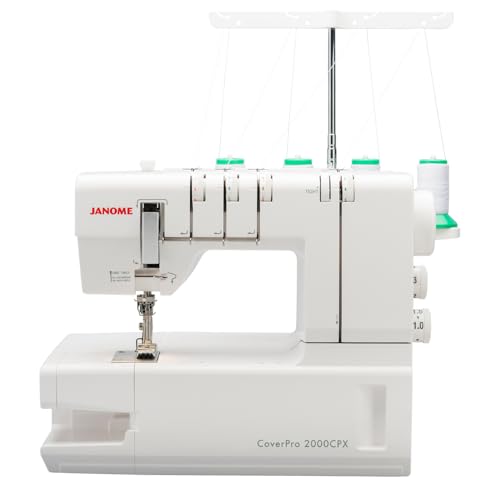
| Janome CoverPro 2000CPX | Triple-needle, wide and narrow cover, chain stitch | Approx. 15.5 × 13.5 × 14.5 in; 16.5 lb | Reliable general-purpose knit sewing without top cover | About $700–$950 |
| Juki MCS-1500 | Triple-needle, wide and narrow cover, chain stitch | Approx. 10.6 × 11.3 × 11.4 in; 14.6 lb | Compact workspaces and users who value simple controls | About $500–$750 |
| Bernette b42 | Triple-needle, wide and narrow cover, chain stitch | Approx. 11.8 × 10.6 × 11.8 in; 18.1 lb | Beginners and occasional hemming at a moderate price | About $500–$700 |
Dimensions and prices can vary by region, bundle, and included accessories. The figures above are useful for comparing the machines, but allow extra table space for fabric, thread cones, and access to the rear of the machine.
1. Janome CoverPro 3000 Professional: best overall for stitch choice
The CoverPro 3000 Professional is the strongest choice when “clean seams” means more than a basic two-line hem. It provides narrow and wide coverstitch configurations, a three-needle coverstitch, chain stitch, and a top-cover stitch. The top-cover option adds extra thread coverage on the outside of the garment, making it useful for sweatshirt hems, sportswear, and visible decorative details.
Its main advantage is control rather than speed alone. The machine includes features intended to make the start and finish of a seam neater, and its larger body gives you more working room around bulky hems. Presser-foot clearance is suitable for ordinary knit hems and layered waistbands, but no domestic coverstitch machine should be treated like an industrial machine for very thick belt loops or multiple layers of denim.
Threading is moderately demanding because the top-cover system adds another thread path and requires careful needle selection. It is a good investment for someone sewing several garments each month, but excessive for a person who only wants to hem a few T-shirts each year.
2. Brother CV3550: best for top-cover decoration
The Brother CV3550 is the most appealing pick when the outside appearance matters as much as stretch. Its top-cover stitch creates a second layer of thread on the garment’s face, giving hems a more finished, ready-to-wear look than a standard coverstitch. It also supports wide, narrow, and triple-needle coverstitches plus chain stitch.
The machine has a relatively approachable layout and useful visual guides, although threading is still more involved than threading a regular sewing machine. The top-cover looper and additional thread paths are the parts most likely to slow down a first-time user. Once threaded, it handles jersey, cotton-spandex blends, rib knit, lightweight sweatshirt fleece, and many athletic fabrics well.
Choose it over the Janome 2000CPX if you specifically want top-cover stitching. Choose the Janome 3000 instead if you want a broader professional feature set and expect to sew frequently.
3. Juki MCS-1500: best compact everyday machine
The Juki MCS-1500 is a sensible choice for users who want clean stretch hems without paying for decorative top-cover capability. It offers chain stitch and the main coverstitch widths used for garments. Its compact footprint is helpful when the machine must be stored after each project.
Juki’s strong point is controlled fabric feeding. The machine is particularly comfortable on jersey, interlock, ribbing, and medium-weight knits. Presser-foot clearance is adequate for folded hems, but thick intersections should be approached slowly and leveled with a small fabric shim if the foot struggles to climb the ridge.
Threading remains the central learning curve. The looper thread must be seated correctly, and the needles need to be inserted fully and oriented properly. A mis-threaded looper can create skipped stitches that look like a tension problem. For occasional users, photographing the threaded machine before changing colors is a practical ownership shortcut.
4. Bernette b42: best for beginners on a budget
The Bernette b42 focuses on core coverstitch functions: wide, narrow, and triple-needle coverstitching along with chain stitch. It does not offer the top-cover capability found on the Brother CV3550 and Janome CoverPro 3000, but that omission keeps the machine easier to understand and usually less expensive.
It suits cotton jersey, rayon jersey, rib knit, and light-to-medium sweatshirt fabric. Differential feed helps reduce waviness on stretchy fabric, although it is not a cure for every problem. If a hem is rippling, first check that the fabric is not being pulled behind the presser foot, then adjust differential feed and test on a scrap.
The b42 is a good match for a beginner who wants professional-looking twin lines on T-shirts, leggings, pajamas, and children’s garments. Users making heavy activewear or sewing daily may prefer the larger working area and additional features of a higher-tier machine.
How the important features affect your choice
Stitch options
A narrow two-needle coverstitch is useful for small hems and lightweight knits. A wide two-needle coverstitch gives a more visible twin-line finish. A three-needle coverstitch spreads the lines across a wider area and is common on sportswear and ready-to-wear hems. Chain stitch is useful for seams that need a little flexibility, but it is not a substitute for an overlocked edge finish.
Top-cover stitch is the specialist option. It places decorative coverage on the upper side while retaining a looper structure underneath. It looks attractive, but it adds threading steps, thread consumption, and more opportunities for setup errors.
Threading difficulty
All coverstitch machines are more demanding than ordinary sewing machines because they use multiple needles and a looper beneath the fabric. The most common mistakes are threading in the wrong order, failing to seat a thread in a guide, using the wrong needle system, and threading with the presser foot lowered.
For easier color changes, use the same thread weight in every position, tie the new thread to the old thread, and pull the knot through gently rather than forcing it through the needles. Rethread the needles separately if the knot catches.
Presser-foot clearance
Clearance determines how comfortably a machine crosses a folded seam, waistband join, or side-seam intersection. Coverstitch machines generally handle one or two layers of knit fabric well. Thick fleece, elastic enclosed in several layers, and bulky crossed seams are more challenging.
If you regularly sew dense athletic fabrics or thick sweatshirt fleece, prioritize a machine with a stable presser-foot lift, a strong motor, and a clear working area. Do not judge clearance by the maximum lift alone: the feed dogs still need to move the fabric evenly under the foot.
Differential feed
Differential feed changes the relative speed of the front and rear feed dogs. A higher setting can help prevent stretched knits from forming wavy hems; a lower setting can help manage gathering or excess fullness. Start at the machine’s neutral setting, sew a test strip, and change one increment at a time.
| Your situation | Recommended choice | Why |
|---|---|---|
| First coverstitch machine, occasional use | Bernette b42 | Core stitches without the added complexity of top cover |
| Small sewing room or frequent setup and storage | Juki MCS-1500 | Compact format and useful everyday stitch selection |
| Visible decorative hems | Brother CV3550 | Top-cover stitch adds face-side thread coverage |
| Several garments each month | Janome CoverPro 2000CPX | Versatile standard coverstitch performance without top-cover threading |
| High frequency, multiple fabric types, maximum flexibility | Janome CoverPro 3000 Professional | Broadest stitch options and a more feature-rich platform |
Setup and maintenance that prevent messy seams
-
Use the correct needles. Stretch or ballpoint needles are appropriate for many knits, while a coverstitch-compatible needle system should be confirmed in the manual. Replace bent or dull needles before troubleshooting tension.
-
Thread with the presser foot raised. This opens the tension discs and helps each thread seat correctly.
-
Test on the actual fabric. Use the same number of layers, hem fold, and thread type as the garment. A stitch that works on cotton jersey may tunnel on rib knit.
-
Begin on a leader. Starting directly at a fabric edge can cause thread nests. A short fabric scrap or chain-off leader gives the stitches time to form.
-
Clean lint frequently. Brush around the needle plate, feed dogs, and looper area after each project involving fleece or brushed knits. Follow the manual for lubrication; many modern machines should not be oiled by the owner.
-
Check the first skipped stitch. Skipping at a bulky seam often points to fabric height, needle condition, or timing rather than a simple tension adjustment.
For most home sewists, the Brother CV3550 is the best choice when top-cover decoration is a priority, the Juki MCS-1500 is the best compact option, and the Bernette b42 offers the simplest route into coverstitch sewing. If you want one machine with the fewest compromises and expect to use it often, the Janome CoverPro 3000 Professional is the most capable pick.

Write Your Review
No reviews yet. Be the first to share your experience!