

Key takeaways
- Check the laptop first. A USB-C-shaped port may support USB4, Thunderbolt, DisplayPort Alt Mode, charging, or only some of these functions.
- Count the display signal paths. Multiple ports on a dock do not always mean multiple independent displays on every operating system.
- Separate resolution from refresh rate. A dock may support 4K at 60Hz but not 4K at 120Hz, even when the connector is HDMI 2.1.
- Expect macOS differences. Many base-model MacBook systems have native limitations on the number of external displays. DisplayLink-based docks can change the result, but they require software and are a different technology from native Thunderbolt display output.
- Use the right cable. A monitor cable rated only for older HDMI or DisplayPort standards can limit the result even when the dock is capable of more.
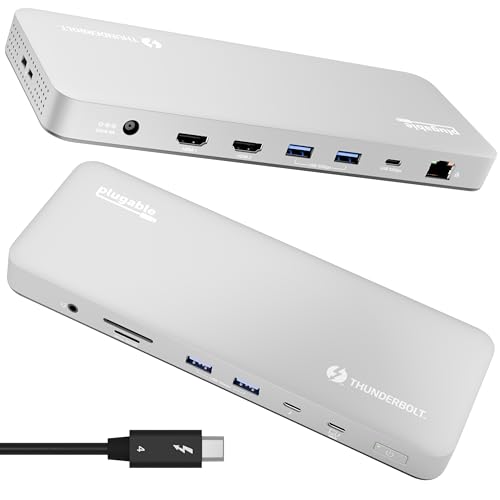
The best Thunderbolt docks for most desks are the CalDigit TS4 for maximum port variety, the OWC Thunderbolt Go Dock for a portable workstation, and the Plugable TBT4-UDZ for a Windows desk with two conventional monitor outputs.
Our top picks



As an Amazon Associate we earn from qualifying purchases at no extra cost to you. Ratings are shown as listed on Amazon.
Quick comparison
| Dock | Thunderbolt generation | Charging to laptop | Display connections | Notable ports | Approximate footprint |
|---|---|---|---|---|---|
| CalDigit TS4 | Thunderbolt 4 | 98W | DisplayPort 1.4 plus Thunderbolt display output | 18 total ports, 2.5Gb Ethernet, SD and microSD, audio in/out | 158 x 113 x 42 mm; about 0.47 kg |
| OWC Thunderbolt Go Dock | Thunderbolt 4 | 90W | HDMI 2.1 plus Thunderbolt display output | 11 ports, 2.5Gb Ethernet, SD, integrated power supply | Approximately 204 x 89 x 32 mm; about 0.85 kg |
| Anker 778 Thunderbolt Docking Station | Thunderbolt 4 | 100W | HDMI 2.1, DisplayPort 1.4, and Thunderbolt display output | 12 ports, 2.5Gb Ethernet, SD, USB-C and USB-A expansion | Approximately 183 x 79 x 26 mm; about 0.46 kg |
| Plugable TBT4-UDZ | Thunderbolt 4 | 96W | Two HDMI 2.0 and two DisplayPort 1.4 outputs | 14 ports, 2.5Gb Ethernet, SD and microSD | Approximately 190 x 85 x 32 mm; about 0.82 kg |
| Kensington SD5780T | Thunderbolt 4 | 96W | DisplayPort 1.4 plus Thunderbolt display output | 11 ports, 2.5Gb Ethernet, SD, USB-C and USB-A | Approximately 223 x 80 x 28 mm |
Dimensions and weight can vary slightly by revision and included accessories. The comparison is intended for desk planning rather than millimetre-perfect furniture fitting.
Best Thunderbolt docks by situation
Best overall for a busy workstation: CalDigit TS4
The CalDigit TS4 is the strongest choice when one dock must replace a collection of adapters. Its 18 ports include fast USB-C and USB-A connections, a front-facing USB-C port, UHS-II SD and microSD card readers, 2.5Gb Ethernet, separate audio connections, and three downstream Thunderbolt 4 ports. Its 98W host charging is enough for many professional laptops.
Choose it for photography, video work, development, or a desk shared by several computers and accessories. Its limitation is display flexibility: it is not designed around several dedicated HDMI sockets. Monitor arrangements depend on the laptop, the dock’s DisplayPort connection, and Thunderbolt-compatible displays or adapters. It also occupies more depth than slimmer docks.
Best for moving between desks: OWC Thunderbolt Go Dock
The OWC Thunderbolt Go Dock has a practical advantage that a specification list understates: its power supply is built into the dock. You do not need to carry a separate large power brick, which makes it useful for a home office, a hot desk, or occasional travel. It offers 90W laptop charging, HDMI 2.1, 2.5Gb Ethernet, SD storage, and Thunderbolt expansion.
The integrated supply makes the dock heavier than some compact alternatives, so it is better described as transportable than truly lightweight. Its 11-port layout is also less generous than the TS4. Pick it when reducing cable-bag clutter matters more than having the maximum number of legacy ports.
Best for two ordinary monitors on Windows: Plugable TBT4-UDZ
The Plugable TBT4-UDZ is a particularly sensible Windows workstation dock because it provides two HDMI 2.0 and two DisplayPort 1.4 outputs. That makes it easier to connect common office monitors without buying multiple video adapters. It also includes 96W charging, 2.5Gb Ethernet, SD and microSD readers, and a broad selection of USB ports.
Display behavior still depends on the computer. A Windows laptop with Thunderbolt 4 can generally use two external displays through the dock, subject to its graphics hardware and monitor resolutions. macOS has more restrictive multi-monitor behavior on many MacBook models, so do not select this dock solely because it has four video sockets.
Best for HDMI 2.1 and high-power charging: Anker 778
The Anker 778 Thunderbolt Docking Station combines 100W host charging with HDMI 2.1, DisplayPort 1.4, Thunderbolt 4, 2.5Gb Ethernet, and 12 total ports. It suits a modern desk using a high-resolution HDMI monitor, a fast network, and several USB-C peripherals.
Its 100W figure is a maximum delivery rating, not a guarantee that every laptop will draw 100W. The computer negotiates its own charging rate, and the dock must reserve some power for its USB devices. Gaming laptops and mobile workstations may still require their original charger during sustained heavy loads.
Best for a tidy, business-oriented desk: Kensington SD5780T
The Kensington SD5780T is a good fit when the essentials are more important than a large port count. It offers Thunderbolt 4 expansion, 96W charging, DisplayPort, 2.5Gb Ethernet, SD storage, and USB-C and USB-A ports in a relatively narrow chassis. Kensington’s range is also commonly considered by businesses that value security accessories and standardized office equipment.
Its long, low shape is easy to place behind a monitor stand, but measure the cable route before buying: the overall length is greater than that of many upright docks. It is less attractive for users who need multiple front-access ports or several dedicated monitor connectors.
Thunderbolt 4 versus Thunderbolt 5
Thunderbolt 4 provides up to 40Gbps of shared connectivity and supports PCIe tunneling, USB devices, displays, and networking through one cable. It is the mature choice for most current docks, especially if your laptop, monitors, and storage devices are Thunderbolt 4 or USB4.
Thunderbolt 5 raises the headline bandwidth to 80Gbps and can provide up to 120Gbps in a display-focused mode. However, a Thunderbolt 5 dock only delivers its principal advantages when the laptop and peripherals also support Thunderbolt 5. A Thunderbolt 4 computer connected to a Thunderbolt 5 dock will not become a Thunderbolt 5 workstation. For a mixed-generation desk, spending more on Thunderbolt 5 may be poor value unless you already own high-bandwidth storage or unusually demanding displays.
Display support: the specification that causes the most surprises
- Check the laptop first. A USB-C-shaped port may support USB4, Thunderbolt, DisplayPort Alt Mode, charging, or only some of these functions.
- Count the display signal paths. Multiple ports on a dock do not always mean multiple independent displays on every operating system.
- Separate resolution from refresh rate. A dock may support 4K at 60Hz but not 4K at 120Hz, even when the connector is HDMI 2.1.
- Expect macOS differences. Many base-model MacBook systems have native limitations on the number of external displays. DisplayLink-based docks can change the result, but they require software and are a different technology from native Thunderbolt display output.
- Use the right cable. A monitor cable rated only for older HDMI or DisplayPort standards can limit the result even when the dock is capable of more.
How much charging power do you need?
For a simple office laptop, 60W to 90W is usually adequate. Premium 13- and 14-inch laptops benefit from 90W or more, while larger mobile workstations may need their own charger under sustained CPU or GPU load. A dock rated at 100W does not mean 100W reaches the computer continuously: power is shared with dock electronics and connected USB devices.
For example, if a dock reserves 15W for its own operation and connected accessories, a 100W power budget may leave approximately 85W for the laptop. That can maintain charge during office work but may be slower than the laptop’s original 100W or 140W adapter during rendering or gaming.
Desk footprint and ownership realities
Compact docks save space, but they often place ports close together and use an external power brick. A larger dock can be easier to manage because connectors are spread out and heavy cables are less likely to pull it across the desk. Measure not only the dock’s width and depth, but also the bend radius of the Thunderbolt cable and the clearance needed for ventilation.
The parts most likely to cause trouble are cables, connectors, and removable power supplies rather than the metal enclosure. Repeatedly twisting a short host cable, plugging dusty USB connectors into tight ports, or covering ventilation openings can create intermittent disconnects. Keep the dock above accumulated dust, avoid hanging several heavy cables from one side, and replace a suspect cable before replacing the dock.
Common setup mistakes include connecting the laptop before installing a required Windows utility, using a non-Thunderbolt USB-C cable for a Thunderbolt peripheral, and assuming sleep or wake behavior will be identical across Windows and macOS. Update the laptop firmware, dock firmware, graphics drivers, and operating system when troubleshooting; then test one monitor and one accessory at a time.
Bottom line
Choose the CalDigit TS4 for the richest port selection, the OWC Thunderbolt Go Dock when an integrated power supply simplifies moving between locations, the Plugable TBT4-UDZ for Windows dual-monitor convenience, the Anker 778 for HDMI 2.1 and 100W-class charging, and the Kensington SD5780T for a narrower business desk. Before ordering, confirm your laptop’s operating system, maximum external-display count, charging requirement, monitor inputs, and the space available behind your desk.

Write Your Review
No reviews yet. Be the first to share your experience!