
Our Short List of 3

All 3 Picks at a Glance
| Product | Specs | Action |
|---|---|---|
| 1. CaribSea Eco-Complete Planted Black — Best for Planted Tanks With Built-In Nutrients | Check price on Amazon | |
 3. AquaNatural Diamond Black — Best Simple Decorative Black Gravel | Check price on Amazon | |
| 4. Fluval Plant and Shrimp Stratum — Best Volcanic Soil for Shrimp and Aquascapes | Check price on Amazon |
Key takeaways
- best black substrate for aquarium: four black gravel, sand and soil options compared for planted tanks, shrimp and bold fish color.
The best black substrate for aquarium setups depends on what the tank is meant to do. For a planted tank, CaribSea Eco-Complete Planted Black gives roots minerals straight out of the bag, while Seachem Flourite Black Sand suits a fine-grained bed that leaves water chemistry alone. If you want a simple dark floor with no planted-tank agenda, AquaNatural Diamond Black is the straightforward pick, and Fluval Plant and Shrimp Stratum is the choice for shrimp and aquascapes that benefit from a mildly acidic, nutrient-rich soil. Each of the four options below is a different kind of black substrate, so the right one follows from the fish, the plants, and the water you keep.
Why a Black Bed Changes a Tank
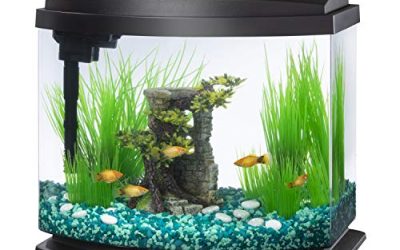
A dark floor does more than change the look of a tank. Against black gravel or sand, green plants read greener and fish with red, yellow, or blue coloration show stronger contrast, which is the main reason aquascapers reach for black substrate in the first place. Dark floors also give shy fish a sense of cover, since many species behave more calmly over a dark bottom than over pale sand that reflects light upward.
There is a trade-off to accept before buying. Debris, uneaten food, and light-colored waste show up more clearly on a black bed than on a mixed natural gravel, so a black tank rewards regular siphoning. Fine black sand can also make clouding more visible during setup, and very fine grains drift more easily when a filter outlet points at the bed. None of that makes black substrate a bad choice. It only means the type of black substrate matters: a coarse planted gravel behaves differently from a fine sand, and an active volcanic soil behaves differently from an inert clay bed.
Black substrate comes in four broad families, and the picks below cover each one. Nutrient-rich gravels feed roots from the bag. Inert clay gravels and sands stay out of the chemistry and last for years. Decorative gravels are mainly about looks and are the simplest to live with. Active soils change water chemistry on purpose, usually toward mildly acidic water that suits shrimp and soft-water plants. Knowing which family a product belongs to is the fastest way to avoid a mismatch.
How to Choose a Black Substrate
Grain size
Grain size decides which fish and plants the bed suits. Fine sand in the 1 mm range and below looks smooth and lets bottom dwellers sift comfortably, while grains in the 2 to 5 mm range anchor stems more firmly and let water move through the bed. Very fine grains can pack down when laid deep, so a sand bed is best kept around 1 to 2 inches unless the layout calls for a deeper slope. Coarse gravel in the 3 to 7 mm range resists compaction but can trap debris between grains, which means a gravel vacuum becomes part of the routine.
Chemistry: inert or active
An inert substrate does not change pH or hardness. Seachem Flourite products and plain decorative gravels belong here, and they suit community tanks where the keeper wants to control nutrition with root tabs and liquid fertilizer instead. An active substrate, such as Fluval Stratum, is a volcanic soil that supports neutral to slightly acidic water and carries minerals that feed roots. Active soils suit shrimp and soft-water plants, but they are not the right call for tanks that need hard, alkaline water for African cichlids or livebearers that prefer it.
Planted or decorative
If the tank is heavily planted, a substrate that supports roots matters more than looks. Nutrient-rich gravels and active soils give root feeders such as Amazon swords and crypts something to draw on from day one. Inert beds can still grow plants well, but they need root tabs or a fertilizer plan to keep up. If the tank is mainly fish with a few hardy plants or plastic decor, a decorative black gravel is enough, and it is the easiest to clean.
Bottom dwellers
Corydoras, loaches, and other bottom dwellers spend their time nosing through the bed, so grain shape matters as much as grain size. Smooth, rounded grains are kinder to barbels than sharp, angular ones. Fine sand is the gentlest option for these fish. A rough basaltic gravel can still work in a community tank, but keepers who keep corydoras often pair it with a sand area where the fish can feed.
Rinsing and dust
Some black substrates arrive ready to use, while others need a thorough rinse before they go in the tank. Clay-based products in particular can carry dust from transit, and a few washes in a bucket save hours of cloudy water later. Active soils are the exception: their granules are softer, so heavy rinsing can break them apart, and a light rinse or none at all is the usual approach. The bag directions are the authority here, and the picks below note what each product needs.
Depth and coverage
A common guideline is roughly 1 pound of substrate per gallon for about 1 inch of depth, with planted tanks often running 2 to 3 inches at the back for root depth. Bags come in different weights, so check the bag size against the tank footprint before ordering. A 10 lb bag suits a nano tank, a 20 lb bag suits a standard 20-gallon setup, and larger or deeper tanks need two or more bags.
Our Picks
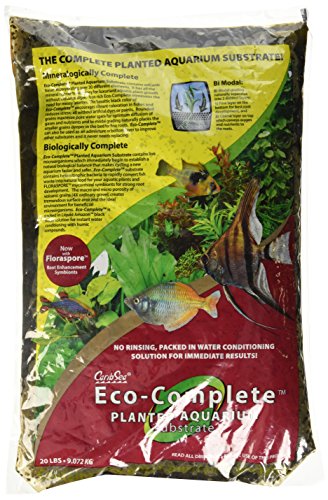
1. CaribSea Eco-Complete Planted Black — Best for Planted Tanks With Built-In Nutrients
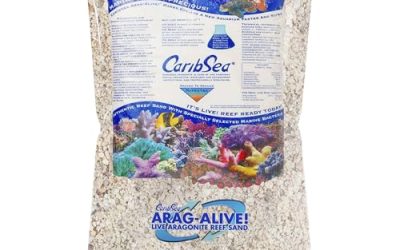
CaribSea Eco-Complete Planted Aquarium Substrate, Black, 20 lb
CaribSea Eco-Complete Planted Black is a nutrient-rich gravel made from basaltic volcanic soil, sold as a complete planted-tank substrate in a 20 lb bag. The grains run about 1 to 3 mm, and the material carries iron and other minerals that support root growth, so plants get nutrition from the bed itself rather than only from the water column. The maker describes it as an all-in-one substrate that also works as biological filtration media, and the bag is sold ready to use with no rinsing required.
The black color is deep and even, and it holds up well under bright light without washing out. Because the grains are small and irregular, stems anchor firmly, and carpeting plants can spread across it. It suits a freshwater planted community tank where the keeper wants a dark floor and a bed that contributes to plant growth from the first week.
Limitations are worth knowing. The grains are angular basalt rather than smooth river stone, so keepers with delicate bottom dwellers may want a sand patch for feeding. CaribSea has renamed this line Eco-Planted, so the bag and listing may show the newer Eco-Planted name while the contents remain the same black planted substrate; confirm the black planted variant and the 20 lb bag size on the listing before ordering. The substrate is not a complete fertilizer on its own, so heavy root feeders still benefit from root tabs over time.
Who it is for: planted community tanks where the keeper wants nutrients in the bed, a dark high-contrast floor, and a substrate that needs no rinsing.
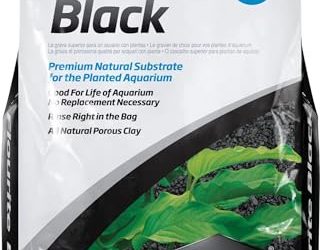
2. Seachem Flourite Black Sand — Best Fine Black Sand for a pH-Neutral Bed
Seachem Flourite Black Sand, 15 lb
Seachem Flourite Black Sand is a porous clay sand in a 15 lb bag, made from the same fired clay as the well-known Flourite gravel line but in a fine grain under 1 mm. Seachem describes it as a stable, porous clay that is not chemically coated and does not alter pH, so it leaves water chemistry to the keeper. It can be used alone as the aquarium bed and does not need laterite or a separate gravel cap.
The fine grain gives a smooth, almost velvety dark floor that makes green plants and brightly colored fish stand out. It is a strong choice for nano tanks and aquascapes where a soft, even surface matters, and for keepers who want a long-lived bed: Seachem says the material is good for the life of the aquarium with no scheduled replacement. The clay grains also act as a cation-exchange medium, holding dissolved nutrients near the roots once fertilizer is dosed.
The main limitation is preparation. The sand is dusty from transit and needs several washes before the water runs clear, and the very fine grains can cloud the tank if a plant is uprooted or the bed is disturbed. Laid deeper than about 2 inches, fine sand can also pack down, so keep the bed shallow or slope it toward the back. It carries no built-in fertilizer, so rooted plants need root tabs or liquid dosing.
Who it is for: keepers who want a fine black sand that stays chemically neutral, suits nano tanks and aquascapes, and lasts for years with a fertilizer plan.
3. AquaNatural Diamond Black — Best Simple Decorative Black Gravel
AquaNatural Diamond Black, 10 lb, 1-2 mm
AquaNatural Diamond Black is a 100 percent natural fine gravel in a 10 lb bag, with grains in the 1 to 2 mm range and a polished black quartz look. The maker lists it for aquariums, fish tanks, and terrariums, and the fine, even grain gives a clean dark floor without any planted-tank chemistry to manage. It is an inert decorative substrate: it does not feed plants and does not shift pH, so it behaves the same in a community tank, a betta tank, or a shrimp tank.
The 10 lb bag is a good fit for nano and small tanks, and the small grain size lets it settle into a smooth, tidy bed that is easy to siphon. The dark color gives strong contrast for light-colored fish and pale decor, and the quartz grains hold their color without coatings that can flake. For a keeper who wants black substrate mainly for looks, this is the least complicated option in the list.
Limitations follow from its simplicity. It carries no nutrients, so a planted tank built on Diamond Black alone needs root tabs or liquid fertilizer for anything beyond the hardiest plants. The fine grains can drift under a strong filter outlet, and a 10 lb bag will not cover a large tank, so bigger setups need more than one bag. Rinse it before use, since fine gravel can carry dust from the bag.
Who it is for: keepers who want a simple, natural black gravel for looks, small tanks, and community setups where the substrate is decoration rather than plant food.
4. Fluval Plant and Shrimp Stratum — Best Volcanic Soil for Shrimp and Aquascapes
Fluval Plant and Shrimp Stratum, 8.8 lb
Fluval Plant and Shrimp Stratum is a volcanic soil substrate in an 8.8 lb bag, model 12694, with granules in the 3 to 5 mm range. Fluval describes it as mineral rich, made to stimulate strong root growth and to support neutral to slightly acidic water, which suits shrimp and soft-water plants. The granules do not compact over time, so the bed stays oxygenated and roots can spread, and the small granule size gives baby shrimp places to hide.
The dark granules give an aquascape a natural, soil-like floor that pairs well with driftwood and stone, and the active-soil chemistry is the point of the product: it feeds roots and gently moves water toward the mildly acidic range that cherry shrimp and many popular plants prefer. The 8.8 lb bag suits a nano or small planted tank, and larger tanks can use the 17.6 lb bag of the same line.
Limitations are part of the active-soil bargain. The granules are softer than gravel and can break down if handled roughly, so avoid heavy rinsing and avoid stirring the bed once it is set. New setups with active soil need more water changes in the first weeks while the soil settles, and the mildly acidic direction is wrong for tanks that need hard, alkaline water. It is also lighter than gravel, so strong flow can move granules around until plants root in.
Who it is for: shrimp keepers and aquascapers who want a nutrient-rich volcanic soil, a natural dark floor, and water that trends neutral to slightly acidic.
Comparison Table
| Product | Type | Grain size | Water impact | Best for |
|---|---|---|---|---|
| CaribSea Eco-Complete Planted Black, 20 lb | Nutrient-rich basaltic gravel | 1-3 mm | Carries minerals; pH effect minimal | Planted tanks wanting nutrients in the bed |
| Seachem Flourite Black Sand, 15 lb | Porous clay sand | Under 1 mm | Does not alter pH | Fine black sand for nano tanks and aquascapes |
| AquaNatural Diamond Black, 10 lb | Natural fine gravel | 1-2 mm | Inert; no pH change | Simple decorative black floor |
| Fluval Plant and Shrimp Stratum, 8.8 lb | Volcanic aquasoil | 3-5 mm | Supports neutral to slightly acidic water | Shrimp and planted aquascapes |
Frequently Asked Questions
Does black substrate change water chemistry?
It depends on the type. Inert black substrates such as Seachem Flourite Black Sand and AquaNatural Diamond Black do not alter pH, so they leave water chemistry to the keeper. Active soils such as Fluval Stratum are made to support neutral to slightly acidic water, which suits shrimp and soft-water plants but not tanks that need hard, alkaline water. CaribSea Eco-Complete sits between the two: it is a mineral-rich basaltic gravel whose main job is feeding roots, and its pH effect is minimal in most freshwater setups.
How much black substrate do I need?
A common guideline is roughly 1 pound per gallon for about 1 inch of depth. A 10 lb bag suits a nano tank, a 20 lb bag suits a standard 20-gallon setup at a modest depth, and planted tanks often run 2 to 3 inches at the back, which takes more. Measure the tank footprint rather than guessing from gallons alone, since a long shallow tank needs more substrate than a tall narrow one of the same volume.
Do I need to rinse black substrate before adding it?
Follow the bag directions, because the answer differs by type. CaribSea Eco-Complete is sold ready to use with no rinsing required. Seachem Flourite Black Sand benefits from several washes in a bucket until the water runs clear, since clay products carry dust from transit. AquaNatural Diamond Black should be rinsed as well. Fluval Stratum is the exception: its granules are soft, so heavy rinsing can break them apart, and a light rinse or none at all is the usual approach.
Is black substrate safe for corydoras and other bottom dwellers?
Grain shape matters more than color. Smooth, fine grains are the gentlest option for corydoras, loaches, and other fish that sift the bed, which is why fine sand suits them well. Angular basaltic gravel can be rougher on delicate barbels, so keepers who use it often add a sand area where bottom dwellers can feed. Watch the fish for a few days after setup: steady foraging without visible irritation is the sign the bed suits them.
Will black substrate make my fish look brighter?
A dark floor raises contrast, so red, yellow, and blue coloration tends to read more strongly against black than against pale sand, and green plants look deeper green as well. Many shy species also behave more calmly over a dark bottom. The effect is visual rather than chemical, and it works best with good lighting and a clean bed, since debris shows up more clearly on black than on mixed gravel.
Conclusion
The best black substrate for aquarium setups is the one that fits the tank, not the one with the darkest bag. CaribSea Eco-Complete Planted Black is the pick for a planted tank that should feed roots from day one. Seachem Flourite Black Sand is the pick for a fine, pH-neutral bed that lasts for years. AquaNatural Diamond Black is the pick for a simple decorative floor with nothing to manage. Fluval Plant and Shrimp Stratum is the pick for shrimp and aquascapes that benefit from a mildly acidic, nutrient-rich soil. Match the substrate family to the fish and plants first, check the grain size and the bag weight against the tank, and the black floor will do what it is meant to do: make the plants greener, the fish brighter, and the whole tank look finished.
Disclosure: As an Amazon Associate, we may earn from qualifying purchases.
More from Amazon
Programs that pair well with the guide above. Offers and eligibility are set by Amazon and may change.
Set up recurring deliveries of everyday items on eligible products. Terms and savings are set by Amazon.
Explore Subscribe & SaveFree shipping on eligible items, Prime Video and more. Eligible new members can start with a free trial.
Start a Prime free trialAudiobooks and podcasts to listen to on the go. Eligible new members can start with a free trial.
Try Audible freeRead from a large library of eBooks and audiobooks on any device. Check Amazon for current plans.
Explore Kindle UnlimitedAs an Amazon Associate we earn from qualifying purchases.



Write Your Review
No reviews yet. Be the first to share your experience!