
Our Short List of 3

- Best for: reef tanks that want a fine, natural-looking bed with a cycling head start.
- Material: live aragonite reef sand
- Grain size: 0.5–1.5 mm
- Bag weight: 20 lb
- Color: Fiji Pink
- Best for: fish-only and mixed reef tanks that want a coarse, gravel-like bed with live bacteria.
- Material: live Caribbean aragonite sand
- Grain size: 0.25–6.5 mm (Original Grade)
- Bag weight: 20 lb
- Item model number: 00920
- Best for: dry aquascaping, budget-conscious large beds, and topping up established tanks.
- Material: dry oolitic aragonite
- Bag weight: 20 lb
- Item model number: ARAGO020
- Color: Sand
All 4 Picks at a Glance
| Product | Specs | Action |
|---|---|---|
| CaribSea Arag-Alive Fiji Pink Live Sand, 20 lb |
| Check price on Amazon |
| CaribSea Ocean Direct Original Grade Live Sand, 20 lb |
| Check price on Amazon |
| Aqua Natural Oolitic Aragonite, 20 lb |
| Check price on Amazon |
 CaribSea Arag-Alive Bahamas Oolite, 10 lb |
| Check price on Amazon |
Key takeaways
- The best gravel for a marine aquarium is aragonite: compare live sands, oolitic aragonite and coarse grades by grain size, bag weight and tank type.
Marine keepers shopping for “gravel” quickly discover that saltwater substrate is a chemistry decision, not just a floor covering. The coarse, inert gravel sold for freshwater tanks does nothing to buffer seawater, so marine beds are built from aragonite: fine live sands, sugar-grade oolites, and wider mixed grades that behave like the gravel end of the range. Grain size decides which fish can burrow, how much flow the bed tolerates, and how detritus behaves, so it matters more than color.
This guide serves three groups: first-time saltwater keepers choosing a bed for a new setup, reef owners replacing or topping up an existing substrate, and fish-only keepers who want a coarser, easy-vacuuming grade. Every product below is a marine aragonite substrate sold on Amazon, selected from the names, grain sizes, and bag weights stated on its product page.
Quick Picks
As an Amazon Associate we earn from qualifying purchases
| Product | Best for | Key spec from title |
|---|---|---|
| CaribSea Arag-Alive Fiji Pink Live Sand, 20 lb | Reef tanks wanting a fine, pink-toned bed | Live aragonite, 0.5–1.5 mm grain |
| CaribSea Ocean Direct Original Grade Live Sand, 20 lb | Mixed-grain beds closest to classic gravel | Live sand, 0.25–6.5 mm grain range |
| Nature’s Ocean Bio-Activ Live Aragonite #0, 10 lb | Nano tanks and sugar-fine beds | Live aragonite, 0.1–0.5 mm grain |
| Aqua Natural Oolitic Aragonite, 20 lb | Dry starts seeded with bottled bacteria | Dry oolitic aragonite, 20 lb bag |
| CaribSea Arag-Alive Bahamas Oolite, 10 lb | Deep beds for sand-sifting fish | Live oolite, 0.25–1.0 mm grain |
How to Choose
Grain size decides who can live on the bed
Grain diameter is the single most consequential spec on the bag. Sugar-fine oolite in the 0.1 to 0.5 mm range suits sand-sifting gobies and delicate burrowers, but strong reef flow blows it into drifts. Mid-range grains around 0.5 to 2.0 mm stay put under wavemakers while still letting most burrowing fish dig. Coarse and mixed grades running up to 5.5 or 6.5 mm act like traditional gravel: easy to vacuum, good for jawfish that build with rubble-sized pieces, but too rough for fish that sift substrate through their gills. Match the grade to your livestock list before anything else.
Live sand versus dry aragonite
Live substrates such as the Arag-Alive, Ocean Direct, and Bio-Activ lines are packed wet with marine bacteria already on the grains, which shortens the early ammonia phase of a new tank. They go straight into the aquarium without rinsing, because rinsing would wash away the bacteria you paid for. Dry aragonite costs less per pound and stores indefinitely, but it arrives sterile: the cycle has to come from live rock, bottled bacteria, or an established filter. Neither format is better in the long run; the difference is how much biological head start the bag gives you on day one.
How much substrate to buy
Manufacturers converge on roughly one to two pounds of substrate per gallon of tank volume for a standard shallow bed. A 40-gallon breeder therefore needs somewhere around 40 to 80 pounds depending on the depth you want, which is why bag weight belongs in your first calculation rather than your last. Shallow decorative beds sit near one inch deep, while burrowing species and jawfish setups call for two to four inches in at least part of the tank. Buying one bag short is a common frustration, because matching the same grade later means a second shipping wait.
Why aragonite, and what to avoid
Aragonite is calcium carbonate, and it slowly dissolves at marine pH, releasing carbonate that helps hold alkalinity steady between water changes. That buffering is the core reason marine substrates are aragonite rather than quartz or silica sand, which contribute nothing chemically. Avoid freshwater gravel entirely: it offers no buffering, and dyed decorative gravels can carry coatings never intended for a reef. Also avoid play sand and construction sand, whose silica content and uncontrolled grading make them poor substitutes. If a listing does not state aragonite or crushed coral, it does not belong in a saltwater tank.
The 5 Best Options
CaribSea Arag-Alive Fiji Pink Live Sand, 20 lb
- Best for: reef tanks that want a fine, natural-looking bed with a cycling head start.
- Material: live aragonite reef sand
- Grain size: 0.5–1.5 mm
- Bag weight: 20 lb
- Color: Fiji Pink
reef tanks that want a fine, natural-looking bed with a cycling head start.
CaribSea notes this grade is too fine for undergravel filter plates, so pair it with a sump or hang-on filtration instead.
Fiji Pink is the default recommendation for reef keepers who want a fine bed with a warm tint instead of stark white. Its 0.5 to 1.5 mm aragonite grains are small enough for most burrowing fish yet heavy enough to stay settled under moderate reef flow, and the pink cast photographs well under blue-heavy lighting. Because it is a live Arag-Alive product, the grains arrive coated with marine bacteria, so a new tank gets biological help from the substrate itself rather than starting from sterile sand.
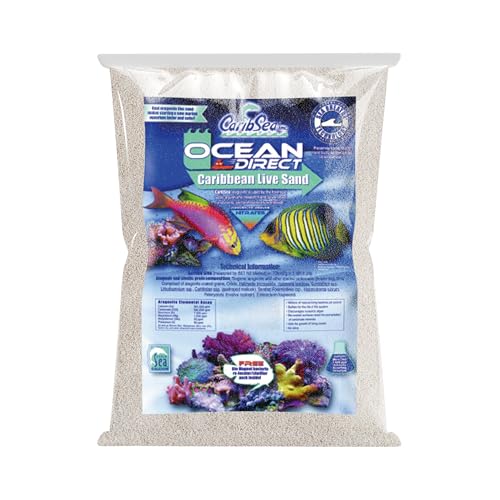
CaribSea Ocean Direct Original Grade Live Sand, 20 lb
- Best for: fish-only and mixed reef tanks that want a coarse, gravel-like bed with live bacteria.
- Material: live Caribbean aragonite sand
- Grain size: 0.25–6.5 mm (Original Grade)
- Bag weight: 20 lb
- Item model number: 00920
fish-only and mixed reef tanks that want a coarse, gravel-like bed with live bacteria.
the wide grading includes genuinely coarse pieces, so it is a poor match for fish that sift sand through their gills.
Ocean Direct is the closest thing in this roundup to old-school gravel. The Original Grade mixes grains from 0.25 mm up to 6.5 mm, so the bed has the varied, coarse texture of a natural reef flat, with larger pieces that vacuum easily and resist being blown around. CaribSea packs it in a breathable bag using its Sea Breathe approach, with each grain filmed in real ocean water so the original bacteria stay alive on the sand rather than being added later in a lab.
Nature’s Ocean Bio-Activ Live Aragonite #0, 10 lb
Nature’s Ocean collects its sand from the ocean floor and packages it in its natural state, and the #0 grade is the finest option here at 0.1 to 0.5 mm. That sugar-fine texture suits nano reefs, seahorse setups, and fish with soft bellies that rest on the bed. The 10 lb bag is sized for small tanks, and the sand is packed with the brand’s Nutri-SeaWater liquid to keep the bacteria alive in storage. The natural white color keeps the aquascape looking clean without tinting the light.
Specs
- Material: live aragonite reef sand
- Grain size: 0.1–0.5 mm (#0 grade)
- Bag weight: 10 lb
- Color: Natural White
- Packed with Nutri-SeaWater to preserve live bacteria
- Saltwater aquariums only, per the listing
Best for: nano tanks and keepers who want the finest, brightest white bed available.
Watch out for: grains this fine drift under strong powerheads and can be drawn toward pump intakes, so moderate your flow or shield intakes.
ASIN: B0018CLX9Q
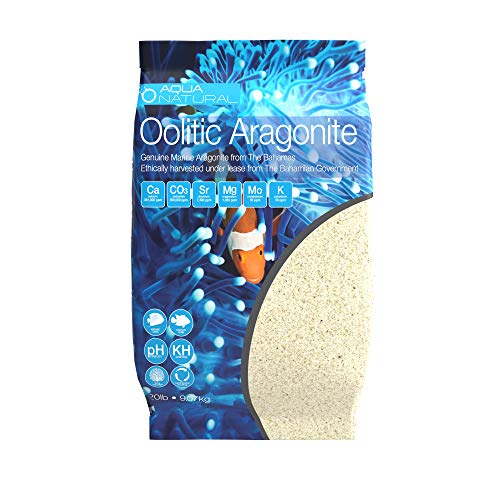
Aqua Natural Oolitic Aragonite, 20 lb
- Best for: dry aquascaping, budget-conscious large beds, and topping up established tanks.
- Material: dry oolitic aragonite
- Bag weight: 20 lb
- Item model number: ARAGO020
- Color: Sand
dry aquascaping, budget-conscious large beds, and topping up established tanks.
it brings no bacteria of its own, so plan a separate cycle source such as live rock or bottled bacteria.
Aqua Natural’s oolitic aragonite is the dry entry in this list, aimed at keepers who would rather rinse their substrate, aquascape at leisure, and seed the cycle themselves. Oolitic grains are naturally rounded rather than crushed, which gives a smooth, uniform bed that is gentle on bottom dwellers. The listing positions it squarely for reef, saltwater, and marine tanks, and the 20 lb bag covers a mid-sized shallow bed in one purchase. It is also the practical choice for topping up an established tank, where adding live sand is unnecessary.
CaribSea Arag-Alive Bahamas Oolite, 10 lb
- Best for: sand-sifting fish, burrowing invertebrates, and deep fine beds.
- Material: live aragonite oolite sand
- Grain size: 0.25–1.0 mm
- Bag weight: 10 lb
- CaribSea item 01793
sand-sifting fish, burrowing invertebrates, and deep fine beds.
fine oolite can compact in very deep beds with low flow, so keep some water movement across the surface.
Bahamas Oolite is the fine-bed specialist in CaribSea’s Arag-Alive line, with rounded grains in the 0.25 to 1.0 mm range. That smooth, consistent grading is what sand-sifting gobies and burrowing shrimp handle best, and it packs into the deep, stable beds that denitrification-focused setups call for. As an Arag-Alive product it is packed wet with live bacteria and clarifier already in the solution, so it clears quickly after filling. The 10 lb bag suits nano and mid-sized tanks, or a fine top layer over a coarser base.
Which One Fits Your Situation
You are setting up your first reef tank
Start with Fiji Pink or Ocean Direct. Both arrive live, so the bed itself contributes bacteria while your rock cycles, and both come in 20 lb bags that cover a typical first tank at a shallow depth. Choose Fiji Pink for a finer reef look, or Ocean Direct if you prefer a coarser, more gravel-like texture that vacuums easily.
You keep sand-sifting or burrowing fish
Pick Bahamas Oolite or Nature’s Ocean #0. Their fine, rounded grains pass through gills and shift easily for digging without the sharp edges of crushed grades. Build the bed at least two inches deep so sifters and burrowers can work it properly, and avoid the coarse Ocean Direct grade, whose largest pieces are too big for sifting species.
You run a nano tank under 20 gallons
The 10 lb bags fit your scale: Nature’s Ocean #0 for the brightest white, finest finish, or Bahamas Oolite for a slightly coarser grain that drifts less. One bag usually covers a nano at one to two pounds per gallon, so you are not paying extra to store leftover substrate in a closet.
You are filling a large tank on a budget
Dry Aqua Natural oolitic aragonite is the economical route for big footprints, since dry substrate stores well and you can work through several bags without racing a live product’s shelf life. Seed the cycle with live rock or bottled bacteria, and consider a single bag of any live sand above mixed through the top layer to speed colonization.
Common Mistakes
- Buying freshwater or dyed decorative gravel for a saltwater tank, where it provides no buffering and may carry unsuitable coatings.
- Rinsing live sand before adding it, which washes away the bacteria that justify choosing a live product.
- Pairing sugar-fine sand with high-flow reef pumps, then fighting constant sand drifts and bare patches.
- Guessing the quantity instead of calculating pounds per gallon, and ending up one bag short mid-aquascape.
- Choosing a coarse grade for sand-sifting fish, whose gills and mouths are built for fine grains only.
Frequently Asked Questions
Is gravel or sand better for a marine aquarium?
For saltwater, aragonite sand in a grade matched to your livestock beats traditional gravel almost every time. Fine and mid grades support burrowers and sifters, while coarse mixed grades like Ocean Direct Original give you the easy vacuuming of gravel with proper marine buffering. The right answer is the coarsest grade your fish can still handle comfortably.
How much substrate does a marine tank need?
Plan on roughly one to two pounds per gallon for a standard bed, adjusted for the depth your livestock needs. Burrowing species justify the deeper end of that range in at least part of the tank. Measure your footprint, decide on depth first, then convert to pounds so you order enough bags in a single delivery.
Should I rinse live sand before putting it in the tank?
No. Live sand is packed wet precisely so the bacteria coating each grain survive the trip, and rinsing under tap water would kill or wash away much of that population. Add it straight to the aquarium, fill gently to limit clouding, and let filtration clear the water. Dry aragonite is the opposite case: rinse it before use.
Can I use freshwater gravel in a saltwater aquarium?
It is a poor idea. Freshwater gravel is chemically inert in seawater, so it does none of the alkalinity buffering aragonite provides, and decorative colored gravels may use coatings never tested around corals and invertebrates. Marine tanks need aragonite or crushed coral substrates; the products in this guide are all sold specifically for saltwater use.
More from Amazon
Programs that pair well with the guide above. Offers and eligibility are set by Amazon and may change.
Set up recurring deliveries of everyday items on eligible products. Terms and savings are set by Amazon.
Explore Subscribe & SaveFree shipping on eligible items, Prime Video and more. Eligible new members can start with a free trial.
Start a Prime free trialAudiobooks and podcasts to listen to on the go. Eligible new members can start with a free trial.
Try Audible freeRead from a large library of eBooks and audiobooks on any device. Check Amazon for current plans.
Explore Kindle UnlimitedAs an Amazon Associate we earn from qualifying purchases.


Write Your Review
No reviews yet. Be the first to share your experience!