

Key takeaways
- Whether the charger holder accepts the charger size you can reliably source.
- Whether the dispenser is designed for one charger, multiple chargers, or a regulated supply at its rated capacity.
- Whether replacement seals and charger-holder parts remain available in your region.
The best professional whipped cream dispenser for most cafés and small kitchens is a 0.5-liter stainless-steel model with a threaded charger holder, a reusable stainless nozzle set, and a manufacturer-rated safety valve; choose a 1-liter unit for continuous service, an insulated model for longer holding, or a lighter aluminum dispenser when portability matters most.
Our top picks


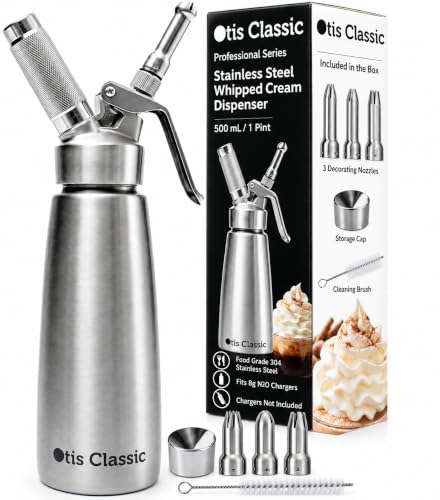

As an Amazon Associate we earn from qualifying purchases at no extra cost to you. Ratings are shown as listed on Amazon.
Quick comparison: professional whipped cream dispensers
The table below compares the specifications that affect real service rather than focusing only on appearance. Exact included tips and approved charger brands can vary by regional package, so confirm the manual before purchase.
| Dispenser type or example | Working capacity | Body material | Approximate empty weight | Best use |
|---|---|---|---|---|
| iSi Gourmet Whip | 0.25, 0.5, or 1 L configurations | Aluminum body; stainless-steel head and valve components | About 0.4–0.8 kg, depending on size | General café, dessert, and kitchen service |
| iSi Thermo Whip | Typically 0.5 L | Insulated stainless-steel construction | About 0.9–1.1 kg | Service where chilled contents must hold temperature longer |
| Professional 1 L stainless dispenser | 1 L maximum fill | Stainless steel body and head | About 0.8–1.2 kg | High-volume prep and fewer refills |
| Professional 0.5 L aluminum dispenser | 0.5 L maximum fill | Anodized aluminum body | About 0.4–0.7 kg | Lower purchase weight and occasional service |
These capacities are not the same as the amount of finished whipped cream produced. Liquid should remain below the marked fill line, and the gas expands the mixture during dispensing. Overfilling can create inconsistent texture, obstruct the valve, or make the head difficult to remove.
Our picks by working situation
Best all-rounder: a 0.5-liter stainless professional dispenser
A half-liter stainless model is the safest choice for most businesses. It is large enough for several dessert portions without becoming cumbersome, and it gives better resistance to dents, staining, and repeated washing than inexpensive thin aluminum. Look for a removable head gasket, a metal charger holder, a pressure-release safety feature, and at least two dispensing tips.
This size is especially practical when the kitchen prepares more than one flavor or filling. Instead of keeping a large batch in a 1-liter canister, staff can prepare smaller batches and reduce the time that dairy or other perishable mixtures remain in service.
Best for high-volume service: a 1-liter stainless model
A 1-liter dispenser reduces interruptions during brunch, catering, and dessert service. It is the better capacity when one recipe is used continuously and the team can refrigerate the filled dispenser safely. The disadvantages are greater weight, a larger refrigerator footprint, and more product wasted if demand is unpredictable.
Choose the 1-liter size only when the recipe and service volume justify it. A large canister does not make cream last longer, and it can be harder to rinse thoroughly if the head, valve, and gasket are not removed after use.
Best for temperature retention: an insulated dispenser
An insulated model such as the iSi Thermo Whip is useful when the dispenser must move between a refrigerated preparation area and a serving station. Insulation slows warming, but it does not replace refrigeration or make a perishable mixture shelf-stable. Follow the recipe’s food-safety requirements and the manufacturer’s temperature instructions.
Insulated dispensers are usually heavier and more expensive than standard aluminum models. They also make a poor choice if staff frequently need to see how much mixture remains, because the outer body may provide less visual feedback than a plain canister.
Best for portability and lower cost: an aluminum model
Aluminum dispensers are light, quick to handle, and widely available in professional formats. Anodized aluminum is preferable to a poorly finished surface because it is less vulnerable to staining and flavor retention. The trade-off is durability: aluminum dents more easily, threads can be damaged by cross-threading, and harsh cleaners may mark the finish.
Aluminum is reasonable for moderate use, mobile catering, and kitchens where weight matters. For a busy café that cycles the same dispenser every day, stainless steel generally offers a longer ownership life.
Aluminum versus stainless steel: which should you buy?
| Criterion | Aluminum | Stainless steel |
|---|---|---|
| Handling | Lighter and easier to carry | Heavier, especially at 1 L |
| Impact resistance | More likely to dent | Better suited to repeated commercial handling |
| Cleaning tolerance | Needs more care with chemicals and abrasion | Usually more forgiving, subject to the manual |
| Heat and temperature retention | Warms and cools quickly | Some insulated stainless models retain temperature longer |
| Best ownership case | Lower weight, occasional use, mobile service | Daily service, shared kitchens, and long-term durability |
Material alone does not determine quality. A well-machined aluminum dispenser with a reliable valve can outperform a badly made stainless unit. Inspect the head threads, gasket fit, charger seal, and availability of replacement parts. Those details matter more than a polished exterior.
Nozzles, chargers, and pressure control
Nozzle options
A straight star nozzle creates the familiar ridged swirl for cakes, drinks, and plated desserts. A tulip or decorative nozzle produces a broader shape, while a narrow nozzle is useful for filling pastries. A professional set should include at least one star tip and one plain or narrow tip, preferably made from stainless steel.
Check whether the tips attach externally or through a removable adapter. External tips are quick to change, but the adapter and valve must still be cleaned because mixture can collect behind the nozzle. Avoid choosing a dispenser solely because it includes many decorative tips; two useful, durable tips are better than ten difficult-to-clean accessories.
Charger compatibility
Most cream dispensers use food-grade nitrous oxide chargers, commonly sold in 8-gram sizes for smaller dispensers. Some commercial systems use larger chargers or a regulated gas supply. Never substitute carbon dioxide or a charger that the dispenser manufacturer does not approve: the gas changes flavor and behavior, and incompatible pressure can be unsafe.
Before buying, check three points:
- Whether the charger holder accepts the charger size you can reliably source.
- Whether the dispenser is designed for one charger, multiple chargers, or a regulated supply at its rated capacity.
- Whether replacement seals and charger-holder parts remain available in your region.
Pressure control
Basic dispensers depend on the correct charger quantity and shaking technique. More advanced commercial systems may offer a regulator or controlled gas connection, which can improve consistency during long service. Pressure control is valuable when the recipe changes frequently or when several staff members need repeatable results.
More pressure is not automatically better. Excess gas can produce coarse bubbles, force liquid through the valve, or make the cream collapse quickly. Follow the capacity and charger instructions exactly, and do not open a pressurized dispenser until pressure has been released according to the manual.
What wears out first?
The gasket and small valve seals usually need attention before the metal body. They can flatten, crack, retain odors, or fail to seal after repeated washing. Charger-holder threads and the nozzle adapter are also vulnerable to cross-threading and accumulated residue. Keep replacement gaskets and valve parts available if the dispenser is used commercially.
Common ownership mistakes include putting a pressurized dispenser in a dishwasher when the manufacturer prohibits it, using abrasive scouring pads, leaving mixture in the valve overnight, and storing the unit assembled while damp. These practices can cause odor, sticky valves, corrosion at mixed-metal contact points, or an unreliable seal.
Setup and cleaning routine
- Strain the mixture. Remove cocoa, fruit fibers, herbs, or undissolved sugar that could block the valve.
- Fill below the marked line. Leave the air space required for expansion and pressure.
- Install the head carefully. Align the threads and tighten by hand; forcing a cross-threaded head can permanently damage it.
- Charge with the approved gas. Use only the quantity specified for the dispenser and recipe.
- Shake as directed. Insufficient mixing gives weak dispensing; excessive shaking can alter texture.
- Test with the tip pointed downward. The first short burst confirms that gas and mixture are moving correctly.
- Depressurize before opening. Keep the nozzle pointed safely away and follow the release procedure in the manual.
- Disassemble and rinse every food-contact part. Clean the nozzle, adapter, valve, gasket, head, and canister separately, then dry fully before reassembly.
Buying verdict
For most professional users, buy a 0.5-liter stainless dispenser with a removable head gasket, stainless nozzles, compatible 8-gram nitrous oxide chargers, and readily available replacement seals. Move to a 1-liter stainless model when one recipe is used heavily enough to justify fewer refills. Choose an insulated model when temperature management during service is important, and choose anodized aluminum when low weight and lower upfront cost matter more than maximum durability.
The best professional whipped cream dispenser is therefore not the largest or the one with the most tips. It is the model whose capacity matches daily demand, whose charger system fits your supply chain, and whose seals, valves, and cleaning routine your staff can maintain consistently.

Write Your Review
No reviews yet. Be the first to share your experience!