

Key takeaways
- UV-resistant face and hands: Helps limit fading and brittleness from direct sunlight.
- Sealed lens: Reduces dust and moisture entering around the dial.
- Large mounting hole or bracket: Makes installation easier and supports safer removal for battery changes.
- Temperature display: Useful when placed in shade; less useful when the clock receives direct sun.
- High-contrast numerals: More valuable than decorative details for clocks viewed across a deck.
- Corrosion-resistant screws: Stainless steel or coated hardware is preferable near pools and coastal air.
- Low-temperature operating range: Important for digital clocks in regions with freezing winters.
The best outdoor clocks are weather-resistant analog or digital models with a sealed case, a readable 12–18-inch face, UV-resistant markings, and mounting hardware suited to your patio wall, fence, or covered porch.
Our top picks
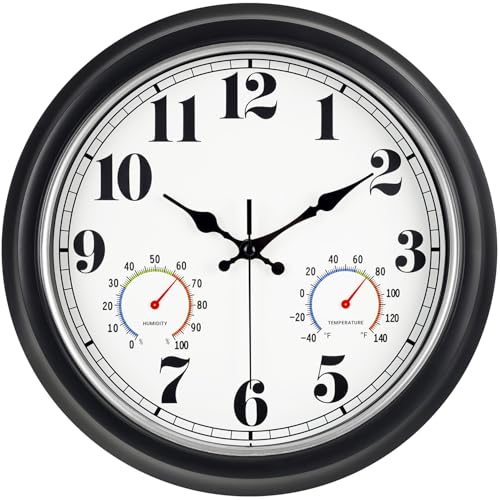


As an Amazon Associate we earn from qualifying purchases at no extra cost to you. Ratings are shown as listed on Amazon.
Quick picks by patio situation
| Patio situation | Best clock type | Target specifications | Why it fits |
|---|---|---|---|
| Small balcony or apartment porch | Compact analog clock | 10–12 inches; under 2.5 lb; one AA battery | Readable without overwhelming a narrow wall |
| Large deck or outdoor kitchen | Oversized analog clock with temperature display | 16–20 inches; 3–6 lb; sealed movement | Visible from a grill, dining table, or seating area |
| Uncovered, rainy location | Weather-sealed digital clock | IPX4 or better; outdoor temperature sensor; backlit display | Better protection from splashes and easier nighttime reading |
| Covered porch with changing seasons | Analog clock with thermometer | 12–18 inches; metal or UV-stabilized plastic case | Provides time at a glance without frequent adjustments |
| Decorative farmhouse or garden setting | Large metal-look analog clock | 18–24 inches; sealed hands; corrosion-resistant finish | Acts as wall decor while remaining legible at distance |
What separates the best outdoor clocks from indoor clocks
Weather resistance
“Outdoor” does not always mean waterproof. A clock designed for a covered porch may tolerate humidity and occasional splashes but fail when exposed to driving rain, snow, or irrigation spray. For an uncovered patio, look for a sealed lens, a gasket around the case, corrosion-resistant hardware, and a stated splash-resistance rating such as IPX4 or higher.
IPX4 indicates protection from water splashed from any direction; it does not mean the clock can be submerged or pressure-washed. If a manufacturer provides no rating, install the clock under an overhang rather than treating it as fully weatherproof.
Plastic cases resist rust and are usually lighter. Aluminum or steel cases can look more substantial, but the finish and fasteners matter more than the metal itself. Powder-coated aluminum is a practical choice, while untreated steel may eventually develop rust around screw holes and the battery compartment.
Clock-face readability
Choose the face size from the distance at which you will normally read it. A 10–12-inch clock works well within roughly 15 feet. For a clock viewed from 20–30 feet, a 16–20-inch face is more useful. Large numerals and high contrast usually matter more than decorative styling.
Black numerals on a pale face are easy to scan in daylight. Dark faces can look attractive but may become difficult to read in shade or low light unless the hands and markers are strongly contrasted. Avoid thin, ornate hands if the clock will hang across the yard. A second hand is optional; removing it can reduce visual clutter and slightly extend battery life on some quartz movements.
Movement and battery access
Quartz movements are the sensible default for most patios because they are inexpensive, quiet, and accurate enough for everyday use. A clock that uses one AA battery is generally simpler to maintain than a model requiring several specialty batteries. Look for a battery door that can be opened without removing the entire clock from its mount.
Temperature swings can shorten battery life, particularly in very cold weather. Alkaline batteries commonly last about 9–18 months in an outdoor quartz clock, although cold conditions, second hands, and illuminated displays can reduce that range. Rechargeable batteries are convenient but may deliver lower voltage and perform poorly in freezing temperatures unless the clock specifically supports them.
Analog versus digital outdoor clocks
Analog: best for simple, all-day visibility
Analog clocks are readable from multiple angles and do not require a backlight. They are a strong choice for dining areas, porches, and garden walls where you want the time visible without pressing a button. Their limitations are less precise temperature information and occasional problems with condensation inside the lens.
Digital: best for time, temperature, and nighttime use
Digital models can show indoor or outdoor temperature, date, humidity, and alarms. They are especially useful beside an outdoor office, pool area, or covered grilling station. Confirm whether the displayed temperature comes from a remote sensor or from the clock itself. A sensor placed in direct sun can read substantially warmer than the surrounding air.
Digital displays need more power and may be difficult to read when the backlight is off. If the clock will be viewed after dark, choose a model with an always-visible display, an adjustable backlight, or a light sensor. For a completely exposed location, prioritize the enclosure rating over extra calendar or alarm functions.
Outdoor clock features worth paying for
- UV-resistant face and hands: Helps limit fading and brittleness from direct sunlight.
- Sealed lens: Reduces dust and moisture entering around the dial.
- Large mounting hole or bracket: Makes installation easier and supports safer removal for battery changes.
- Temperature display: Useful when placed in shade; less useful when the clock receives direct sun.
- High-contrast numerals: More valuable than decorative details for clocks viewed across a deck.
- Corrosion-resistant screws: Stainless steel or coated hardware is preferable near pools and coastal air.
- Low-temperature operating range: Important for digital clocks in regions with freezing winters.
Mounting options and patio-size fit
Wall-mounted clocks are the most stable option, but the wall material determines the hardware. Use masonry anchors for brick or concrete, exterior-rated screws for wood, and appropriate anchors for vinyl or composite siding. Do not rely on a decorative hanging loop alone if the clock weighs several pounds or sits in a windy position.
A double-sided clock is useful on a walkway or between two seating zones, but its depth and weight can be greater than a flat wall clock. Check the full projection from the wall and leave enough clearance for hands, doors, cabinet lids, and umbrellas.
For a useful sizing check, measure the viewing distance and divide it by about 1.5 to estimate a readable face diameter in feet. For example, a clock viewed from 24 feet away would need approximately 16 inches of face diameter: 24 ÷ 1.5 = 16. This is a starting point, not a guarantee; glare, eyesight, and numeral design can require a larger face.
Ownership realities: what wears out first
The movement is not always the first failure point. Sunlight can fade numerals, temperature cycles can loosen seals, and condensation can corrode the hands or battery contacts. On inexpensive models, the plastic lens may yellow before the mechanism stops. A clock exposed to salty air or pool chemicals can also corrode mounting screws and springs.
Extend service life by placing the clock where it receives shade during the hottest part of the day, keeping sprinkler spray away, and wiping dust from the lens with a damp microfiber cloth. Do not use abrasive cleaners, solvent-based sprays, or a pressure washer. Before winter, remove the battery if the clock will not be used and the manufacturer permits storage without power.
Check the time twice a year when changing batteries. If the clock loses several minutes per month, stops after a fresh battery, or shows fogging that does not clear, replacing the movement or the complete clock is usually more economical than repeated repairs.
How to choose in five steps
- Measure the viewing distance. Select about 10–12 inches for close seating and 16–20 inches for larger decks or distant sight lines.
- Identify the exposure. Covered and shaded locations can use standard weather-resistant designs; fully exposed locations need stronger sealing and corrosion protection.
- Decide whether temperature data matters. Choose a remote-sensor digital model only if you will use the reading and can position the sensor in shade.
- Check the mounting surface and weight. Match anchors to masonry, wood, siding, or composite materials before buying.
- Plan battery access. A convenient battery door can save more time over several years than a small difference in purchase price.
Bottom line
For most patios, the best outdoor clock is a 12–18-inch quartz analog model with a sealed lens, UV-resistant face, high-contrast hands, and a corrosion-resistant wall mount. Choose an oversized 18–24-inch design when the clock must be read across a large deck, and choose a digital model when outdoor temperature, nighttime visibility, or additional data is more important than battery simplicity. Spend first on weather protection and readability; decorative finishes and extra functions should come afterward.

Write Your Review
No reviews yet. Be the first to share your experience!