

Key takeaways
- Small dogs: Favor a low basin or gently bubbling surface. Tall towers may be awkward and can increase splashing.
- Medium dogs: Most standard fountains work; prioritize stability and the dog’s preferred stream style.
- Large dogs: Consider a wider basin and a raised stream, but check that the dog can drink without crouching excessively.
- Long-eared dogs: A contained stream or narrower drinking area can reduce wet ears.
- Messy drinkers: Choose a heavy base, non-slip feet, and a low-flow setting. A waterproof mat is often more useful than a larger reservoir.
The best dog water fountains are the PetSafe Drinkwell Stainless Steel 360 for most multi-dog homes, the PetSafe Drinkwell Platinum for large dogs that drink heavily, and the Pioneer Pet Raindrop Stainless Steel for owners who want a compact, easy-to-clean fountain.
A fountain can make water more appealing and reduce the number of times you refill a bowl, but the right choice depends on more than capacity. Compare the dog’s shoulder height, drinking style, available floor space, pump noise, replacement-filter cost, and how often you are willing to wash the unit.
Our top picks
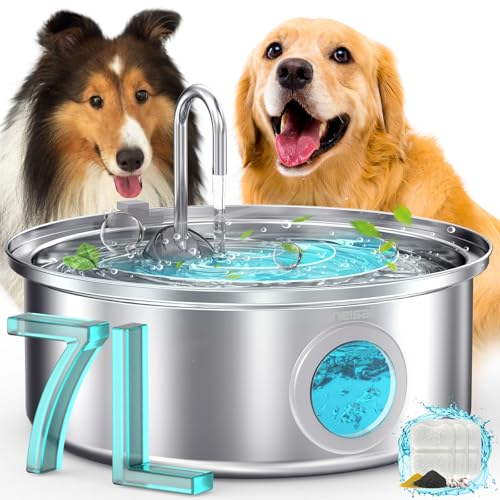


As an Amazon Associate we earn from qualifying purchases at no extra cost to you. Ratings are shown as listed on Amazon.
Best dog water fountains by household situation
| Situation | Best fit | Why it suits the situation | Main compromise |
|---|---|---|---|
| One small or medium dog in a limited space | Pioneer Pet Raindrop Stainless Steel | Compact footprint, roughly 60 oz capacity, and a low drinking surface | Less reserve water than larger fountains |
| Large dog or two dogs sharing one fountain | PetSafe Drinkwell Stainless Steel 360 | About 128 oz capacity and several drinking sides around a central spout | More parts and a wider area to clean |
| Large, thirsty dog that needs a raised stream | PetSafe Drinkwell Platinum | Approximately 168 oz capacity and an adjustable stream | Bulky and more demanding to disassemble |
| Owner prioritizing a quiet drinking area | Low-flow stainless-steel or ceramic fountain | Water movement is usually softer than a tall, aerated stream | May provide less splash and visual encouragement to drink |
| Dog that pushes or tips lightweight bowls | Heavy ceramic or stainless-steel fountain with rubber feet | Greater stability and less sliding across hard floors | Ceramic can chip; heavy units are harder to lift when full |
Head-to-head: the most useful differences
PetSafe Drinkwell Stainless Steel 360: best all-around choice
The Drinkwell Stainless Steel 360 is a practical middle ground for many homes. Its approximately 128-ounce reservoir is large enough for a medium dog over several days, although water should still be refreshed regularly rather than left untouched until the reservoir is empty. The stainless-steel construction is preferable to plastic for owners concerned about scratches that can trap residue.
The central tower creates multiple streams, so two dogs can approach from different sides. That is useful when one dog guards a bowl or when household traffic makes a single drinking position inconvenient. The stream height is moderate, not a true elevated feeder height. A short-nosed dog or small breed should manage it easily, while a very large dog may prefer a taller fountain.
The trade-off is cleaning effort. The tower, filter housing, pump, and basin all need attention. A fountain with several streams also tends to spread droplets farther than a quiet bubbling design.
PetSafe Drinkwell Platinum: best for high water demand
The Drinkwell Platinum holds approximately 168 ounces and uses a raised, adjustable stream. Its larger reserve is useful for a large dog, multiple dogs, or an owner who cannot refill the fountain several times a day. The stream can usually be adjusted to reduce splashing and pump noise.
This is not automatically the best choice for every large dog. Its larger reservoir takes more time to wash and becomes heavy when full. Measure the space before buying: a fountain that fits under a counter may still require enough clearance to remove its lid and lift out the pump.
Choose it when capacity and a more prominent stream matter more than a small footprint. If your dog drinks modestly and you are home often, the extra water reserve may add maintenance without adding much value.
Pioneer Pet Raindrop Stainless Steel: best compact option
The Pioneer Pet Raindrop Stainless Steel fountain holds roughly 60 ounces and has a lower, simpler water presentation than tall multi-stream models. It works well for one small or medium dog, especially in an apartment, office, or kitchen where counter and floor space are limited.
Its smaller reservoir is also easier to carry to the sink. The disadvantage is refill frequency. A 60-ounce fountain used by one dog may need topping up every day or two, depending on weather, diet, activity, and how much water evaporates or splashes out. It is a poor fit for several dogs or a large dog that empties bowls quickly.
Capacity is not the same as usable water
Manufacturers generally quote the reservoir’s total volume, but the pump needs a minimum water level to operate. Some water also remains below the pump intake or is trapped in internal channels. Treat listed capacity as a ceiling, not as the amount your dog can drink before the next refill.
For a simple planning estimate, use the fountain’s capacity divided by the dog’s approximate daily water intake, then refill before the reservoir reaches the pump’s minimum level. For example, a 128-ounce fountain used by a dog drinking 48 ounces per day appears to offer 2.7 days of reserve:
128 ÷ 48 = 2.67 days
In practice, you should not wait that long. A reasonable routine is to top it up daily, empty and rinse it every one to two days, and perform a full wash at least weekly. A dry-running pump can become noisy or fail, and standing water becomes less appealing as debris accumulates.
Height and drinking style: what to measure
Most floor fountains are comfortable for small and medium dogs. Large or elderly dogs may find a raised drinking surface easier, but height should not force the neck sharply upward. Measure from the floor to the dog’s chest or lower neck while standing, then compare that with the fountain’s drinking surface.
- Small dogs: Favor a low basin or gently bubbling surface. Tall towers may be awkward and can increase splashing.
- Medium dogs: Most standard fountains work; prioritize stability and the dog’s preferred stream style.
- Large dogs: Consider a wider basin and a raised stream, but check that the dog can drink without crouching excessively.
- Long-eared dogs: A contained stream or narrower drinking area can reduce wet ears.
- Messy drinkers: Choose a heavy base, non-slip feet, and a low-flow setting. A waterproof mat is often more useful than a larger reservoir.
Pump noise: why fountains become louder
A new pump should produce a soft hum, not a rattling or grinding sound. Most noise problems come from low water, trapped air, hair wrapped around the impeller, or a pump that is touching the basin. A tall stream can also sound louder because water falls farther.
For the quietest setup, place the fountain on a level mat, fill it above the pump’s minimum line, and select the lowest flow that still attracts your dog. Do not hide a noisy fountain inside a cabinet: restricted airflow and unnoticed leaks can create new problems. If the pump remains loud after cleaning, its impeller or rubber feet may be worn.
Cleaning effort and the parts that wear first
Filters improve taste and capture some hair and food particles, but they do not replace washing. Activated-carbon filters commonly need replacement about every two to four weeks, while foam pump filters may last longer if rinsed weekly. The exact interval depends on how much hair, food, and mineral content is in your water.
- Daily: Check the water level, remove visible food or hair, and top up with fresh water rather than repeatedly adding water to a dirty basin.
- Every one to two days: Empty the fountain, rinse the basin, and wipe the drinking surface.
- Weekly: Unplug it, remove the pump and filter, wash every accessible part with mild dish soap, and rinse thoroughly.
- Monthly: Inspect the impeller, intake screen, tubing, seals, and rubber feet. Descale according to the manufacturer’s instructions if white mineral buildup appears.
The pump is usually the first functional component to suffer. Hair and slime can restrict the impeller, while hard-water deposits can make it noisy. Plastic basins can develop scratches, ceramic can chip, and stainless steel can still accumulate residue around seams or underneath removable parts. Keep a spare compatible filter and, if the fountain is essential, a replacement pump so a failure does not leave your dog without a clean water station.
Decision guide: match the fountain to your routine
- Refilling once a day is easy: Choose a 60- to 100-ounce compact fountain and spend more attention on easy disassembly.
- You are away during long workdays: Select roughly 100 to 170 ounces, but still arrange a second clean water bowl as backup.
- You have multiple dogs: Favor at least 128 ounces, a wide basin, and more than one approach angle.
- You dislike frequent washing: Avoid complex towers and narrow channels. A simple stainless-steel or ceramic design with fewer parts will be easier to maintain.
- You have hard water: Budget for more frequent descaling and filter replacement; a filter will not remove all mineral deposits.
- You have a tight budget: Basic fountains commonly cost about $25 to $60, while larger stainless-steel or ceramic models often range from $60 to $130. Include recurring filters in the ownership cost.
Setup mistakes to avoid
Do not place the fountain beside the food bowl if crumbs regularly fall into the water. Do not run the pump below its minimum level, and do not assume a filter makes stagnant water safe indefinitely. Introduce the fountain while keeping the familiar bowl available, because some dogs need several days to accept the sound and moving water.
For most owners, the best dog water fountains are not the biggest or most elaborate models. Choose the Drinkwell Stainless Steel 360 for a balanced multi-dog setup, the Drinkwell Platinum when capacity and a taller adjustable stream are priorities, or the Pioneer Pet Raindrop Stainless Steel when compact size and simpler daily handling matter most. If your dog suddenly drinks far more or less than usual, consult a veterinarian rather than relying on a fountain to solve the change.





Write Your Review
No reviews yet. Be the first to share your experience!