

Key takeaways
- How to measure a dog for a harness: find the chest girth, neck and length with a soft tape, compare to the size chart, and run a two-finger fit check at home.
To measure a dog for a harness, stand your dog squarely on all four legs and wrap a soft tape measure around the widest part of the chest, just behind the front legs. Add the neck circumference and, for some styles, the back length, then compare these numbers with the size chart for the exact harness you want. A harness that is too loose can slip off, while one that is too tight can rub the skin and restrict movement. This guide covers the tools, each measurement, a fit check and a worked sizing example.
What you need before you measure
You do not need special equipment. A flexible tailor’s tape is ideal. If you only have a rigid ruler or metal tape, use a piece of string or a soft shoelace, mark where it meets itself and then lay it flat against the ruler. Have a few small treats ready, a notepad or phone to record numbers, and ideally a second person to hold the dog’s attention. Most dogs hold still much better when they are relaxed and rewarded, so keep the first session short and calm.
Also note your dog’s current weight and age. Weight ranges appear on many size charts, and a young dog may grow out of a size within weeks. If your dog has a thick or fluffy coat, press the tape gently into the fur so you measure the body rather than the fluff, then keep that coat thickness in mind when checking the fit.
Step-by-step: taking the three measurements
- Stand the dog on a flat surface, head up, with weight evenly on all four legs.
- For chest girth, find the widest part of the rib cage, usually just behind the elbows. Wrap the tape fully around, over the back and under the belly. The tape should lie flat and touch the body without compressing the coat.
- Check that the tape is level on both sides and note the number where it meets the start of the tape.
- For neck girth, measure where a collar normally sits, at the base of the neck and not up near the ears.
- For back length, measure from the base of the neck, where the collar sits, along the spine to the base of the tail. Only some charts use this, but it matters for vest and body-style designs.
- Repeat each measurement twice. If the readings differ by more than half an inch, measure a third time and use the most common value.
Which number matters most
Chest girth is typically the deciding measurement, since it sets the circumference of the main strap. Neck girth matters for harnesses where a loop passes over the head or where a front strap rests near the throat. Weight is a rough backup, not a substitute, because two dogs of the same weight can have very different builds.
Body type changes how a chart works. Deep-chested, narrow-waisted dogs such as greyhounds and whippets often need a harness cut for their shape, while stocky breeds with broad chests and short bodies may need extra adjustability. Flat-faced breeds and dogs with sensitive necks may do better with a design that avoids pressure on the neck. If your dog sits outside typical proportions, look for models that list several adjustment points and read the sizing notes.
Reading a size chart
Charts use ranges, such as a chest of 20 to 26 inches for one size and 24 to 32 inches for the next. The overlap is intentional because most harnesses are adjustable. When your number falls in an overlap, think about the strap range, not only the label. A good fit uses the middle of the adjustable range, leaving room to tighten or loosen as weight or coat changes.
| Measurement | Where to take it | What it affects |
|---|---|---|
| Chest girth | Widest part of the rib cage, behind the front legs | Main strap length and overall size |
| Neck girth | Base of the neck where a collar sits | Head loop or neck strap size |
| Back length | Base of neck to base of tail | Vest or body-style fit and coverage |
| Weight | Scale or vet record | Backup range and strength rating |
The numbers in any example chart are illustrative, so always use the actual manufacturer chart and check current specifications before ordering.
Worked example
Assume a medium dog that weighs about 40 pounds, measures 27 inches around the chest and 16 inches around the neck, and has a short coat. Suppose a harness lists size Medium as a chest range of 22 to 28 inches and Large as 26 to 34 inches. The dog fits both on paper. At 27 inches, Medium sits near the top of its range with little room to loosen, while Large sits near the bottom with room to tighten but may hang loosely at first. If the dog has finished growing, many owners would pick the size where the measurement lands closer to the middle of the range and check the strap adjustment points. If the dog is still maturing, the larger size can give growing room. This is only an assumption-based illustration, and the right choice depends on the actual product.
Check the fit once the harness is on
Measuring gets you in the right size family, but only a fit check confirms it. Put the harness on, buckle it, and look for these signs:
- You can slide two fingers flat under every strap, but not a whole hand.
- The harness cannot be pulled over the head or backwards over the shoulders when you gently tug.
- Straps stay clear of the armpits and do not crowd the front legs.
- The dog moves, trots and sits without the harness riding up or twisting.
- The chest plate sits on the breastbone, not on the throat.
- No hair is pinched in buckles and no skin looks red after a short walk.
Run through the same checks again after a few minutes outdoors, because padding settles and straps shift once the dog starts moving.
Choosing a style after you have your numbers
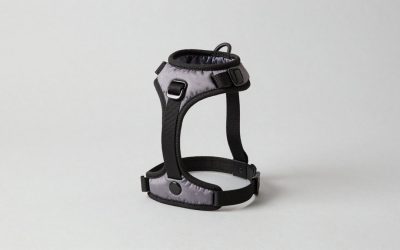
Back-clip harnesses are comfortable for calm walkers and small dogs, front-clip designs can help reduce pulling by turning the dog toward you, and step-in or vest styles suit dogs that dislike things going over their heads. Dual-clip models give you both options. Dogs with mobility problems or older dogs may benefit from a harness with a top handle that lets you offer support on stairs or when loading into a car. If lifting becomes a daily task, a ramp can also reduce strain, and our guide to dog ramps for cars, beds and senior dogs covers that side of things.
Common mistakes and when to stop
The most frequent errors are measuring over a bulky coat, pulling the tape too tight, using a collar size instead of chest girth, and buying for current weight when the dog is still growing. Another is skipping the fit check and relying on the label alone.
Stop using a harness and ask a veterinarian or a trained fitter for advice if your dog limps after wearing it, shows hair loss or sore skin under the straps, resists wearing it in a way that seems like pain, or backs out of it repeatedly. Never leave a harness on an unsupervised dog, since straps can snag on furniture or crates.
Related guides
- Washable Dog Feeding Mat For Messy Drinkers
- How To Get Cat Urine Smell Out Of Carpet
- Dog Nail Clippers For Thick Nails
Frequently asked questions
What is the most important measurement for a dog harness?
Chest girth is usually the most important number. It is the circumference around the widest part of the rib cage, just behind the front legs. Most size charts use it as the primary range, with neck girth and weight as backups. Because harness designs differ, always compare your numbers with the specific chart for the model you are considering, and read any notes about adjustability.
Should you measure a dog standing or sitting?
Measure while your dog is standing squarely on all four legs, relaxed and looking forward. Sitting or lying down changes how the skin and muscle sit around the chest and can give a smaller, misleading reading. A second person to offer a treat and keep the dog still makes the job easier and more consistent.
What if a dog is between two harness sizes?
Look at how adjustable the harness is. If the straps have a wide range and your dog’s measurements fall near the top of the smaller size, the smaller one may fit after adjusting. If the dog is still growing or has a thick coat, the larger size is often the safer pick. Check the return policy and the manufacturer’s guidance, then confirm with a two-finger fit test.
How tight should a dog harness be?
Snug enough that it cannot slip over the head or shoulders, but loose enough that you can slide two fingers flat between the strap and your dog’s body. Straps should not pinch the armpits, press on the throat or restrict shoulder movement. Recheck the fit after a short walk, since padding can settle and straps can loosen as the dog moves.
How often should you remeasure a dog?
Puppies may need remeasuring every few weeks during fast growth, since a harness can become too tight quickly. Adult dogs are worth measuring again if their weight changes, after a haircut or coat change, or when you switch to a different harness style. Checking once or twice a year is a reasonable habit even when nothing seems to have changed.



Write Your Review
No reviews yet. Be the first to share your experience!