

Key takeaways
- Doors and tracks wear first: Fine substrate can make sliding doors stick. Vacuum or brush tracks before wiping them, and do not force misaligned panels.
- Seals need inspection: Check silicone seams and cable ports during deep cleaning. Replace damaged seals with animal-safe materials only after the enclosure is empty, cured, and fully ventilated.
- Thermostats and bulbs are consumables: Keep spare bulbs, probe mounts, and a backup thermometer. UVB lamps require replacement according to their manufacturer’s output guidance, even when they still produce visible light.
- Decor changes the climate: A dense background, cork, plants, and deep substrate can reduce airflow and alter temperature readings. Recheck the enclosure after every major rearrangement.
- Cleaners are not automatically safe: Remove the reptile before cleaning, follow product dilution instructions, rinse where required, and allow surfaces to dry and air out before returning the animal.
The best reptile terrariums match the animal’s adult size, ventilation needs, humidity target, access habits, and heating equipment—not simply the enclosure with the largest glass panels.
For most keepers, a front-opening glass terrarium from a specialist brand such as Exo Terra or Zoo Med is the easiest all-purpose choice. Choose a well-ventilated screen enclosure for animals that need strong airflow and low humidity, a PVC enclosure for efficient heat and moisture retention, or a purpose-built arboreal enclosure when climbing height matters more than floor area.
Our top picks
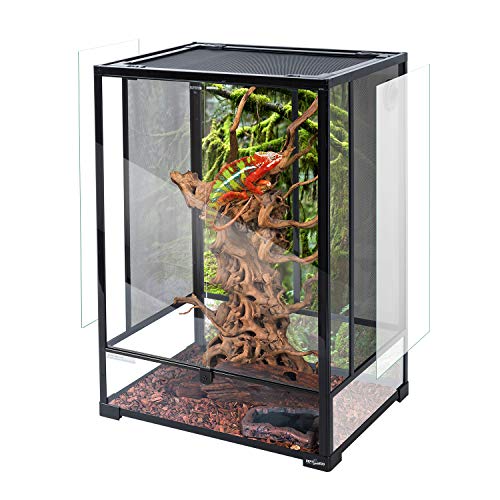

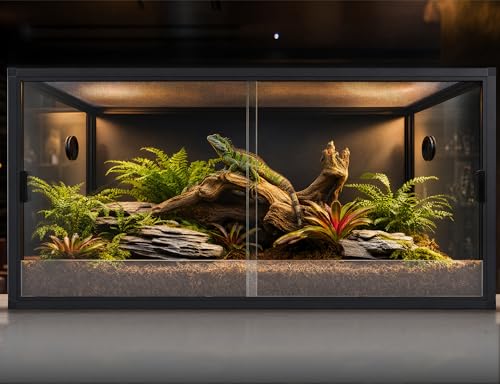

As an Amazon Associate we earn from qualifying purchases at no extra cost to you. Ratings are shown as listed on Amazon.
Quick picks by reptile and situation
| Reptile or situation | Practical enclosure target | Best enclosure type | Key buying priority |
|---|---|---|---|
| Leopard gecko | At least 36 × 18 × 18 in for one adult | Front-opening glass or PVC | Floor space, secure doors, warm and cool zones |
| Crested gecko | At least 18 × 18 × 24 in for one adult | Tall front-opening glass or PVC | Vertical climbing area and controlled ventilation |
| Bearded dragon | At least 48 × 24 × 24 in for one adult | Large front-opening PVC or glass | Floor area, strong overhead heat, easy cleaning |
| Corn snake | At least 48 × 24 × 24 in for a typical adult | Front-opening PVC or glass | Length, climbing enrichment, escape-resistant locks |
| Ball python | Commonly 48 × 24 × 24 in for an adult, adjusted to body length | PVC or sealed front-opening glass | Humidity retention and thermostatic heat control |
| High-humidity arboreal species | Usually 18 × 18 × 24 in or larger, depending on adult size | Purpose-built arboreal enclosure | Drainage, misting access, ventilation adjustment |
These are planning targets rather than universal rules. Adult body length, activity level, local husbandry guidance, and the amount of furniture inside the enclosure can require a larger habitat.
Head-to-head: glass, PVC, and screen terrariums
Glass terrariums: best for visibility and modular setups
Glass is a strong choice when you want clear viewing from several sides, removable panels, and compatibility with common lamps, ceramic heat emitters, thermostats, and digital sensors. Front-opening models from Exo Terra and Zoo Med are widely used because the doors allow access without reaching down from above, which can make routine maintenance less disruptive.
The trade-off is weight and heat loss. A 36 × 18 × 18-inch glass enclosure can weigh roughly 70–100 pounds before substrate and furnishings, depending on its frame and glass thickness. Screen-top models also lose humidity quickly in dry rooms. A glass terrarium is therefore easier to modify for a leopard gecko or corn snake than for a species requiring consistently high humidity unless the top and ventilation are managed carefully.
PVC enclosures: best for heat and humidity efficiency
Expanded PVC panels are lighter than an equivalent glass habitat and usually hold warmth and moisture more efficiently. That can reduce how long heating equipment must run, although the actual energy saving depends on room temperature, thermostat settings, lamp wattage, and ventilation.
PVC is particularly practical for ball pythons, many geckos, and keepers building a stacked enclosure system. Look for sealed seams, a waterproof floor, vents that can be adjusted or partially covered, and a roof or mounting area rated for the equipment you plan to use. PVC can scratch more easily than glass, and poorly sealed joints may swell or retain odor after repeated wet cleaning.
Screen enclosures: best for airflow and hot climates
Aluminum screen habitats are useful for species that need excellent ventilation, including many chameleons and some tropical lizards in warm, humid rooms. They are lightweight and easy to transport, but they are poor at holding heat and humidity in cool or dry indoor conditions.
Screen mesh also changes heating safety. A heat bulb mounted above the screen may have less effective heat transfer than the same bulb over glass or PVC, while a lamp mounted inside creates burn and escape risks. Measure temperatures at the animal’s basking surface rather than assuming a particular bulb wattage will work.
Features that separate a safe terrarium from a frustrating one
Ventilation that can be tuned
Ventilation should exchange stale air without making the enclosure impossible to humidify. Side vents are often more useful than a large, uninterrupted screen top because they support a warm-to-cool airflow path. Adjustable vents or removable panels are valuable when seasonal room humidity changes.
A common mistake is sealing every opening to preserve humidity. This can create condensation, stagnant air, and persistently wet substrate. Another mistake is leaving a screen top completely open over a high-humidity habitat, then compensating with constant misting. A better approach is to measure humidity at the animal’s level and adjust ventilation, substrate, water access, and misting together.
Front access and escape resistance
Front-opening doors make it easier to place food, remove waste, and handle furnishings without reaching over the animal. Hinged doors provide a wide opening, while sliding doors use less space in front of the enclosure. Sliding panels should meet cleanly, move smoothly, and include a lock or latch that prevents even a small gap.
Snakes and small lizards exploit surprisingly narrow openings. Check the corners, cable ports, ventilation covers, and the seam where doors overlap. A lockable frame is preferable to relying on a loose clip. For species that climb, inspect the ceiling and lamp access points after every equipment change.
Heating and lighting compatibility
Before buying, list every device: basking lamp, deep-heat projector, ceramic heat emitter, ultraviolet lighting, thermostat probe, misting nozzle, and digital hygrometer. Confirm that the enclosure has a safe mounting location and that the manufacturer permits the planned equipment.
Never place an unguarded heat source where the reptile can touch it. Use a thermostat for heat sources that can overheat the habitat, secure probes so they cannot be moved, and verify surface temperature with an infrared thermometer. UVB lighting also needs correct distance and unobstructed output; glass and many plastic panels can block useful UVB.
Decision matrix: which enclosure fits your constraints?
| Your priority | Most suitable choice | Why | Watch out for |
|---|---|---|---|
| Lowest initial cost | Basic screen or smaller glass enclosure, only if adult size permits | Usually has a lower market price, often about $80–$180 for common starter sizes | Replacing it later can cost more than buying the adult-size habitat first |
| Stable humidity | PVC with sealed seams or modified front-opening glass | Less moisture loss and more consistent room-to-room conditions | Insufficient ventilation and wet substrate |
| Frequent cleaning or handling | Front-opening enclosure with removable floor tray | Access is faster and less disruptive | Tracks, hinges, and seals collecting debris |
| Limited floor space | Tall arboreal enclosure, if the species uses vertical space | Provides climbing volume without excessive footprint | Height cannot replace floor area for terrestrial reptiles |
| Moving or rearranging often | Modular PVC or lighter screen enclosure | Easier to transport and assemble in sections | Flexible mesh, loose fasteners, and damaged cable ports |
How to calculate the real usable space
Nominal dimensions do not equal usable habitat. Suppose a 48 × 24 × 24-inch enclosure contains a 4-inch-deep substrate layer and a large hide occupying 12 × 8 inches of floor area. The floor footprint is 1,152 square inches, but the hide covers 96 square inches and other furnishings may remove another 150 square inches. That leaves roughly 906 square inches of unobstructed floor—still a substantial area, but less than the box label suggests.
For terrestrial reptiles, plan around the clear floor after adding hides, water bowls, and climbing structures. For arboreal reptiles, calculate usable height after subtracting the substrate, lighting clearance, and a safe distance from the roof-mounted heat source.
Ownership details that matter after purchase
- Doors and tracks wear first: Fine substrate can make sliding doors stick. Vacuum or brush tracks before wiping them, and do not force misaligned panels.
- Seals need inspection: Check silicone seams and cable ports during deep cleaning. Replace damaged seals with animal-safe materials only after the enclosure is empty, cured, and fully ventilated.
- Thermostats and bulbs are consumables: Keep spare bulbs, probe mounts, and a backup thermometer. UVB lamps require replacement according to their manufacturer’s output guidance, even when they still produce visible light.
- Decor changes the climate: A dense background, cork, plants, and deep substrate can reduce airflow and alter temperature readings. Recheck the enclosure after every major rearrangement.
- Cleaners are not automatically safe: Remove the reptile before cleaning, follow product dilution instructions, rinse where required, and allow surfaces to dry and air out before returning the animal.
Final buying recommendation
Choose the largest practical enclosure that fits the reptile’s adult needs and your available space, then prioritize secure front access, adjustable ventilation, safe heat mounting, and measurable temperature and humidity control. A front-opening glass terrarium is a versatile starting point for many geckos and snakes; PVC is usually the easier route to stable warmth and humidity; and screen is best when airflow is the main challenge. The right enclosure is the one that maintains the required habitat gradient reliably after furnishings, equipment, and maintenance access are accounted for.

Write Your Review
No reviews yet. Be the first to share your experience!