

Key takeaways
- Weighted or rubberized base: reduces movement while pulling.
- Spring-loaded end arm: keeps the roll centered and prevents free-spinning.
- Raised tear bar: gives the sheet a defined point to separate.
- Non-slip backplate: limits vibration against tile or cabinetry.
- Open-sided design: makes replacement faster, but provides less protection from splashes.
Best Wall Mount Paper Towel Holders
The best wall mount paper towel holder for most kitchens is a stainless-steel or powder-coated metal model with a screw-mounted backplate, a spring-loaded or weighted tear bar, and enough clearance for a standard 11-inch-wide roll.
Wall mounting saves counter space, but the mounting method matters as much as the dispenser. A light adhesive holder can be convenient on tile, while a screw-mounted bracket is the safer choice for large rolls, frequent use, or a busy kitchen. The comparison below focuses on the details that product listings often leave out: how much force the mount can tolerate, whether one-handed tearing is practical, and which materials cope best with steam, splashes, and gradual loosening.
Our top picks

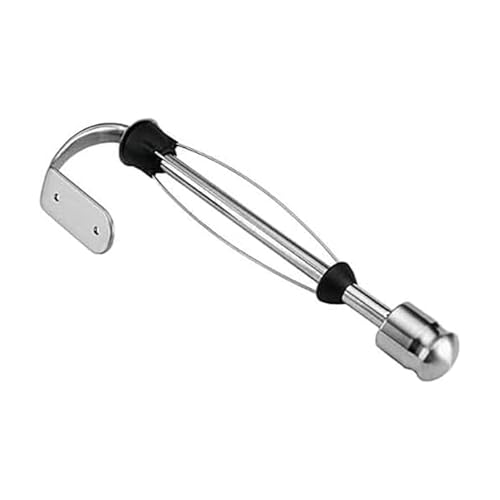


As an Amazon Associate we earn from qualifying purchases at no extra cost to you. Ratings are shown as listed on Amazon.
Quick Comparison: Which Type Fits Your Kitchen?
| Holder type | Typical roll capacity | Approx. weight | Mounting method | Best use | Typical price range |
|---|---|---|---|---|---|
| Screw-mounted metal bracket | 1 roll, up to 5.5 in diameter | 1.0–2.5 lb | Screws and wall anchors | Frequent use and heavy rolls | $20–$55 |
| Adhesive stainless-steel holder | 1 standard roll, up to 4.8 in diameter | 0.5–1.3 lb | Adhesive pad or mounting tape | Renters and smooth tile | $15–$40 |
| Under-cabinet or cabinet-side holder | 1 standard roll | 0.7–1.8 lb | Screws or adhesive | Small kitchens and hidden storage | $15–$45 |
| Two-roll reserve dispenser | 2 rolls, usually 8–11 in total | 1.5–3.5 lb | Screws recommended | Large households and high usage | $25–$70 |
These are useful buying ranges rather than guarantees for every model. A roll’s diameter varies substantially by brand and sheet count, so measure the rolls you actually buy before choosing a compact holder.
Best for Most Kitchens: Screw-Mounted Metal Holders
A screw-mounted holder is the strongest all-round choice when the dispenser will be used several times a day. It spreads pulling force through a backplate instead of relying on a small adhesive patch. This reduces the two most common failures: the holder falling from the wall and the mounting plate slowly peeling away when the roll becomes heavy.
Look for a backplate at least 2.5 inches wide and two mounting points separated vertically or horizontally by roughly 1.5–3 inches. Two screws resist twisting better than a single central screw. For drywall, use suitable anchors rather than driving screws into empty plasterboard. In tile, avoid drilling close to an edge or grout line unless you are comfortable using a tile-rated bit.
A screw-mounted holder is especially appropriate for thick “mega” rolls, households with children, or anyone who wants true one-handed dispensing. The drawback is installation: the holes are permanent, and a poorly tightened bracket can still wobble.
Best No-Drill Choice: Adhesive Mounting
Adhesive mounting works well on smooth, clean, nonporous surfaces such as glazed tile, glass, sealed stone, and some finished cabinet panels. It is less dependable on textured paint, unfinished wood, wallpaper, dusty grout, or surfaces that regularly collect cooking grease.
The important distinction is between a thin decorative adhesive pad and a larger mounting plate using high-bond acrylic tape. A stronger adhesive system usually has a plate of about 10–20 square inches and a published cure time. Do not load the holder immediately after installation; many adhesives need 12–24 hours before use.
Adhesive holders are best for light or medium rolls and moderate pulling force. If the holder includes a tear bar that requires a sharp tug, adhesive mounting becomes less attractive. A gradual downward tilt, a sticky residue at the edges, or a gap between the plate and wall are signs that the mount is beginning to fail.
One-Handed Dispensing: What Actually Helps?
“One-handed” does not simply mean that a holder has a tear edge. The roll must turn with controlled resistance while the base remains fixed. The most useful features are:
- Weighted or rubberized base: reduces movement while pulling.
- Spring-loaded end arm: keeps the roll centered and prevents free-spinning.
- Raised tear bar: gives the sheet a defined point to separate.
- Non-slip backplate: limits vibration against tile or cabinetry.
- Open-sided design: makes replacement faster, but provides less protection from splashes.
A tight spring is not automatically better. Excessive resistance can pull an adhesive holder from the wall or cause the sheet to rip before the perforation. For one-handed use, a moderate brake is preferable: the roll should stop within about a quarter-turn after you release it, without requiring a forceful yank.
Material Head-to-Head: Stainless Steel, Aluminum, Plastic, and Wood
| Material | Moisture resistance | Common weakness | What to check |
|---|---|---|---|
| 304 stainless steel | Very good for normal kitchen humidity | Can show water spots or surface rust if poorly finished | Sealed joints and a smooth, wipeable finish |
| Powder-coated steel | Good while the coating remains intact | Chips can expose steel to rust | Covered edges and no sharp coating breaks |
| Aluminum | Good and naturally corrosion-resistant | Can bend more easily than steel | Thick bracket and rigid backplate |
| ABS or other hard plastic | Good; will not rust | May crack or flex under a heavy roll | Thick mounting area and UV-resistant finish |
| Bamboo or solid wood | Variable | Swelling, staining, and finish wear | Sealed grain and no exposed end-grain near the sink |
For a position beside the sink or dishwasher, 304 stainless steel is usually the safest material choice. “Stainless” does not mean maintenance-free, however. Salt, acidic cleaners, and standing water can mark the surface. Wipe it dry after cleaning and avoid abrasive powders that can scratch the finish.
Decision Matrix by Situation
| Your situation | Recommended choice | Reason |
|---|---|---|
| Renter with smooth tile | Adhesive stainless-steel holder | No drilling; adequate for a standard roll if the surface is prepared correctly |
| Busy family kitchen | Two-screw metal holder with tear bar | Handles repeated pulling and resists twisting |
| Very large rolls | Deep open holder rated for at least 5.5-inch roll diameter | Prevents rubbing and allows the roll to rotate freely |
| Limited counter and wall space | Under-cabinet holder | Uses unused vertical space while keeping the roll accessible |
| Infrequent use or small apartment | Compact plastic or aluminum holder | Lower cost and less visual bulk are more valuable than maximum capacity |
How to Size and Install the Holder
- Measure the roll. Record its width, diameter, and the diameter of the cardboard core. Add at least 0.25 inch of side clearance and about 0.5 inch of radial clearance.
- Choose the position. Leave enough room below the holder for a hand and enough room above it to replace the roll. Keep it away from direct spray from the faucet.
- Check the substrate. A screw mount is simplest on a stud, solid wood, or properly anchored drywall. Adhesive requires a smooth, degreased surface.
- Install without preload. Tighten screws until the backplate is secure, but do not crush plastic spacers or deform thin metal.
- Test gradually. Start with a partly used roll. Pull several sheets with one hand, then check whether the bracket shifts or the adhesive plate lifts.
As a practical fit calculation, a roll measuring 5 inches in diameter needs a holder with at least 5.5 inches of usable internal depth. If the holder’s side arms reduce that space to 4.75 inches, the roll may rub even though the advertised width appears compatible.
Durability and Maintenance Realities
The part most likely to wear first is usually not the frame. It is the spring, rubber brake, adhesive pad, or plastic end cap that controls roll tension. A holder that initially dispenses perfectly may begin free-spinning after repeated cleaning or may become stiff when grease collects around the axle.
- Wipe the axle and tear bar weekly with mild dish soap and water.
- Dry metal joints rather than leaving them wet beside the sink.
- Do not hang a wet cloth from the holder; that adds weight and traps moisture.
- Retighten screw-mounted brackets when they begin to wobble, before the holes enlarge.
- Replace adhesive mounts rather than adding new tape over grease or an old failing pad.
Avoid mounting directly above a toaster, cooktop, or steam outlet. Heat and vapor can weaken adhesives, soften some plastics, and make paper towels absorb moisture before use. For the longest service life, choose a two-point screw mount in 304 stainless steel when drilling is acceptable; choose a large adhesive plate only when the wall surface is smooth and the roll is reasonably light.
Final Recommendation
Choose a screw-mounted stainless-steel holder with a controlled tear bar for the best combination of capacity, one-handed use, and resistance to loosening. Choose adhesive mounting for convenience on smooth tile, but stay with standard-size rolls and respect the curing time. Whichever design you select, verify the actual roll diameter, inspect the mounting plate rather than only the decorative finish, and prioritize a stable bracket over extra features that make replacement or cleaning harder.

Write Your Review
No reviews yet. Be the first to share your experience!