

Key takeaways
- Polycarbonate: A practical balance of impact resistance, moderate weight, and flexibility. It may develop scratches and scuffs without losing its protective function.
- ABS plastic: Usually less expensive and lighter, but generally less resistant to repeated impact and cold-weather brittleness than polycarbonate.
- Aluminum: Rigid and visually distinctive, with replaceable hardware on some premium cases. It is usually heavier, more expensive, and prone to dents.
- Ballistic nylon or polyester: Light and flexible, with useful pockets. Fabric can be more vulnerable to stains, moisture, and punctures.
The best travel trunks for most travelers are a sturdy polycarbonate trunk with four smooth spinner wheels, roughly 100–120 liters of capacity, a compression system, and dimensions that remain within your airline’s checked-baggage limit; the right choice depends on whether you prioritize maximum volume, lower weight, or easier handling.
Our top picks


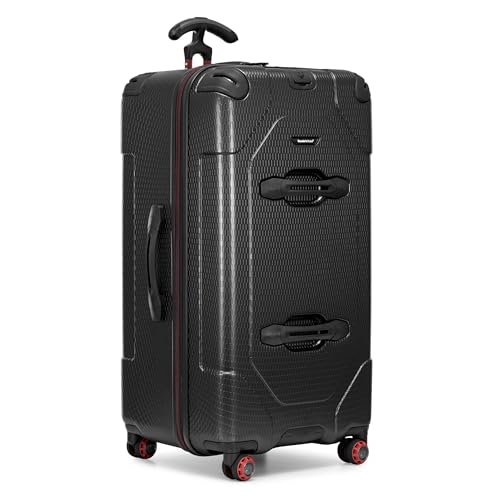
As an Amazon Associate we earn from qualifying purchases at no extra cost to you. Ratings are shown as listed on Amazon.
Quick comparison: leading travel trunk styles
| Trunk or type | Approx. capacity | Shell and construction | Approx. weight | Best for |
|---|---|---|---|---|
| Away The Trunk | 110 L | Polycarbonate hard shell; interior compression and laundry bag | 12.1 lb | Frequent checked-bag travelers who want structured organization |
| Monos Check-In Trunk | About 120 L, depending on version | Polycarbonate shell; compression panels and divided interior | About 12–13 lb | Maximum capacity without moving to an oversized case |
| July Trunk | About 95–100 L | Polycarbonate shell; compression system and 360-degree wheels | About 11–12 lb | Travelers wanting a slightly easier-to-lift trunk |
| Traditional soft-sided rolling trunk | 90–120 L | Ballistic nylon or polyester with a flexible frame | About 8–11 lb | Odd-shaped gear, exterior pockets, and lower empty weight |
Published dimensions and weights can vary by size, production year, and whether expansion is included. Check the current manufacturer specification before buying, especially if you intend to fly internationally.
Best travel trunks by situation
Best for organized family or pet travel: Away The Trunk
A trunk-style case is useful when you need separate zones for clothing, shoes, toiletries, and travel accessories. Away The Trunk uses a clamshell layout, so each half can hold a different category rather than creating one deep pile at the bottom of a conventional suitcase. Its compression system is particularly helpful for bulky clothing, jackets, or a pet-travel kit containing food containers, towels, collapsible bowls, and spare supplies.
The trade-off is weight. At roughly 12 pounds empty, it leaves less of an airline’s checked-baggage allowance for its contents. A 50-pound baggage limit leaves approximately 38 pounds for packing, before accounting for the case’s actual weight on your scale.
Best for maximum capacity: Monos Check-In Trunk
A large Monos trunk is a strong choice when volume matters more than compactness. Its tall, deep format can accommodate winter clothing, formalwear, or equipment that does not pack efficiently in a narrow rectangular suitcase. The divided interior and compression panels help stop contents from shifting when the trunk is opened.
Large trunks can be deceptively easy to overpack. If the case holds 120 liters but your airline allows only 23 kilograms, volume is not the limiting factor—weight is. This type is most practical for travelers who use a luggage scale and pack lightweight clothing cubes rather than dense books, shoes, or heavy gear.
Best for easier lifting: a lighter polycarbonate trunk
A trunk in the 95–100-liter range, such as the July Trunk, can be a better compromise than the largest available model. You lose some capacity, but the case is easier to lift into a car, onto a scale, or over a hotel-room threshold. This matters when you travel alone, use public transport, or have to move several bags at once.
For many trips, a lighter 100-liter case is more useful than a 120-liter case that must be left partially empty to meet the airline weight limit.
Best for flexible packing: a soft-sided rolling trunk
Soft-sided trunks usually have a fabric exterior, a flexible frame, and more external pockets than hard-shell models. They are convenient when you need quick access to documents, chargers, jackets, or snacks without opening the entire case. Their flexible walls can also accommodate irregularly shaped items.
They are less resistant to rain, abrasion, and rough baggage handling than a quality polycarbonate shell. Choose one with reinforced corners, covered zippers, a rigid base, and a water-resistant—not merely decorative—fabric. A soft trunk is also less suitable for fragile items unless you create padding around them.
What to compare before buying
Capacity versus airline practicality
Do not judge a trunk by liters alone. Airlines generally enforce the combined external dimensions of a checked bag, commonly expressed as length plus width plus height. A case measuring 30 × 16 × 12 inches has a combined measurement of 58 inches, which is commonly within a 62-inch checked-bag limit. Wheels, handles, and expansion may be included in the airline’s measurement, so confirm the carrier’s rule before departure.
Expansion is useful for the return journey, but an expanded trunk may cross the size limit or become difficult to maneuver. Pack the case at its normal depth unless you have confirmed that the expanded dimensions are acceptable.
Shell material
- Polycarbonate: A practical balance of impact resistance, moderate weight, and flexibility. It may develop scratches and scuffs without losing its protective function.
- ABS plastic: Usually less expensive and lighter, but generally less resistant to repeated impact and cold-weather brittleness than polycarbonate.
- Aluminum: Rigid and visually distinctive, with replaceable hardware on some premium cases. It is usually heavier, more expensive, and prone to dents.
- Ballistic nylon or polyester: Light and flexible, with useful pockets. Fabric can be more vulnerable to stains, moisture, and punctures.
For a checked trunk, shell thickness alone does not determine durability. Corner protection, the wheel attachment, handle rails, zipper quality, and the availability of replacement parts often matter more.
Wheel quality and maneuverability
Four 360-degree spinner wheels are usually easier in airports than two fixed wheels because you can push the trunk beside you rather than drag it behind. Look for wheels that rotate without grinding, sit partially protected beneath the case, and have enough clearance to roll over door thresholds.
A very deep trunk can feel unstable when fully loaded. Test the handle at its lowest and highest positions if shopping in person. The case should track without veering, and the telescoping handle should not flex excessively under a normal pushing force. Large wheels help on rough pavement, while small exposed wheels are more vulnerable to impacts and baggage conveyors.
Interior organization
Compression panels are more useful than a collection of small pockets because they keep clothing from spilling out when the trunk is opened. A zippered divider is valuable for separating clean clothing from shoes or used laundry. Look for a washable laundry pouch, removable packing panels, and a light-colored lining that makes small items easier to find.
Deep trunks can hide items at the bottom. Packing cubes or transparent pouches solve that problem better than relying on the case’s built-in pockets. Keep liquids in a sealed pouch and place fragile items in the center, surrounded by soft clothing.
Decision matrix
| Your situation | Prioritize | Most suitable choice |
|---|---|---|
| One or two trips per year | Moderate price, repairable wheels, adequate organization | Midrange polycarbonate or soft-sided trunk |
| Monthly or frequent flying | Wheel replacement, strong handle rails, warranty, durable shell | Premium polycarbonate trunk |
| Traveling with winter clothing or equipment | 100–120 L capacity and compression | Large trunk, used with a luggage scale |
| Small car, stairs, or public transportation | Lower empty weight and manageable depth | 95–100 L lighter trunk |
| Irregular gear and frequent quick access | Flexibility and outside pockets | Soft-sided rolling trunk |
Ownership realities: what wears out first
Wheels and telescoping handles usually experience more stress than the shell. Sand, hair, and grit can collect around wheel bearings, while overpacking puts extra force on the handle rails and zipper. After every trip, wipe the wheels and inspect them for thread, pet hair, or stones. A small brush and damp cloth are safer than soaking the wheel assembly.
Clean hard shells with mild soap and water; avoid abrasive cleaners that can cloud the surface. For fabric trunks, spot-test a diluted detergent on an inconspicuous area and let the case dry completely before storage. Store the trunk unexpanded, with zippers closed but not under tension.
Before buying, check whether the brand sells replacement wheels, handles, and zipper pulls. A repairable $300 trunk can cost less over several years than a cheaper case that must be discarded after one broken wheel. Also check the warranty exclusions: cosmetic scuffs, airline damage, and normal wear may not be covered.
Bottom line
Choose a large polycarbonate trunk such as Away The Trunk or the Monos Check-In Trunk when organized capacity is the priority and you can control the packed weight. Choose a lighter, slightly smaller trunk such as the July Trunk when lifting and maneuverability matter more. Select a soft-sided rolling trunk when exterior access and flexible storage outweigh maximum shell protection. Whichever style you choose, measure the packed case, weigh it before leaving home, and treat wheel repairability as an essential feature rather than an afterthought.


Write Your Review
No reviews yet. Be the first to share your experience!