

Key takeaways
- Best for an average living room: A 7.5-foot, 48- to 60-inch-wide warm-white LED tree with 800 to 1,200 lights. It offers a convincing silhouette without overwhelming standard ceilings.
- Best for apartments: A 6.5- to 7.5-foot pencil or slim tree, usually 28 to 40 inches wide. It preserves walking space and is easier to carry through narrow doors.
- Best for beginners: A hinged, three-section tree with color-changing and warm-white settings, numbered branches, and a foot-pedal or remote control.
- Best for a traditional look: A full-profile tree with molded PE branch tips mixed with PVC interior needles. This combination looks more natural than a tree made entirely from flat PVC strips.
- Best for frequent use: A tree with individually replaceable bulbs or separately fused light sections, a sturdy metal stand, and a storage bag sized for the assembled sections.
- Best for homes with pets: A stable, low-tipping base, securely attached branch tips, flame-resistant materials, and lights with protected wiring. Keep cords inaccessible to chewing pets and avoid tinsel or small detachable ornaments.
The best pre lit Christmas trees for most homes are a 7.5-foot LED tree with hinged branches, a medium-full profile, and replaceable light sections; choose a slim 6.5- to 7.5-foot model for a small room, or a 9-foot tree only when you have both ceiling and floor space to spare.
Our top picks


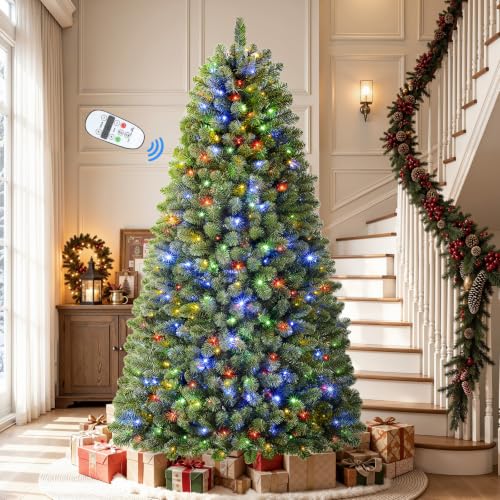

As an Amazon Associate we earn from qualifying purchases at no extra cost to you. Ratings are shown as listed on Amazon.
Quick picks by room and decorating style
- Best for an average living room: A 7.5-foot, 48- to 60-inch-wide warm-white LED tree with 800 to 1,200 lights. It offers a convincing silhouette without overwhelming standard ceilings.
- Best for apartments: A 6.5- to 7.5-foot pencil or slim tree, usually 28 to 40 inches wide. It preserves walking space and is easier to carry through narrow doors.
- Best for beginners: A hinged, three-section tree with color-changing and warm-white settings, numbered branches, and a foot-pedal or remote control.
- Best for a traditional look: A full-profile tree with molded PE branch tips mixed with PVC interior needles. This combination looks more natural than a tree made entirely from flat PVC strips.
- Best for frequent use: A tree with individually replaceable bulbs or separately fused light sections, a sturdy metal stand, and a storage bag sized for the assembled sections.
- Best for homes with pets: A stable, low-tipping base, securely attached branch tips, flame-resistant materials, and lights with protected wiring. Keep cords inaccessible to chewing pets and avoid tinsel or small detachable ornaments.
What separates the best pre lit Christmas trees?
Pre-lit trees save decorating time, but the lighting system and construction determine whether that convenience lasts beyond the first season. Examine these features together rather than choosing by light count alone.
Height and width
Measure both the ceiling and the floor area. A 7.5-foot tree needs more than 7.5 feet of vertical clearance because the stand, top clearance, and topper add height. Leave at least 6 to 12 inches above the highest branch; leave more if you plan to use a star or angel.
Width matters just as much. A full 7.5-foot tree may measure 50 to 60 inches across, while a slim version may measure 30 to 45 inches. Mark the intended diameter on the floor with painter’s tape before ordering. This reveals whether the tree will block a doorway, radiator, window, or pet’s usual path.
LED versus incandescent lights
LED lights are the practical choice for most buyers. They use less electricity, produce less heat, and are usually rated for longer service than traditional incandescent mini lights. Warm-white LEDs give the familiar golden appearance; cool-white LEDs look sharper and more contemporary. Color-changing systems provide flexibility but add controllers and electronic components that can become another failure point.
Incandescent pre-lit trees can have a softer, classic glow, but their bulbs and wires become warmer and generally consume more electricity. They may suit someone who specifically prefers that appearance, but LEDs are easier to recommend for extended daily use and homes with children or animals.
Branch fullness and realism
Tree fullness is not the same as realism. Dense PVC branches can hide the trunk and create a lush outline, but too much flat PVC can look uniformly green and leave little space for ornaments. Molded PE tips add needle shape and color variation, while PVC interior branches fill gaps at lower cost.
For a balanced appearance, look for PE tips on the visible outer branches and a strong inner frame. Hinged branches are faster to open than hook-in branches, but they still need to be shaped. Plan on 20 to 45 minutes of “fluffing” even with a well-designed tree; this is what separates a compressed shipping shape from the finished silhouette.
Head-to-head comparison of common tree formats
| Tree format | Typical sizes | Typical width | Light type and count | Setup time | Best room fit |
|---|---|---|---|---|---|
| Slim or pencil | 6.5–7.5 ft | 28–40 in | LED, 400–900 | 20–35 min | Apartment, hallway, small living room |
| Medium-full | 7–7.5 ft | 42–55 in | LED, 700–1,300 | 30–50 min | Typical living room or family room |
| Full traditional | 7.5–9 ft | 52–72 in | LED or incandescent, 900–2,000 | 40–70 min | Large room with open floor area |
| Tabletop | 2–4 ft | 16–28 in | LED, 30–150 | 5–15 min | Desk, entry table, supervised pet-free surface |
The figures above are useful planning ranges, not specifications for every model. A densely branched tree may need fewer visible bulbs than a sparse tree, while a color-changing tree may have a higher price without having more lights.
Decision matrix: choose according to your situation
| Your priority | Recommended specification | Why it fits | Trade-off |
|---|---|---|---|
| Lowest initial cost | 6.5–7.5 ft, PVC-heavy, warm-white LED | Lightweight and less expensive to manufacture | Less realistic tips and potentially thinner branch structure |
| Limited floor space | Pencil profile, 28–40 in wide | Leaves room for furniture and walking paths | Fewer large ornaments fit on the narrow sides |
| First artificial tree | Three hinged sections, color-coded plugs, remote | Reduces assembly errors and makes lighting simple | More controls and electronics to store safely |
| Annual long-term use | PE/PVC construction, metal stand, replaceable bulbs or sections | Better resistance to repeated assembly and storage | Usually heavier and more expensive |
| Pets in the home | Wide stable base, low-voltage LED, protected cord route | Reduces heat, tipping, and accessible wire risks | Still requires supervision and cord management |
Setup: the fastest way to make a pre-lit tree look full
- Choose the final position first. Assemble the tree close to its destination rather than carrying a fully decorated tree across the room.
- Secure the stand and bottom section. Tighten the base evenly and confirm that the trunk is vertical before adding higher sections.
- Connect and test each light section. Do this before fluffing. If a section is dark, it is easier to correct while the branches are accessible.
- Separate branches from the inside outward. Bend inner branches toward gaps, then spread outer tips in alternating directions. This hides the trunk and creates depth.
- Check from several angles. Walk around the tree and correct flat spots, especially on the side facing the room.
- Add decorations after the lights are working. Place heavier ornaments near the trunk and lower branches, where the branch structure is strongest.
A useful planning calculation is to reserve roughly 30 inches of clear floor diameter around a slim tree and 48 to 60 inches around a full tree. For example, a 7.5-foot tree listed as 52 inches wide needs a circular footprint about 4.3 feet across before adding gift boxes, a tree collar, or clearance from walls. That measurement often matters more than the tree’s height.
Storage and ownership costs that listings often omit
Measure the packed box or storage bag, not just the assembled tree. A 7.5-foot tree commonly separates into three sections, each approximately 24 to 40 inches long, but branch width can make the package bulky. A rigid plastic tote protects branches better than a thin fabric bag, while a fabric bag is lighter and easier to fit in a closet. Never compress damp branches into storage; moisture can encourage odor and corrosion.
The parts most likely to wear first are plugs, foot pedals, fuses, hinges, and individual bulbs. Before buying, check whether the manufacturer provides replacement bulbs, spare fuses, replacement adapters, or a full replacement light section. A tree with sealed light strips may look neat but can be harder to repair when one section fails.
For routine care, unplug the tree before dusting. Use a dry microfiber cloth or a vacuum’s soft brush attachment on low suction. Avoid water, sprays, and aggressive bending of wired branch tips. At the end of the season, remove ornaments, allow the branches to return to a relaxed position, label each section, and wrap the power cord loosely rather than tightly around the trunk.
Safety considerations for homes with pets
Anchor a tall tree to the wall or a heavy furniture point if a cat, dog, or child may bump it. Route the power cord behind furniture or through a protective cord cover, and inspect it each season for chewing, crushed insulation, or loose connections. Keep water bowls away from electrical connections, and avoid edible decorations, tinsel, ribbon, and small ornament hooks where pets can reach them.
Final buying checklist
- Does the assembled height leave at least 6 to 12 inches below the ceiling?
- Is the listed width compatible with the marked floor area?
- Are the lights LED, warm-white, color-changing, or incandescent?
- Are the branches hinged, and can the visible tips be shaped naturally?
- Does the tree use PE tips, PVC branches, or a combination?
- Can you obtain replacement bulbs, fuses, adapters, or light sections?
- Will the stand remain stable around pets and normal household traffic?
- Is there a realistic storage plan for all three sections and the stand?
For most shoppers, the strongest all-round choice is a 7.5-foot medium-full LED tree with PE/PVC branches, hinged sections, a metal stand, and serviceable light components. Choose a slim profile when floor space is the deciding factor, and spend more on construction and repairability when the tree will be assembled and stored every year for many seasons.

Write Your Review
No reviews yet. Be the first to share your experience!