

Key takeaways
- Frequent car trips: Consider a folding or telescoping ramp that fits your trunk and locks securely when opened. A model with side rails or raised edges can help define the walking path, but does not replace careful supervision.
- Bed access: A fixed or folding indoor ramp can be convenient if it stays stable and does not slide on the floor. Measure the bed height and the space available for the ramp’s footprint; a long ramp may reach into a walkway.
- Large or heavy dog: Prioritize a clearly stated weight capacity, a rigid-feeling frame, broad walking surface, and secure contact at both ends. Choose a capacity with room above your dog’s current weight, especially if the dog may step abruptly or shift weight.
- Small, cautious, or inexperienced dog: Favor a wide surface with consistent traction and a low enough grade to allow slow practice. A ramp’s advertised load capacity says little about whether its texture or width will feel reassuring.
- Limited storage: Compare the folded or collapsed dimensions against the actual storage space. Telescoping ramps can pack shorter, while some folding designs may be wider or thicker when stored.
Best Dog Ramps for Cars, Beds, and Senior Dogs
The best dog ramps are long enough to keep the incline manageable, rated comfortably above your dog’s weight, and covered with a surface that stays grippy under paws. For a bed, a compact ramp around 40–60 inches long can suit a modest rise; for an SUV, a ramp roughly 60–72 inches long is often a more practical starting point. Measure your own rise and available storage space before choosing—those measurements matter more than a product’s “for cars” or “for beds” label.
Start with the incline, not the product category
To estimate ramp steepness, divide the vertical rise by the ramp’s usable length, then multiply by 100 for the grade. A 24-inch bed rise and a 48-inch ramp produce a 50% grade. A 30-inch SUV entry and a 60-inch ramp also produce a 50% grade. These are planning calculations, not universal safety thresholds: dogs differ in confidence, mobility, and traction, and a ramp’s usable surface may be shorter than its advertised overall length.
Our top picks


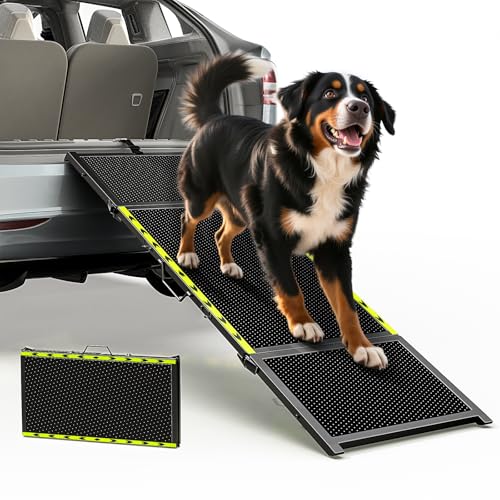

As an Amazon Associate we earn from qualifying purchases at no extra cost to you. Ratings are shown as listed on Amazon.
If you want a gentler approach, increase ramp length. For example, a 30-inch rise over 72 inches is about a 42% grade. Measure the actual height to the point where your dog’s paws will land, and check the ramp maker’s guidance on maximum height and placement. A ramp that is too steep can be difficult to use even when its weight rating is ample.
| Use case | Example rise | Ramp length to compare | Calculated grade | Storage consideration |
|---|---|---|---|---|
| Low bed | 20 in | 40 in | 50% | Measure the space beside the bed and under furniture |
| Taller bed | 26 in | 52 in | 50% | Check whether the ramp can stay in place without blocking a walkway |
| Car or crossover | 24 in | 60 in | 40% | Compare folded length with the trunk’s usable floor length |
| SUV cargo area | 30 in | 72 in | 42% | Check folded dimensions, not just the open length |
These examples show how length changes the grade; they are not guarantees that a particular dog will find a ramp comfortable. If a vehicle’s entry is higher than expected, or the ramp must sit at an angle because of the bumper, redo the calculation with the actual setup.
Which type fits your situation?
- Frequent car trips: Consider a folding or telescoping ramp that fits your trunk and locks securely when opened. A model with side rails or raised edges can help define the walking path, but does not replace careful supervision.
- Bed access: A fixed or folding indoor ramp can be convenient if it stays stable and does not slide on the floor. Measure the bed height and the space available for the ramp’s footprint; a long ramp may reach into a walkway.
- Large or heavy dog: Prioritize a clearly stated weight capacity, a rigid-feeling frame, broad walking surface, and secure contact at both ends. Choose a capacity with room above your dog’s current weight, especially if the dog may step abruptly or shift weight.
- Small, cautious, or inexperienced dog: Favor a wide surface with consistent traction and a low enough grade to allow slow practice. A ramp’s advertised load capacity says little about whether its texture or width will feel reassuring.
- Limited storage: Compare the folded or collapsed dimensions against the actual storage space. Telescoping ramps can pack shorter, while some folding designs may be wider or thicker when stored.
Features worth comparing before you buy
| Feature | What to check | Why it matters |
|---|---|---|
| Weight capacity | Published limit in pounds; compare it with your dog’s weight | A capacity that is too close to the dog’s weight leaves little margin for movement |
| Open length | Usable walking length, plus the height it is intended to reach | Length determines the working incline at a given rise |
| Folded length | Collapsed dimensions and whether the ramp separates into sections | A long ramp that does not fit your trunk may be inconvenient on every trip |
| Walking surface | Textured rubber, carpet-like material, or another traction treatment | Grip can change with dirt, moisture, wear, and paw condition |
| Width and edges | Usable width between side rails, if present | A narrow path may be harder for a large dog or one that turns while walking |
| Contact points | Non-slip feet, vehicle attachment, or a stable top lip | Movement at either end can undermine confidence and safe footing |
Commonly available options to compare
Several established designs illustrate the trade-offs to look for. Dimensions and capacity can vary by model or product revision, so verify the current manufacturer’s specifications before purchase.
- PetSafe Happy Ride Telescoping Dog Ramp: A telescoping style intended for vehicle access. It may suit owners who want adjustable length and a more compact collapsed form; compare the exact model’s extended length, capacity, and stored dimensions with your vehicle.
- PetSafe Happy Ride Folding Dog Ramp: A folding option for car entry that is simpler in concept than a telescoping design. Check its folded footprint and whether that shape fits your cargo area.
- Pet Gear Tri-Fold Pet Ramp: A folding ramp format that stores in sections. Its broad, multi-panel design may take more trunk floor area than a narrow telescoping ramp, so compare the folded measurements rather than assuming “tri-fold” means compact.
- Indoor foam pet stairs or ramps: These can be easier to leave near a bed, but foam models are not interchangeable with rigid vehicle ramps. Check the maker’s intended use, the base footprint, and whether the surface stays in place on your flooring.
These are starting points for comparison, not a ranking. A model with a higher stated capacity is not automatically the better choice if it is too steep, difficult to store, or poorly suited to your dog’s stride.
Check the fit with a worked example
Suppose your SUV cargo floor is 28 inches above the ground, and the ramp you are considering has 60 inches of usable length. The estimated grade is 28 ÷ 60 × 100, or about 47%. If a 72-inch model fits your vehicle and setup, the estimate falls to about 39%. Before deciding, check whether the longer ramp can rest securely on the bumper and ground without rocking, and whether its folded length fits in the trunk.
Now consider storage: if the cargo floor offers 34 inches of clear length and the ramp folds to 36 inches, it may not fit flat without moving other items. A model that is slightly shorter when folded could be more useful even if it is heavier or has a different opening mechanism. Measure around wheel wells, cargo covers, and seats—not just the advertised trunk length.
Set up and maintain the ramp safely
- Use a level, stable landing point. Place the lower end on firm ground and the upper end securely against the vehicle or furniture. Avoid loose gravel, slick flooring, or a ramp that can shift sideways.
- Open and lock every section. Confirm hinges, telescoping locks, or latches are engaged before your dog steps on. Keep hands clear of pinch points while unfolding.
- Introduce it gradually. Start with the ramp nearly flat on the ground. Let your dog approach and cross at its own pace, rewarding calm progress. Raise it in stages rather than pulling or pushing the dog up.
- Inspect traction and joints. Dirt, hair, water, and worn coverings can reduce grip. Clean according to the manufacturer’s instructions, dry the surface fully, and check for loose hinges, cracks, or damaged feet.
- Recheck fit when the setup changes. A different vehicle, parking slope, bed frame, or ground surface can alter the ramp angle and stability.
Traction coverings and moving joints are common wear points. Replace a damaged ramp or worn grip surface rather than relying on a weight rating alone. Do not exceed the stated capacity, and supervise use—especially during training or when the ramp is wet.
When a ramp may not be the right fit
A ramp can reduce the need to jump, but it is not a treatment for pain or a guarantee against injury. If your dog is suddenly reluctant to climb, appears uncomfortable, or has trouble walking, ask a veterinarian whether a ramp, steps, lifting support, or another approach is appropriate. For a dog that cannot use a ramp confidently, a professional can also help you choose a safer access plan.






Write Your Review
No reviews yet. Be the first to share your experience!